Chelsea Green describes how she went from WWE's 'big loser' to stealing hearts and championships
Green has made herself into an attraction on camera thanks to her incredible personality

•
4 min read
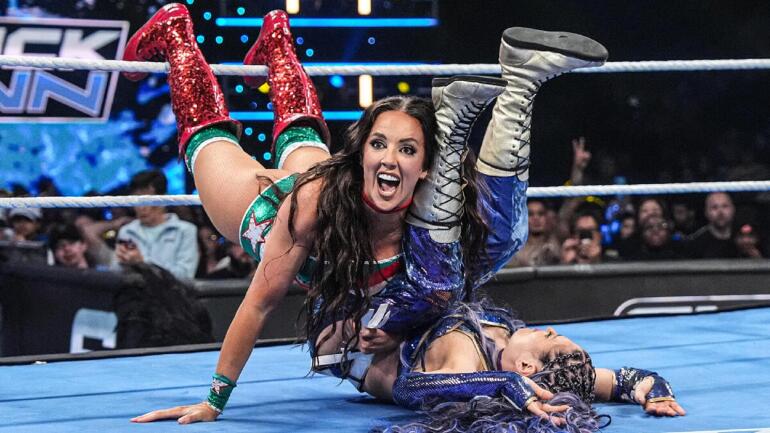
Chelsea Green isn't supposed to be a winner. She flunked out of WWE the first time, and her grand return lasted mere seconds. Yet Green succeeded anyway, becoming a multi-time champion in the promotion. Her secrets? Checking her ego and maximizing minutes.
Green's first WWE stint was a series of blink-and-you'll-miss-it moments: playing Daniel Bryan's physical therapist, finishing fourth on "Tough Enough," and stints on NXT and SmackDown, both of which were interrupted by broken wrists.
Green spent the next two years gaining experience on the independent scene. When WWE eventually came calling again, she was convinced the second go would be different. Instead, Green, who stars on Season 2 of Netflix's "WWE Unreal" reality show, got a harsh reality check.
"When you get released, the No. 1 goal is to get back to WWE..." Green told CBS Sports ahead of the reality show's Jan. 20 premiere. "I think every person would say that they think they'll come in and go straight to the top. They're going to win the Royal Rumble and have a glorious comeback. All the things they didn't have in their first run.
"I quickly realized when I got to the Royal Rumble that I was going to be in and out. Nobody really gave two shits about me. It's not what I dreamt of. It's not what I had envisioned."
Undeterred, Green went to work, finding small windows to make herself seen and making the most of every opportunity.
"I had to pivot my mindset and the direction I was going. 'OK, so I'm not going straight to the top. They don't think I'm up here.' Now we have to work extra hard to show them in double time why I deserve to be up there."
Green made the most of a bad situation. She found a silver lining in being eliminated from her first Royal Rumble in 14 seconds, making sure WWE's social and digital teams were waiting so she could deliver her best on-camera freakout. Within a week, she was collaborating with creative while continuing to film content with the social team, turning herself into an asset in real time.
"I did everything within my power to control my narrative," Green explained. "You really can't in WWE, but I think, for the most part, for the past three years, I've controlled my narrative as much as I could. At the end of the day in wrestling, there will always be forks in the road. There will always be speed bumps. There will be deadends. Once you get to your destination, you realize those twists and turns are what make your story unique."
Green is a throwback superstar, a nod to the trashy Attitude Era and dolled-up WWE Divas that followed. There's a magnetism to her over-the-top performances. She isn't afraid to make a fool of herself or end up headfirst in a dumpster if it leaves an impression.
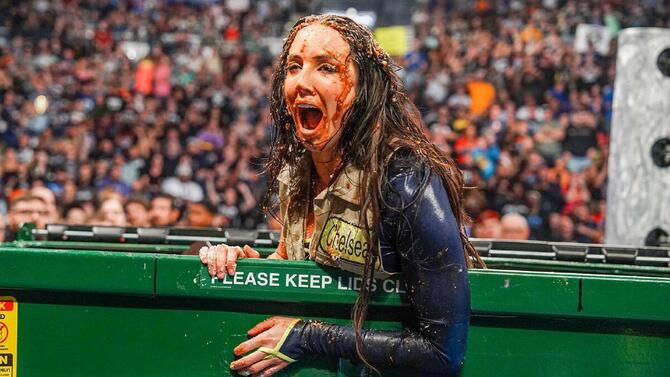
"That's what I knew coming back. I wanted to make sure I was undeniable," Green said. "I'm not saying I'm the best wrestler, but I'm saying I'll make sure when you give me something, I'll always do my best to make people talk about it. That's the point. If you can't do that, there won't be a spot for you."
In a few years, Green went from a 14-second Rumble elimination to becoming a multi-time champion. She's the inaugural women's United States champion and the first two-time champion, feats she accomplished while maintaining her goofy persona. It's an underdog story told through a character who regularly cheats.
"For me, it's what makes me relatable. It's what people talk to me about," Green said. "I wasn't a chosen one. I haven't gone straight to the top. You've seen me struggle over and over again. You've seen other people get things that I thought I deserved.
"That's special now that I'm here. I'm a former tag team champion, a former two-time United States champion, and a mixed tag team champion. I've won four to five titles in three years. That's pretty amazing, all things considered, for a big loser like myself."
Green stole hearts with her bubbly nature and vulnerability during the first season of "WWE Unreal." Her joy after winning the women's United States title and heartbreak over not being booked in front of her family at "Survivor Series: WarGames" exposed the relatable performer behind the vile, tacky character.
"My willingness to share and be open is something that a lot of my co-workers love to speak about," Green said. "I assume that's also what the fans think. At the end of the day, it's just a camera following me. I try not to think too much about it because I never want to self-produce.
"I don't want to watch myself in season one or two, or listen to what people are saying, and change how I am. I don't even want to pander. All that stuff matters in unscripted television. You need to be so authentic, or else it shows. It really shows."
Check out the full interview with Chelsea Green below.
Some superstars guard their on-camera personas fiercely, protecting them from outside input. That's a personal preference. Far worse are those who sabotage others for their own success. Green is the antithesis of both.
"Some people can't do that. Some people think that to get to the top, you have to step on people," Green said. "I was having a conversation with Bianca Belair yesterday. We were talking about how you don't need to step on people to get to the top. In fact, the people at the top should be reaching down, holding your hand, pulling you up, and elevating you.
"That's the whole point of being a top girl. You didn't get there because you stepped on all of the little people. We got you to the top. We were all pulling you up one by one and elevating you."