Why the 2026 MAC Tournament has intrigue beyond Miami (Ohio) — and serious bid thief potential
Miami (Ohio) is the MAC Tournament's best story, but are the RedHawks the conference's best team? The 26-5 Akron Zips will have a say

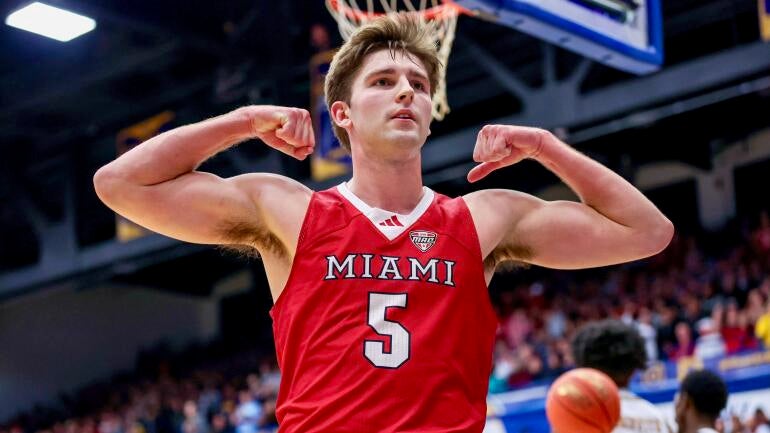
The 2026 MAC Tournament is shaping up to be one of the most impactful of college basketball's conference tournament week, and not just because it involves the sport's only undefeated team.
At 31-0 entering the postseason, No. 19 Miami (Ohio) is enjoying a rare moment in the national spotlight. But the RedHawks are just one piece of a MAC puzzle that could have ramifications on the rest of the 2026 NCAA Tournament bracket.
Despite its gaudy record and historic season, Miami isn't the favorite to cut down the nets on Saturday inside Cleveland's Rocket Arena after the MAC Tournament title game. That distinction belongs to Akron, which has won 16 straight league contests since falling 76-73 at Miami on Jan. 3.
If an Akron title comes to fruition — or if anyone other than Miami wins the crown — the MAC will be a two-bid league for the first time since 1999, which would put the squeeze on at-large hopefuls.
The No. 2 seed Zips (26-5, 17-1 MAC) have a 58.6% chance to win the league tournament, according to the CBS Sports Bracketology model. Top-seeded Miami is second at 26.6%. Then comes a large gap before No. 4 seed Toledo (4.5%) and No. 3 seed Kent State (3.4%) show up as down-ballot candidates.
Stage: SET 🤩
— MACtion (@MACSports) March 7, 2026
Unveiling the official bracket for the 2026 MAC Men's Basketball Tournament at @RocketArena!
🎟️: https://t.co/Z9Wis719ZG | #MACtion pic.twitter.com/XauFsygXg0
Akron has won the past two MAC Tournaments and three of the past four under ninth-year coach John Groce. This profiles as his beat team yet, which sets the stage for a potential must-see conference tournament showdown between the Zips and the RedHawks.
Want more intrigue for a mid-major tournament with NCAA Tournament ramifications and high-dollar intrigue? Groce and Miami coach Travis Steele are half-brothers, and Akron edged Miami in a title game thriller just last season. Here are the storylines to watch in the 2026 version of the MAC Tournament.
Miami seeding debate
Miami's NCAA Tournament seeding is up for interpretation and will almost assuredly be a topic of debate leading up to Selection Sunday and afterward.
Could a MAC Tournament title and 34-0 record send the RedHawks soaring up the No. 6 or No. 7 seed range? Would an early exit relegate Miami to a No. 11 seed? Entering the MAC Tournament, the RedHawks are a No. 10 seed in CBS Sports Bracketology.
For those uninitiated on the nuances of the NCAA Tournament selection process, that may seem like a slap in the face for a 31-0 team. That's where it's important to remember the RedHawks own a NET strength of schedule ranked No. 339 nationally.
There are two sets of metrics the selection committee consults during the selection, seeding and bracketing process that serve as guideposts. Which set the committee relies upon more heavily will dictate where Miami lands on Selection Sunday.

Results-based metrics that appear on official team sheets are the Kevin Pauga Index (KPI), Strength of Record (SOR) and Wins Above Bubble (WAB). Miami's average standing in those metrics is in the low 30s entering the MAC Tournament, which is in line with a No. 9 seed.
Then, there are three "predictive" metrics that measure on-court efficiency adjusted for opponent. In those metrics, Miami averages out around 90th, which would typically be well outside the realm of at-large consideration.
For comparison, the 2013-14 Wichita State team, which entered the NCAA Tournament at 34-0 was ranked No. 5 at KenPom on Selection Sunday after beating teams such as BYU, Saint Louis, Tennessee and Alabama in nonconference play. Miami, by contrast, has not played a single Quad 1 game and has just two Quad 2 wins.
Thankfully for Miami, selection to the field is more closely tied to results-based metrics than predictive metrics. But when it comes to seeding, the committee often factors in both, which is why a double-digit seed is firmly within the realm of possibility for Miami.
The committee historically gives deference or a "boost" of some variety to schools that win both their regular season and conference tournament titles. If Miami checks that box, a more favorable seeding could be in store than the metrics might suggest.
Akron's ascendance
Akron won the outright regular season title and MAC Tournament title last season, becoming the first program to win both in the same year since the MAC did away with divisions for the 2020-21 season.
The Zips have only elevated their play in 2025-26, but have been overshadowed by Miami while doing it. Akron ranks No. 62 at KenPom entering the MAC Tournament, which makes it the league's highest-rated team by a wide margin (Miami is second at No. 91).
A year ago, Akron finished at 100th in KenPom and lost 93-65 to No. 4 seed Arizona in the first round of the NCAA Tournament. The year before, the Zips finished 122nd at KenPom and lost to No. 3 seed Creighton 77-60 in the first round of the Big Dance.
But Groce returned a significant chunk of the nucleus from last year's 28-win team and has only built upon it with fourth-year guard Tavari Johnson leading the way. The senior leads the league in scoring at 20.2 points per game on impressive shooting splits.
Johnson makes 61.9% of his 2-pointers, 37.6% of his 3s and 89.9% of his free throws. As the nation's No. 13 3-point shooting team (38.5%) on 11.1 makes per game, Akron profiles like a potential March menace. But it will need to win the MAC Tournament in order to get a crack at the Big Dance.
Though Akron's "predictive" metrics are better than Miami's, its results-based metrics average out in the mid 60s entering the MAC Tournament. That's typically outside the at-large consideration zone.
MAC is primed for a bid thief
The MAC is not among the contingent of mid-major leagues that have gone to a "stepladder" bracket format that grants automatic byes to the semifinals for its top two seeds. Instead, the top eight teams from the regular season make the MAC bracket, and they all start in the same place: the quarterfinals.
That means Miami's path to the title is the same path as No. 8 seed UMass, despite the fact that UMass finished 7-11 in the league standings and went 0-2 against the Redhawks during the regular season.

If Miami were in dire need of a MAC Tournament title in order to secure its spot in the field, this bracket setup would be detrimental to the conference's aspirations of placing the RedHawks in the NCAA Tournament
But since Miami is almost certainly going to make the NCAA Tournament regardless, this 8-team format actually sets up well for the MAC to optimize its number of bids in 2026. The RedHawks face a tough road to winning the conference tournament, which means the MAC is more likely than any league to produce a bid thief this week.
Bubble teams around the country will be rooting for Miami, because if the RedHawks win the MAC Tournament, the league will be a one-bid league just as it has been during every season so far in the 21st century.