

FRISCO, Texas -- Right in the middle of a press conference, just after basketball coaches had met for a final time at the Big 12 Spring Meetings on Wednesday, Tommy Lloyd flipped his phone over to take a peak.
He said in advance he probably would.
It was totally understandable.
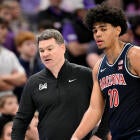
Because there he was, the sixth-year Arizona coach, sitting beside West Virginia's Ross Hodge and Big 12 chief basketball officer Brian Thornton, juggling multiple things. On one hand, Lloyd was here at the Omni PGA Frisco Resort, along with the rest of his conference's coaches, discussing potential new rules, whether to play 18 or 20 league games, NIL and all of the other things that are big-topic issues these days. On the other, he was monitoring the stay-or-go decision from Koa Peat, his second-leading scorer from last season who just helped the Wildcats make the Final Four for the first time since 2001.
Busy day.
So, at one point, I asked Lloyd, out of genuine curiosity, how he's handled Peat's situation given that it's a relatively new set of circumstances for college coaches and players to navigate. Let me explain. For most of the history of the NCAA, when offering anything more than a scholarship wasn't allowed, if you were coaching a likely first-round pick in the NBA Draft with a guaranteed contract waiting for him at the next level, it was mostly seen as ridiculous to even try to talk him into passing on that to return to school. But, you might've heard, colleges are now in a position, in many cases, to outbid what's available as a slotted salary for drafted players and offer millions of dollars to get legitimate prospects to return to school.
And so they do!
And, all over the country, it's been effective.
Florida kept definite-first-round-pick Thomas Haugh out of the draft by helping create a package that's reportedly close to $10 million. That's more than he would've likely made in the NBA next season -- so he'll be back in a Gators' uniform. UConn kept definite-first-round pick Braylon Mullins out of the draft by helping create a package that's reportedly worth around $4 to $5 million. That's more than he would've likely made in the NBA next season -- so he'll be back in a Huskies' uniform.
What those developments show is that it's no longer ridiculous to recruit possible first-round picks back to the school. In fact, it's very normal. So, circling back, I asked Lloyd how he's handled the situation.


In part, here's what he said: "It's the player's race to run -- and you have to respect that. But you set a criteria of what's gonna help them make their decision, and then, ultimately, you have to support them. These aren't easy decisions. I mean, in my mind, I think a lot of things in life you get a second chance to do. You pick a school and you can transfer. You can get married, get divorced and get married again."
Lloyd's point?
The decision Peat had to make wasn't one of those but instead an irreversible one. If he decided to leave college basketball and sign an NBA contract, there's no going back. So, Lloyd acknowledged, he's spent real time in recent weeks trying to straddle that line with Peat, supporting him in his dream to get to the NBA (presumably as soon as possible in an attempt to reach his second contract as early as possible) while also making him aware that a better and more-lucrative deal might actually be available at Arizona.
"It's a fine line," Lloyd said. "College coaches ... I think we always get looked at as selfish, you know, if you're trying to keep the players in the program. And obviously you want good players and good kids in your program. So, yeah, it can make it a delicate situation. There's no doubt about that."
As you probably know by now, about eight hours after Lloyd shared those thoughts, it was reported that Peat will forgo his college eligibility and remain in the 2026 NBA Draft despite the fact that millions of dollars were available to him at Arizona and despite the likelihood that he'll be picked lower than Haugh or Mullins would've been selected had they opted to enter and stay in the draft.
Is it the dumbest draft-decision I've ever seen?
Not even close.
But it's undeniably a questionable one given how the predraft process has gone for Peat. Simply put, whatever reputation he created as a prospect while being named USA Basketball's Male Athlete of the Year in 2023 and a McDonald's All-American in 2025 has been diminished. The on-the-court evaluation is now this: Peat is a 6-foot-7 forward who can't reliably shoot from the perimeter. That can work in college but is not a great combination for the NBA. And it would've been one thing if Peat had done anything at the combine to alleviate concerns -- but he didn't. He shot it poorly. It looked awkward. The feedback wasn't great. All of which caused many to suggest the smartest/best move Peat could make would be to return to Arizona and be the best player on a preseason top-10 team while improving his game in advance of entering what will next year be a much-weaker draft.
Instead, Peat chose the alternative.
And, honestly, I'm sure he'll be fine. Peat is represented by Klutch Sports Group, which got Bronny James selected 55th in the 2024 NBA Draft. Finding Peat a nice landing spot should be simpler by comparison. But, all of that said, I do wonder whether Peat will someday look back with regret at his decision because, like Lloyd noted, once Peat signs a real NBA contract, which he will, there's no going back.
Obviously, anybody trying to tell you they know exactly how Peat's career will unfold from here is playing a guessing game. But I do think it's reasonable to assume -- given his age, his current skillset and where he'll likely be picked -- that Peat will probably spend next season either mostly sitting on an NBA bench or developing in the G League. To each his own. But when the alternative to that was being the best player in one of college basketball's top programs at the rate of millions of dollars, playing high-stakes games in front of sold-out crowds and starting every one of them on the way to a possible second trip to the Final Four, well, it's easy to see why Haugh and Mullins decided to run a different race in this moment, and a little harder to get why Peat opted to sprint to a place that more or less told him he'd probably be better off slowing down.