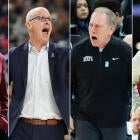


Even as NCAA power brokers are ready to expand March Madness for the men's and women's tournaments to 76 teams, the idea remains controversial among some of the most prominent people in college athletics: the basketball coaches.
While some certainly endorse the idea of expansion, the premise has long had detractors amongst its most recognizable ranks.
"I am adamantly opposed. It's totally unnecessary," Gonzaga coach Mark Few told CBS Sports. Few, who has never missed an NCAA Tournament in more than a quarter of a century running the Bulldogs, was just named to the Naismith Memorial Hall of Fame last month.
"It's the dumbing down of the regular season, which is sad," Few said. "We're out here trying to generate more interest in the regular season and expansion doesn't help. That's where we've been struggling. Plus, the [NCAA Tournament] unit shares, what's happening there? Don't screw with something when you already know it's great. The tournament is great as is."
The NCAA is poised to soon adopt a new model that will increase the field of March Madness for the first time since 2011, when it went from 65 to 68 teams. The new format will inevitably lead to teams with weaker résumés being invited, watering down the competitiveness of getting into the bracket.

Connecticut's Dan Hurley -- arguably the best coach in college basketball thanks to back-to-back national championships in 2023 and 2024, then another title-game run just last month -- has been publicly opposed to NCAA Tournament expansion in the past. With an official vote quickly approaching, he shares a lot of Few's concerns.
"What I think makes the tournament special is the qualification for it," Hurley told CBS Sports. "You don't want the regular season to be rendered meaningless and to take away from November, December, January, February. The qualification process makes the regular season intense and pressure-packed. It should be a privilege to play in the tournament, not a right, and obviously if it expands too much and you don't have to have a real good season to make it, that would take away from the tournament. Does it get too big?"
Hurley acknowledged he was "torn" due to the overwhelming popularity of March Madness as a three-week-long national event. Viewership is unlikely to sag with more teams. There could be more mid-majors that get in as a result, though skepticism runs wide even in coaching circles over how much more of an opportunity teams from outside the power-conference hierarchy will have.
"I love watching 1/16 games, 8/9 games, Dayton games. But I also love the fact that when it was 64, it was really hard to get in," Hurley said. "You want it to be hard to get in. My biggest thing, too, is, you still have to win six games, right?"
In the proposed and circulated template, six games will still be the number for 52 teams selected. But for the 24 sent to Tuesday and Wednesday's opening round, those schools would have to win seven instead of six to become the national champion.
Few coaches have the national profile of Hurley, but Arkansas' John Calipari is surely one of them. He's consistently been anti-expansion as well. The precipice of seemingly inevitable change hasn't swayed him.
"I am a big believer in the idea that if it's not broke, don't fix it, and I think that applies to the NCAA Tournament," Calipari told CBS Sports. "Having said that, if we are to expand, my hope is that at least half the spots are held for non-Power Four teams. If they do that, we are making the decision for the right reasons. As someone who has been both David, and won some, and Goliath, and lost some, that's what makes this tournament special. We can't afford to lose that special piece of our sport."
Calipari told CBS Sports his biggest frustration remains that so much time, effort and attention has gone to increasing the NCAA Tournament when, in his view, that's not nearly the issue that transferring has become in the past half-decade.
"Our main focus should be on fixing the transfer rules, which would help not only all the teams and athletes in our sport but teams in every sport," he said. "And I'll say it again: That's where our energy should be focused."
Brad Underwood toiled in the lower levels before hitting it big at Illinois. He's coming off his First Final Four as a coach and should have one of the five best teams in the country this season. He told CBS Sports he's vexed over why expansion is even an action in 2026.
"Indifference. Don't understand. Why? Who is pushing this? If we want change, let's do it to blow the doors off financially," Underwood said. "This doesn't move the needle at all. Not good for mid-majors, low-majors at all."
Similar to Calipari, Underwood is way more focused on larger issues that, in his view, have a much more profound impact on the health of the sport.
"This makes as much sense as the fifth year [eligibility]. None. Doesn't solve any of our issues," Underwood said.
Calipari has a comrade-in-arms in fellow Hall of Fame coach Tom Izzo. The Michigan State lifer isn't as unwavering as some coaches, but he still would prefer the tournament not be touched.
"I understand it from both sides," Izzo told CBS Sports. "I would rather it stay the same, but as you know, coaches weren't asked at all. I like the excitement of where it is. Could it get better? I don't know. ... If I was leaning to why it would be good it's because of what's happened with these conferences. We have 18 in our conference (the Big Ten) and there's so many more teams. It's hard for everybody. It's hard to please everybody. I was a Division II guy. I feel for the lower, smaller programs. I hate to break something that isn't broken. And I know we went from 64 to 68. It's like NIL. You can get to $10 million, you still won't have enough. You can have $20 million and it's not enough. If we go to 76, 96, it's never going to be enough."
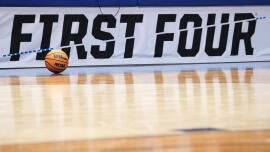
Few, Izzo, Hurley, Calipari and Underwood join the ranks of high-major coaches -- Duke's Jon Scheyer, Nebraska's Fred Hoiberg, Alabama's Nate Oats, Virginia Tech's Mike Young and Wake Forest's Steve Forbes -- who have all previously spoken publicly about keeping the NCAA Tournament at 68. But there are, of course, prominent coaches in favor of it. St. John's R Rick Pitino told CBS Sports last fall he endorsed expansion. Among the more accomplished coaches in the game, Houston's Kelvin Sampson and Michigan's Dusty May have spoken of being on board with adding more teams.
Virginia's Ryan Odom is in that group as well. He favors expansion, but would still make some tweaks. The man responsible for coaching the first No. 16 seed to upset a No. 1 seed (UMBC's epic over Virginia in 2018) doesn't like the proposed format for mid- and low-majors. The new design for the opening round will feature every No. 16 seed and four No. 15 seeds advancing to play-in games. That will manufacture half of the opening round, with the other half constituting at-large teams dropping into the range of No. 11, No. 12 and No. 13 seeds.
"I don't think those teams should have to play into the bracket," Odom told CBS Sports. "I don't like the 16s playing one another to then go play the No. 1 seed. I never have liked that. I think they should be able to go right directly to playing the No. 1 seed, whoever that is. I think we should make the bubble teams play those [play-in] games."
While many share Odom's opinion on forcing automatic qualifiers from small leagues to play in the opening round, winning those games results in millions of dollars in NCAA payouts to the conferences those schools represent. That's why half the opening round will be populated by one-bid conferences. Alternatively, by forcing 12 mid-major schools into the opening round, it also guarantees that six leagues will not have representation in the first round, marking the first time that's happened in the 64-team-plus era (since 1985).
It all but ensures less mid-major representation in the NCAA Tournament field once March Madness begins in earnest with the Round of 64.
"I was hoping we were not going to be in the play-in game," Odom said of his UMBC team. They avoided that and were gifted a five-day lead-up to their Friday night first-round tilt against Virginia.
"There was celebrations and we had practices leading up and obviously the travel down to Charlotte was cool for the guys," Odom said. "You want them to experience all the NCAA Tournament has to offer. We took them to Del Frisco's two nights before the game. These kids were used to eating at a Cracker Barrel."
A new tournament shape will take some getting used to, not just for millions of sports fans but also for the coaches. By lowering the standard to get in, and when accounting for the mountains of money now being a mandatory function of roster building, it puts even more pressure on the coaches not only to qualify for the Big Dance, but to not immediately lose once they get there.
As a result, Izzo said he expects the average timeline of a college coach's tenure to move closer to the high volatility environment of NBA turnover, with some coaches not reaching a third, fourth or fifth season.
With every tweak that comes to college basketball, the sport takes on more of the pressures of the pros. That comes with some upside, but the drawbacks and consequences can be felt just as much -- if not more.