

The Big East was on the brink of power-conference dissolution. If one person was going to save it, Val Ackerman would be that protagonist.
The year was 2013. Conference realignment had again redrawn the map of college sports in the previous 18 months, all of it driven by the greed of football. The Big East was lacerated as a result and forced to hemorrhage many storied programs (Cincinnati, Connecticut, Louisville, Notre Dame, Pittsburgh, Syracuse, West Virginia), every one of them moving to a different league, falsely carried by hopes that chasing football money wouldn't come at the expense of their basketball reputations.
All except one (UConn) would take huge hits on the hardwood in the years that followed, just as Boston College and Miami miscalculated almost a decade prior.
Thirteen years ago, the presidents and athletic directors of the remaining "Catholic 7" (DePaul, Georgetown, Marquette, Providence, St. John's, Seton Hall and Villanova) were determined not to let one of college athletics' most storied and tightly knit institutions dither or wither. In a football-dominated world, the Catholic 7 leaned all the way into basketball — and crucially kept the "BIG EAST" name and branding. To start, they added Butler, Creighton and Xavier. A lot of people were skeptical that the league, even with its incredible heritage, could thrive as a power conference in the decade ahead, as football's financial takeover had reached inevitable mass appeal across the NCAA.
New Big East vs. Old Big East
The presidents and chancellors of the Big East voted in Ackerman as the fifth commissioner of the conference in June 2013. Ackerman, too, was taking a huge professional risk by saying yes to a makeover project unlike any other in college athletics.
The decision not only saved the Big East, but emboldened the league to a better era than most could have envisioned.
"When we re-founded the Big East in 2013 as a basketball-centric conference, our first task was to find a commissioner who could provide the strategic vision needed to position us as a basketball peer with the power football conferences and compete with the country's best," St. John's President Rev. Brian J. Shanley said Monday. "We found that visionary leader in Val Ackerman."
On Monday, the 66-year-old announced her impending retirement for later this year, ending a 13-year run that is as impressive as anything she's ever done as a basketball executive. That's saying a lot for someone who spent almost four decades working in some of the most reputable leagues in sports and whose legacy is already forever enshrined in a little house up in Springfield, Massachusetts, called the Naismith Memorial Hall of Fame.
Ackerman not only saw the vision, she made it tangible. She developed expert negotiating skills that paired with an easy-to-talk-to demeanor. Ackerman was kind but tough. She was inquisitive but savvy. She worked with Big East presidents and athletic directors to make a better future possible. The Big East could still ascend to the top of college basketball if it leaned all the way into the thing that made it great, but proof of concept had to play out, and in 2016 it did when Villanova won a national title in men's basketball.
Then Jay Wright's Wildcats did it again in 2018 with an even better team. Those were a pivotal pair of results to enrich the Big East in that decade of mass change and paved way for the big coup a little more than a year later: A rekindling with Connecticut that brought the Huskies back to where they belonged. In 2019, Ackerman eagerly brokered a deal to get UConn out of the American and into the Big East.
The league was steady in the years since the Huskies severed from the Big East, but a reunion would undeniably keep the conference at the high-major level while reigniting Connecticut's potential under Dan Hurley, who at that point was only one season into what would turn into a Hall-of-Fame tenure in Storrs.
For all of Hurley's basketball brilliance and force of personality, UConn almost definitely does not win back-to-back titles in 2023 and 2024, nor make three title games in a four-year span, if not for its second marriage with the Big East. UConn coming back made the Big East more relevant, the Huskies even more appealing in the 2020s. The same can be said for St. John's revival under Rick Pitino; the Red Storm are coming off their best two-year run in a quarter-century, if not longer.
Val Ackerman made this reality possible.
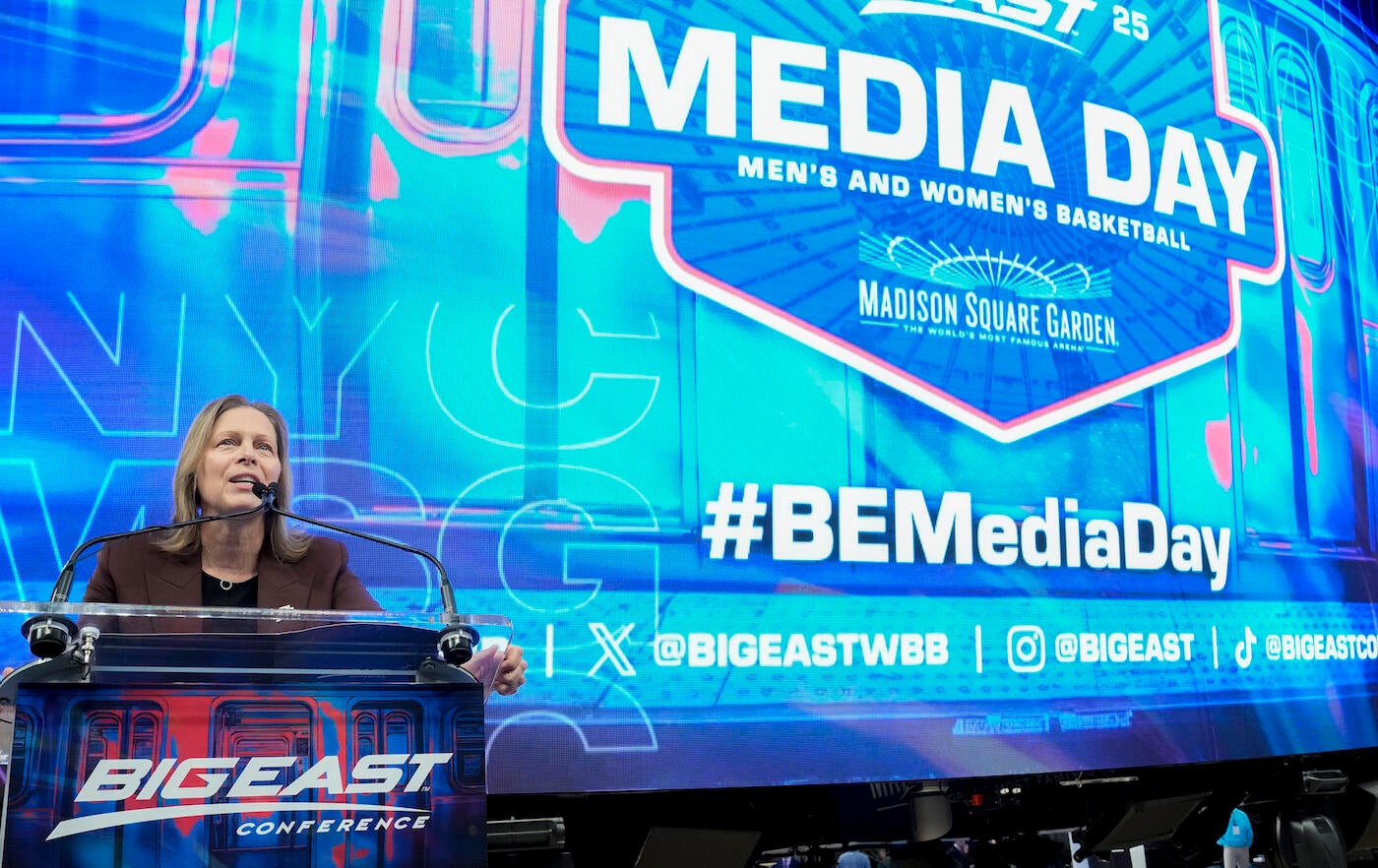
Few people have ever held top-boss designations in both women's and men's sports like Ackerman, doing so at the professional and NCAA levels.
Ackerman was the first president of the WNBA in 1997, a role she won after working hand in hand with former NBA commissioner David Stern. Ackerman did the grunt work to solidify the WNBA for eight years, and in reality, that league sagged in the seasons after she left. In 2005, she trail-blazed again by becoming the first female president of USA Basketball. She's a current member of the NCAA Women's Basketball Oversight Committee, the Women's Basketball Hall of Fame Board of Directors and is a Life Trustee of the Naismith Memorial Hall of Fame.
In addition to being a Naismith HOF inductee, Ackerman's also been honored by the Women's Basketball Hall of Fame, the Sports Broadcasting Hall of Fame and the New Jersey Hall of Fame (yes! A thing!). Her name frequently appeared on lists of the most important and/or influential people in sports. When it came time for the NCAA to face its fate and allow for name, image and likeness to become allowable for college athletes, Ackerman was one of the few at the commissioner level who was not only on the first committee responsible for the change in 2019, but worked with players to better understand and deliver messaging on why such legislation was embarrassingly long overdue.
Her tenure overseeing the Big East is a fitting final major act of service for the American sports landscape. The Big East Tournament — perhaps the most beloved college basketball bracket other than You Know What — has been staged at Madison Square Garden every year since 1983, and despite facing some competition from other leagues to get into that venue, Ackerman made sure that the World's Most Famous Arena would continue to host Big East ball in the days leading up to Selection Sunday. The current agreement runs through 2032, when the conference will stage its 50th tournament in that hallowed building.
Leading a storied league
Successfully leading a conference takes a lot of acumen and ... so many meetings. Thousands of meetings. Former Big East comms chief John Paquette, a legend in his own right, can attest to that. Ackerman was able to keep the Big East viable with multimedia rights deals with every major broadcast network across her 13 seasons. That was made possible because the Big East never lost its stature in college hoops. It remained a power conference even as football decisions were driving so much of how college sports were operating. In fact, the bloats on the Big Ten and ACC (which went to 18 schools) and Big 12 and SEC (each expanding to 16) came in the year after the Big East and UConn reconnected.
There's a lot to be said for knowing your identity and leaning into what makes a team, a school, a conference precious. The Big East has not performed to maximal output in the past 13 years (and coincidentally enough, would be come off its worse year ever if not for UConn saving some hide by making yet another title game in '26), but it's done a lot better than plenty predicted circa 2012.
Since Ackerman took over, the Big East's average finish among all conferences at KenPom was 3.7. Better than fourth, fifth or sixth overall. It finished second or third in KenPom's league power rankings in seven of those 13 seasons — more than half the time. The Big East won five national titles in basketball (men's side: two apiece for Villanova and UConn; one for UConn women) in the past 13 years, which is tied with the SEC for the most combined national championships in that span in hoops by any conference.
She spearheaded a move from the longstanding headquarters in Rhode Island to the media capital of the world, New York City. After more than a decade on Third Avenue, the conference now pays out a lease at the Empire State Building. She's also long been associated with Vatican's Sport at the Service of Humanity group. That partnership will lead to a college sports first in November, when Villanova and Notre Dame's men's and women's basketball teams meet the Pope in Italy before tipping off the 2026-27 season in Rome.
Not bad for someone whose career in basketball came as a four-year starter and the first 1,000-point scorer in Virginia women's basketball history.
Ackerman's legacy extends to so many places. She's one of the most influential people in the history of basketball, across all levels, and among the most important female executives in American sports history. It's a proud era for the Big East — perhaps its proudest of all — that it could have someone as accomplished and revered as Ackerman to take on the task, to walk its hallways and lead its calls.
It's easy to look around now and see how well things turned out.
This was not at all the narrative 13, 14 years ago.
Ackerman, as was so often the case, was the right person for the right job at the right time. The Big East still means something because of it, and because of that, college basketball still has a big piece of its soul alive and well in college athletics.