

College football's rulebook received several notable updates ahead of the 2026 season, and a few could have a major impact on gamedays this fall.
Targeting punishment has been adjusted to better separate dangerous hits from less egregious violations, while changes to pass interference enforcement could create meaningful swings in field position. Officials will also operate under expanded guidance concerning unsportsmanlike conduct, particularly when it comes to taunting, celebrations and actions directed toward opponents.
The goal is greater consistency, though that is always easier promised than delivered when judgment calls enter the conversation. Coaches, players and fans should expect an early adjustment period as crews establish new standards in real time.
Here's a closer look at the biggest changes and how each could influence games during the 2026 college football season.
Targeting punishment changes
The threat of targeting penalties has significantly decreased the number of whistles in recent years, an effort to improve player safety and trying to keep serious head and neck injuries to a minimum.
This season's major change is aimed to lessen disqualifications, including no carryover on a player's first targeting foul. So, if you're flagged for targeting in the third quarter, the suspension for the first half of the following game has been eliminated.
If the same player gets a second targeting foul this season, he'll miss the first half of the next game. A third targeting foul means disqualification from that game and the next game entirely. Only six players in FBS last season had two or more targeting penalties.
Steve Shaw, the NCAA secretary-rules editor for football and national coordinator of officials, said in a recent interview with 365 Sports his rules committee wants to — above all — not punish players for simply making a tackle or a football play.
This is a one-year trial of sorts, according to Shaw..
"Our officials are human," Shaw said. "One of the biggest changes we've made for the good, once it goes to replay, you must confirm all aspects of targeting. We made the change to say if you can't absolutely confirm all aspects, we're going to overturn it because we don't want to disqualify a player on a marginal, not really sure but (call). So that has really helped."
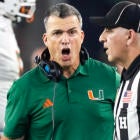
Part of what sparked this punishment alteration, according to Shaw, was Miami defensive back Xavier Lucas' targeting penalty in the fourth quarter of the Hurricanes' win over Ole Miss in the semifinals of the College Football Playoff. By rule, Lucas was forced to miss the first half of the national championship game against Indiana — the biggest game of his career.
Shaw, who's retiring on Sept. 1, will work for various TV networks this season as a rules analyst and says targeting vernacular has changed a bit over the years. Targeting is classified as a hit to a defenseless player that includes an "indicator" of malice — a launch, lead with your head, lowered head — with forceable contact to the head or neck area.
"This is an experimental rule this year and the commissioners were content (on that)," Shaw said. "They wanted to make sure this doesn't change behavior back and start a new trend of targeting."
If a second or additional targeting penalty is committed by a player, individual conferences can initiate the appeals process. Video review will then be completed by the NCAA national coordinator of football officials. If the appeal is successful, the player will be able to play the full game and not be suspended.
Offensive pass interference penalties
In an effort to drive competitive balance throughout the season, offensive pass interference whistles now result in a 10-yard penalty — previously the penalty was 15 yards.
Shaw said coaches called offensive pass interference penalties "drive-killers" to the officiating group and stressed that punishment for such flags should more closely resemble what the defense is assessed for the same mistake.
A defensive pass interference flag is a spot foul with a maximum penalty of 15 yards.
"We really want to reserve 15-yard penalties for unsportsmanlike conduct and personal fouls," Shaw said. "Illegally batting the ball or illegally kicking the ball used to be a 15-yard penalty, those are 10 now. This is part of that. It gives the offense a chance to keep the drive going, but it doesn't change how we call pass interference."
Five automatic unsportsmanlike cases
The rules committee has modernized the interpretation of this rule and how it's presented a bit. Taunting is always flagged — anything directed at an opponent that seemingly disrupts or delays the game. However, players are allowed to celebrate together and not cross the line after a big play, according to Shaw.
There's only five "automatic" unsportsmanlike designations:
- Gun violence including "brandishing" a weapon,
- throat slash or nose wipe gesture,
- players removing their helmet,
- dead-ball contact fouls such as pushing, shoving or striking,
- pushing or pulling an opposing player off the pile after the ball is dead.
Two unsportsmanlike penalties on the same player will result in an automatic ejection.
Fair-catch kick
College football is bringing back what's being called a fair-catch kick. If the opposing team kicks the ball and a team calls for a fair catch, the receiving team has the option to claim a fair-catch kick — which is essentially a kickoff formation with the defense 10 yards away with no rush.
The kicker is not allowed to use a tee, but the team with the ball can kick from wherever they are on the field to try and score three points. This could add a unique twist at the end of a half or end-of-game scenario.
Also, if you kick and the defense doesn't touch it, the opposing team gets possession at the spot of the kick. If the kick is short, the opposing team can have a deep man who's allowed to catch and return it.
The last successful free kick at the NFL level came in December 2024 when Cameron Dicker of the Chargers hit a 57-yarder just before halftime against the Broncos.
Numbering exceptions on punts
By rule in punt formation, a team must have five players on the line of scrimmage Nos. 50-79 at the snap. In recent years, however, special teams coaches have gotten more and more creative with fakes. This season, if a team puts a gunner or speedster on the line, the player may not be hidden.
"The rule was never designed for the punting team to be able to disguise who the eligible receivers are and who's on the line and who's not, who can receive a pass and who can't," Shaw said. "Coaches would also play the shell game, shift everybody and get set for a second then snap it. The defense had no chance.
"Now in every punt formation, teams will have a snapper, two guards, two tackles and the tackles have to be inside or touching the tackle box, five yards from the snapper. Teams can either run a 2x2 formation and if they do that the defense will know those five players are ineligible (by number)"
Shaw said the rules committee is trying to limit coaches from putting in "crazy" formations to circumvent the rules.
"There was a play from last year where Notre Dame, their right guard — who had always been covered up — goes down and catches a pass and the defense didn't know to cover the guard," Shaw said. "The left guard was downfield, No. 47, he was six or seven yards downfield when the pass was thrown but nobody recognized he was downfield. That's where we are now — they'll either (have to) change jersey numbers or be in a 2x2."
Jersey patches here to stay
For the first time, the NCAA is allowing "on uniform advertisements — sponsored jersey patches — for schools looking to drive further revenue, a new source of sorts. With many college football rosters exceeding $30 million this season, a sponsored patch offers a unique opportunity for exposure with top brands and a stream of money coming into the athletic department.
Ohio State recently announced a partnership with JPMorganChase to place a circle Chase Bank logo on the jerseys of all 36 Buckeyes varsity sports. It's a landmark deal reportedly worth $15 million-plus a year, according to Yahoo Sports, which was the most lucrative sponsorship announced this year prior to Notre Dame's landmark deal with SoFi Technologies.
The Fighting Irish signed a six-year patch deal for all sports which is expected to bring $18 million and $20 million annually. Other schools with jersey patch announcements include Arkansas (Tyson Foods), BYU (Entrata), California (Dialpad), Illinois (Busey Bank), Kansas (Ripple), LSU (Woodside Energy), Memphis (FedEx), Michigan State (MSU Federal Credit Union), Oklahoma State (Osage Nation), Tennessee (Axle Logistics), Wisconsin (Culver's) and Vanderbilt (SRM Concrete), among others.
Several schools have also sold ad space on their playing surface this season. The Big 12's deal with Monster Energy in July as an entitlement partner was the first-of-its-kind.
According to the league's release, a "co-branded Monster Energy and Big 12 Conference logo will be featured on football and basketball jerseys, fields and courts, with additional integration across Conference digital and social media channels."