
Explaining the ACC's College Football Playoff conundrum, and a possible fix for the future
The ACC could have anywhere from two to zero teams in the CFP depending on championship weekend

•
9 min read
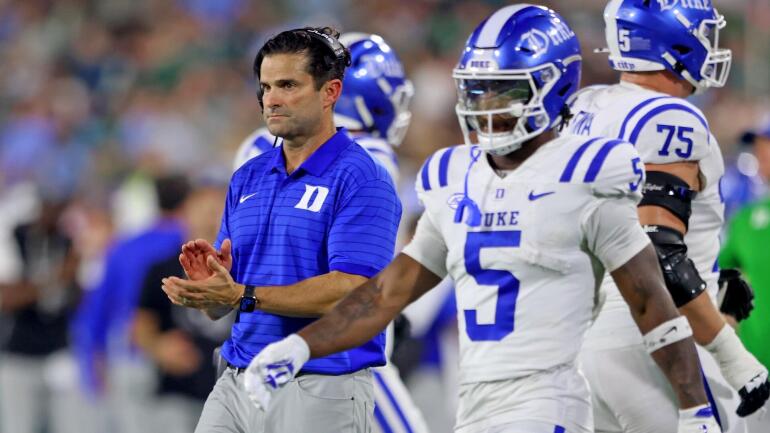
When the ACC Championship Game kicks off on Saturday night in Charlotte, North Carolina, the battle between No. 17 Virginia and unranked Duke will provide finality to what has been a chaotic final couple of weeks in the conference's football season.
In one outcome, Virginia could win and punch its ticket to the College Football Playoff as the fourth highest-ranked conference champion. However, if Duke were to beat Virginia the conference will find itself looking to lobby the College Football Playoff selection committee for the Blue Devils' inclusion as they might not be among the five highest-ranked conference champions who receive an automatic bid to the 12-team CFP bracket.
It's left ACC commissioner Jim Phillips fighting a PR and perception war on two fronts. First, there is the discussion of Miami as an at-large candidate for the playoff. The Hurricanes, at 10-2, are currently ranked No. 12 in the selection committee's rankings, two spots behind a 10-2 Notre Dame team that it beat in Week 1. The ACC has found some solace in the Tuesday night comments from selection committee chair Hunter Yurachek, which included the statement that "idle teams can move following the results of championship games." If that's to be believed, a BYU loss to Texas Tech could provide upward rankings movement for Miami and thus put the head-to-head result between the two teams in the center of the conversation.
"We know the final rankings aren't until Sunday, so there's time for course correction by the committee," Phillips told the Associated Press. "The committee's made it clear that idle teams can move up in the final rankings. And we're going to continue our efforts, as there's no question Miami's a playoff team and they've earned a spot in the playoff."
But the other front for this perception and PR war involves arguing for the ACC's champion. Phillips also told the AP that "the Virginia-Duke winner should absolutely be in the College Football Playoff. Those efforts took a hit this week when James Madison showed up in the selection committee's rankings at No. 25. Though the Dukes had been ranked in the AP Top 25 poll for three weeks already, it was not until reaching 11-1 overall that the committee has moved them into their ranking. JMU will host the Sun Belt Championship Game on Friday night, and with a win almost certainly holds on to their position inside the committee's rankings. With both participants of the American Athletic Conference Championship Game also ranked (No. 20 Tulane hosts No. 24 North Texas), the American is almost certainly locked into having one of the five highest-ranked conference champions.
So all it could take is a win for the Dukes and a win for Duke to find the ACC champion as the sixth-highest-ranked champion, if the Blue Devils -- who would be 8-5 on the season -- were to get ranked at all after the win.
The most frustrating piece of this College Football Playoff conundrum for the ACC has to be unintended consequences of seemingly beneficial actions. The league eliminated divisions after the 2022 season with the hope of improving competitive balance and allowing for teams to visit and be visited by a more diverse collection of the conference, which was already large and would soon expand again with the additions of SMU, California and Stanford. In the division format, the Atlantic Division and Coastal Division champions occasionally did deal with tiebreaker chaos, but because teams played everyone in their respective division you usually had enough common opponents to settle the matter before the end of the season.
Eliminating divisions also seemed, at the time, to improve the ACC's chances of fielding quality candidates for the College Football Playoff. With programs like Clemson, Florida State and Louisville all in the Atlantic, there was a balance of power that tilted to one side and having just one of those teams in the ACC Championship Game seemed (again, at the time) like it was limiting the conference's chances to make a statement on the big stage of championship weekend.
But now conference expansion and College Football Playoff expansion have left the ACC in the unenviable position of potentially having to argue that its five-loss conference champion deserves inclusion in the CFP while an ACC member with 10 wins that is ranked inside the top 12 has no chance to play its way into the field.
Let's get into how we got here, and some potential solutions to avoid this situation in the future.
A College Football Playoff bracket without Alabama, Notre Dame or any ACC team? How this scenario could happen
Brad Crawford

The dreaded fifth tiebreaker
While it cannot be proven specifically, the biggest culprit in this tiebreaker chaos is the combination of a 17-team league and an eight-game conference schedule. Virginia made its way into one of the ACC Championship Game spots with a 7-1 conference record when it beat Virginia Tech on rivalry weekend. But SMU's upset loss at Cal dropped the Mustangs to 6-2 in league play and combined with the rest of the Week 14 results left the ACC with a five-way tie for second place between Miami, Georgia Tech, Pittsburgh, SMU and Duke.
- Tiebreaker No. 1 and tiebreaker No. 2 require either all of the tied teams to have played each other or one of the tied teams to have played all of the other teams in the tie. Since none of those five teams played each of the others, there was no potential for a team to advance or be eliminated from the tie.
Again, this is where division play, a smaller conference or a bigger conference schedule could have potentially created more crossover.
- Tiebreaker No. 3 is win percentage against all common opponents and tiebreaker No. 4 is win percentage against common opponents based on their order of finish. Given the lack of crossover already detailed here, it should not be a shock that neither of those tiebreakers could settle the issue for the ACC.
- Which brings us to tiebreaker No. 5, the one that did send unranked Duke to the ACC Championship Game ahead of both No. 12 Miami and No. 22 Georgia Tech. Tiebreaker No. 5 is combined win percentage of conference opponents.
A convoluted approach to strength of schedule, combined win percentage of conference opponents has also played a factor in other conference championship races in this division-less super-conference era. The ACC is not alone in having this tiebreaker on the record, but the ramifications of this tiebreaker have been put under the microscope because it has produced a result that could negatively impact the league.
Duke's opponents went a combined 32-32 in conference play, while Miami and Georgia Tech's opponents both went a combined 28-36. For the purposes of exposing the silliness of this tiebreaker, we are going to focus on Duke and the Miami team that is widely accepted (by the CFP rankings, AP Top 25 poll, power ratings and more) as the "best" team in the conference.
Duke and Miami had just two common opponents: NC State and Syracuse. They both went 2-0 against those teams. There were then 17 games this season that involved one of Duke's ACC opponents going head-to-head against a Miami ACC opponent that was not on the other team's schedule. Let's call these the "swing games" in the ACC's 5th tiebreaker. In 12 of those games the Duke opponent won against a Miami opponent, providing a direct boost to the Blue Devils opponent win-percentage.
If just three of those 12 games had a different result, then Miami could have had a better opponent win-percentage than Duke. So let's identify three of the games that decided the ACC title race.
- Wake Forest 30, Virginia Tech 23 (Oct. 4): The Demon Deacons bounce back from back-to-back losses to beat the Hokies in Blacksburg in a game where the two teams combined for five field goals and zero touchdowns after halftime.
- North Carolina 20, Stanford 15 (Nov. 8): Neither team totaled more than 325 yards of total offense and North Carolina was able to hold on after nearly blowing a 20-3 fourth quarter lead.
- Clemson 20, Louisville 19 (Nov. 15): Louisville missed two field goals in the final five minutes in an excruciating home loss that bounced the Cardinals from the top 25.
None of the teams involved in those three games finished with a winning record in conference play. Half of those teams aren't even going to a bowl game. Yet those were three of the most significant results in determining the tiebreaker win for Duke over Miami. You could flip all three of those results and have zero impact on the five-way tie in the standings yet tremendous impact in terms of Miami winning the 5th tiebreaker over Duke.
So if we want to distill the tiebreaker drama to its silliest and most non-sensical essence, you could factually argue the following:
The difference between the ACC having a top-20 matchup in its conference championship game and potentially missing the College Football Playoff as a league was just a couple of one-off results between non-contenders, including Bill Belichick's 20-15 win over Frank Reich.
This isn't a butterfly effect or sliding doors situation, this is the Miami Hurricanes losing their easiest path to the College Football Playoff (winning the ACC) in part because of the narrowest margins in games that they had no control in scheduling.

How to prevent this headache in the future
The ACC has already taken some action, even before this tiebreaker chaos, to create more crossover for its 17-team league with the addition of a ninth conference game. That would create more common opponents and head-to-head scenarios that should lessen the odds of getting to the 5th tiebreaker again.
But it's also worth questioning the value of the 5th tiebreaker or any strength of schedule tiebreaker when it comes to selecting teams for a championship game in this super conference era. If the goal is to get your best teams on the field for the final weekend of play before the College Football Playoff selection, shouldn't the goal be to have teams that the selection committee is considering play in the game?
The spirit of competitiveness should remain in that conference record is the first deciding factor in making the conference championship game. That's where Manny Diaz and Duke have no remorse about navigating their conference slate to a 6-2 record that is good enough to finish tied for 2nd place, no matter how many other teams are also in that tie. But if we do have a scenario where teams are tied and there are not the head-to-head results available to break the ties, then put the onus on the same selection committee that would be rating your champion for inclusion in the College Football Playoff.
There are some logistical issues to this that include the shorter turnaround from Tuesday night to Saturday night's conference championship game, and maybe that's where other conferences like the Mountain West have chosen to use a computer rating average as a tiebreaker. Boise State, UNLV, New Mexico and San Diego State all tied for first place in the conference standings with 6-2 records, and the tiebreaker process similarly got complicated because not all of the tied teams played each other. Only this time instead of calculating opponents win percentage like the ACC the MWC went straight to an analytics rating that could be calculated on Sunday morning after the conclusion of the regular season schedule.
Either process, using the committee's own rankings or an analytics average, would have helped the ACC put teams into its conference championship game that would have had a strong likelihood to be one of the five highest-ranked conference champions. Instead, the ACC is a Duke and James Madison Dukes win away from potentially getting shut out from the CFP entirely.