The room was stunned.
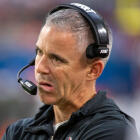
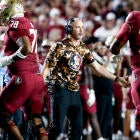
Expecting to make the College Football Playoff after a perfect 13-0 season, Florida State instead was the first team out. Cameras captured a team watch party that seemed incapable of processing what had just happened. Head coach Mike Norvell dropped his head in disbelief.
Florida State never recovered from it.
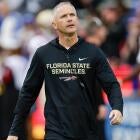
Less than three years later, Mike Norvell is out of a job. Following a 36-24 home loss to Clemson, FSU finally decided to swallow a nearly $50 million buyout to dump Norvell and try to recapture the magic that has been missing since 2023.
How did we get here? From a 19-game winning streak to a midseason firing? It is a mix of money woes, bad evaluations and an indignity the program could never get over.
Orange Bowl disaster
Mike Norvell's career trajectory and the Florida State football program drastically changed when star quarterback Jordan Travis broke his leg against North Alabama. Travis would never be the same after he fractured and dislocated his left ankle, retiring in 2025 after never playing another down in a game.
Florida State was undefeated at the time and well positioned to make the playoff if it kept winning. Yet there was a growing sentiment that the Seminoles didn't look the same without Travis in their regular-season finale and the ACC Championship Game. It opened the door for two one-loss teams, Texas and Alabama, to jump FSU in the final CFP Rankings.
Despite never losing a game, FSU was on the outside looking in. Norvell and the entire Seminoles program were crushed.
"I am disgusted and infuriated with the committee's decision today to have what was earned on the field taken away because a small group of people decided they knew better than the results of the games," Norvell said at the time. "What is the point of playing games?"
Next came a decision that some program insiders deeply regret in hindsight: FSU agreed to play Georgia in the Orange Bowl. The Bulldogs (12-1) were also mad about the final rankings, dropping from No. 1 to No. 6 after losing to Alabama in the SEC Championship Game.
The pain of the exclusion was too much for FSU to handle. It lingered over the program, the death of what was once seemingly promised. In retrospect, FSU should have realized it wasn't going to get over it quickly enough and opted out of the Orange Bowl altogether, just like Notre Dame did with its exclusion last season.
But Norvell and FSU tried to push forward. Twenty-nine scholarship players were missing -- including several players who opted out -- against a hungry Georgia team looking to send a message. Against the Bulldogs, FSU was without its starting quarterback, its top two running backs, its top two receivers and eight starting defensive players.
Georgia took advantage and walloped the Seminoles, delivering the biggest bowl blowout in college football history. There was already bitterness at being left out, and now FSU's argument took a big hit with the 63-3 demolition.
The combination of the playoff exclusion and the Orange Bowl blowout seemed to break something inside the FSU program. Leading into the Orange Bowl, FSU had won 19 consecutive games. Afterward, it went 10-23, including the miserable 2-10 2024 season right after.
Not long after the Orange Bowl loss, Alabama head coach Nick Saban stunned the college football world with his retirement announcement. Norvell became a focus of the search along with Washington's Kalen DeBoer. Whether Norvell was the 1A or 1B option to DeBoer is a source of great debate, but FSU officials were deeply worried that Alabama wanted him and he could soon be on the move. If Norvell had left for Alabama, FSU was prepared to aggressively pursue then-Ole Miss coach Lane Kiffin, whom it had already quietly reached out to about the job.
Instead, FSU rewarded Norvell with a $10 million annual salary and believed it had the man who would bring national championships to Tallahassee. "He's the real deal," an ecstatic FSU source said at the time.
Norvell to Alabama and Kiffin to FSU is one of the great what-ifs in recent college football history. Norvell had every reason to believe he could keep FSU atop the college football mountain. He didn't want to leave a program still reeling from the pain of the playoff decision, either, according to sources. But there are multiple sources who felt Norvell was never the same after 2023.
Early advantage wasn't a forever advantage
Norvell and Florida State embraced the transfer portal early and often. As other programs hesitated on how to utilize it, especially when combined with NIL, Florida State plunged ahead. Inheriting a team that went 3-5 in his first season, the COVID-impacted 2020 season, Norvell rightfully realized the program needed an immediate talent infusion.
That first transfer class started the momentum, headlined by future first-round draft pick Jermaine Johnson. The 2022 transfer class, ranked No. 10 in the country, featured defensive end Jared Verse (first-round pick) and running back Trey Benson (third-round pick). It was enough to take Florida State up another level from a 3-5 team to a 5-7 team to a 10-3 team in 2022.
FSU went all in on that next class, beating out Ole Miss for Michigan State transfer receiver Keon Coleman (future second-rounder) plus signing players such as defensive lineman Braden Friske (another second-rounder) and tight end Jaheim Bell (seventh-rounder). It all led to that big 2023 season.
And then it all came crashing down in 2024.
FSU's early aggression and financial advantage weren't the same anymore. More and more programs realized that the NCAA was incapable of enforcing its rules and that spending big could lead to big results and few punishments. Ole Miss, another early portal adopter, found ways to keep with the financial trends to remain aggressive. Whether through inability or unwillingness, FSU didn't keep pace.
FSU passed on the lofty price tag of future Heisman Trophy finalist Cam Ward, instead bringing in Oregon State transfer DJ Uiagalelei. DJU was a disaster in Tallahassee, starting only five games (he went 1-4) and finishing with more interceptions than touchdowns in an injury-plagued season. The decision to pass on Ward, who flourished at Miami, in favor of Uiagalelei may have ultimately doomed Norvell.
There was a confidence, too, that FSU knew best. It had mastered the transfer portal, and believed that it could do so annually. Where it erred, particularly with the 2024 class, was overpaying for former highly-regarded recruits who didn't have much college production. FSU was no longer bringing in plug-and-play starters who could have an immediate impact like Verse. It was targeting players it loved out of high school and missed out on to rivals like Alabama and Auburn. A few of the transfers from that class paid off, but the vast majority did not and set the program back years.
"Took some bad players," one source said, "and it caught up with him quickly."
FSU may have been better off using 2024 as a rebuilding year and focusing on its high school recruiting (never a strength for Norvell's staff). Replacing 40% of the roster each year was a risky gambit, especially if the program didn't have the financial resources to pay top dollar for the increasingly expensive transfer portal stars. FSU didn't have the money to get the best players out of the portal; the results suffered, and then boosters were even less inclined to give money.
Once considered one of the most feared programs in transfer portal recruiting, FSU now had to mostly shop in the bargain bin. In back-to-back recruiting cycles, FSU opted for a less-expensive quarterback transfer (Thomas Castellanos, Ashton Daniels) when more proven options were interested in coming. FSU just didn't have the money to spend big on a position that could easily get in the $3-4 million range for a successful veteran quarterback.
This season, Florida State spent a little more than $20 million on its roster, according to sources, a number that puts it in the middle of the pack in the ACC. It spent far less in 2026 than its in-state rivals Miami and Florida. While other programs with coaches on the hot seat increased financial resources for one last try, including Wisconsin and Maryland, it did not happen at FSU. The reasoning, according to sources, ranges from former AD Michael Alford believing FSU needed to closely follow the House settlement and College Sports Commission rules to fan base and booster apathy making it more difficult to raise money.
Staff issues
Norvell could never quite figure out the right mix of coaches on his staff. The talent advantage FSU had in 2023 seemed to cover up coaching deficiencies. Those reared their head the following season when Norvell fired offensive coordinator Alex Atkins, defensive coordinator Adam Fuller and receivers coach Ron Dugans in early November of that brutal 2-10 season.
FSU swung big for the 2025 season, bringing in UCF head coach Gus Malzahn as offensive coordinator and swiping Nebraska defensive coordinator Tony White. It was a reunion for Norvell and Malzahn, who had worked together at Tulsa, with the FSU head coach delegating offensive play-calling responsibilities to the veteran coach.
It never quite worked out as Norvell envisioned. FSU beat Alabama in Week 1, raising hope and expectations of what was possible in 2025. The Seminoles were ranked as high as No. 7 in the country before it came crashing down with four straight losses to Virginia, Miami, Pittsburgh and Stanford.
Norvell quietly tried to replace Malzahn after the season, gauging the interest of possible offensive coordinator replacements. He never pulled the trigger, though, and Malzahn ultimately retired. That pushed Norvell to take back over the offensive play-calling responsibilities.
FSU changed over its personnel department, bringing in John Garrett as general manager. It was mostly an arranged marriage – Garrett was seen internally as ousted AD Michael Alford's guy – and not the best fit to get FSU back on track in a critical 2026 season.
It quickly became clear this season that White's defense was a major problem. Norvell was well aware and considered firing White, according to sources, but didn't trust that there was someone on staff who could step up and take over the defensive play-calling responsibilities.
FSU fired White Sunday shortly after it let go of Norvell. Ernie Sims, a former All-American at FSU, was promoted from linebackers coach to interim defensive coordinator.
Program and industry sources describe Norvell as a smart coach and good man, but a combination of not fully trusting his staff and feeling he knew best after the 13-0 2023 regular season led to him getting overly involved in areas he may not have needed to. He unilaterally made decisions that would have benefitted from collaboration. He was a tireless worker, but those around him believe that with a better staff, he may have been able to better prioritize how he used his time each day.
"Micromanaging was a killer," says a FSU source. "Mike failed to empower the right people."
FSU didn't have enough killer recruiters on staff, and it showed in the Seminoles' high school recruiting results. FSU never had the success it needed to recruit the state of Florida and was never able to finish with the ACC's best recruiting class under Norvell. Better recruiters on staff and more of a focus on high school recruiting could have helped FSU get around some of its financial limitations and rely less on portal recruiting each cycle.