Why February's National Signing Day has become an afterthought in modern college football recruiting
By the time February rolls around, most top recruits have left home and begun training for their college football careers

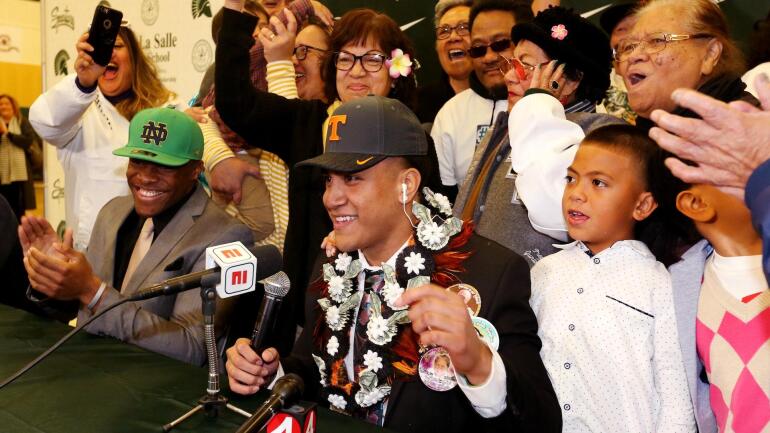
When Solomon Thomas wanted to reveal his college commitment in 2014, a hat didn't feel quite right. Known for his wide frame around Coppell High School in Texas, Thomas was never really a hat person.
Thomas ranked as the No. 41 player in the class and was heavily pursued by Stanford and Arkansas. After seeing close friends and competitors announce their decisions during celebratory National Signing Day events, he decided to do the same as he committed to the Cardinal.
His mom had a little fern tree that seemed to perfectly play into the unofficial mascot for Stanford football. Flanked by his parents, Thomas pulled out the tree and a pair of glasses with tape in the middle to commit to "Nerd Nation." The signing day gimmick went viral as Thomas inked his football letter of intent alongside eight of his closest friends with offers from Yale to Grand View.
"It was a really cool moment," said Thomas, now a defensive lineman with the Dallas Cowboys. "Afterwards, being in the gym with all the guys who I played football with at Coppell who were such close friends with me, we were so proud of each other taking that next step."
No. 25 Overall (No.4 DE) Solomon Thomas commits to Stanford University. #SigningDay pic.twitter.com/zHmHfoospw
— College GameDay (@CollegeGameDay) February 5, 2014
For decades, National Signing Day was one of the premier events in college football. Each February, hundreds of players would ink their signatures on a National Letter of Intent and coaching staffs around the country would breathe a sigh of relief.
The stories from days past have become legendary. There's the case of the late Alex Collins, whose mother refused to sign his NLI to Arkansas because she wanted him to go to Miami. Landon Collins committed to Alabama, only for his mom to say he made a mistake and should have picked LSU. Then, there's Jimmy Clausen committing to Notre Dame after stepping out of a Hummer Limo at the College Football Hall of Fame.
There are still fun commitments and antics in high school recruiting. But in recent years, February signing day has become an afterthought. There's no wall-to-wall recruiting coverage or last-minute pushes after the season anymore.
One longtime recruiting staffer said that the focus has shifted so much that he wasn't even sure when the February signing day was. The answer when we talked? This week.
"I don't even remember," he said. "That tells you how much it matters to us right now."
The main culprit in the death of February signing day is obvious. Nearly a decade ago, the NCAA approved an early signing period in December. Instead of having to wait until February, players were allowed to lock in earlier.
"My thing is, I don't think it's the death of signing day because the one in December was crazy this year," 247Sports national analyst Brian Dohn said. "It's just not what it used to be in February because all of the craziness that happened in December used to happen now."
At the time, many thought that the early signing period would allow teams to lock up their top commitments ahead of time. Mid-sized schools were eager to lock their commitments in so that bigger schools couldn't simply pivot to their players late to fill out their classes. Instead, it sped up the entire recruiting calendar.
Take USC's top-ranked high school signing class, for example, the first non-SEC No. 1 class since 2008. Top recruit Keenyi Pepe committed on May 1, 2025. Five-star edge Luke Wafle joined in June. Fellow five-star defensive lineman Jaimeon Winfield committed in March.
As National Signing Day rolls around on Wednesday, 246 out of the Top247 players had both committed and signed with their schools. The only exception was defensive lineman Dylan Berymon, who was seemingly nudged out of a commitment to Texas in November. Kentucky and Nebraska have been fighting for his services.
The only other major uncommitted players outside the Top247 are also those who faced extenuating circumstances. Four-star cornerback Andre Clarke Jr. committed to Michigan, but opted to re-open his recruitment after the Sherrone Moore debacle. Last month, he committed to Kentucky. Edge rusher Elijah Reeder faced a similar situation after Iowa State coach Matt Campbell left for Penn State; he is expected to follow Campbell to State College.
The pace also hurts late risers in recruiting classes. In the state of Texas, high school state championships don't even take place until two weeks after the early signing period. While a deep run could come with more attention and offers in previous years, classes are already all but complete by then.
"It's completely different than when I was back in high school," Thomas said. "Kids start committing when they're sophomores or juniors. When I was in school, most guys didn't commit until their senior season. It's a little bit harder for the late bloomers."
In previous years, January was a battle royale to finalize classes. With the earlier signing day, suddenly, the January in-home visits are juniors instead. There's no final sprint for coaching staffs because many are planning for conference title games or the College Football Playoff. And as a result, official visits get moved into the spring and commitments follow.
"You don't have time to do all this stuff," Dohn said. "You don't have four coaches going to visit a kid and sitting in the house for three hours when they're supposed to be there for 1.5 because they have games instead. Everything has sped up and changed."
The benefits of finishing a class are obvious, from locking in talent to planning for later cycles. That's only been exacerbated by the one-time transfer window, a two-week period at the beginning of January that went into effect this year.
"You're trying to get everyone admitted here before the spring," one ACC personnel director told CBS Sports. "Before, you would have a good amount of prospects, but there's much more of a push to have everyone there for spring ball."
Spring football has always been a draw for high-level prospects to integrate quicker before the season, but now it's a near-prerequisite. Take USC's top-ranked class again. Out of 35 commitments in the class, 32 are expected to enroll early. Especially in a world where transfers can fill roster spots with ease, there's even more pressure for underclassmen to arrive and prove they can play as freshmen.
Even at the Group of Six level, long-term planning for individual players has never been more difficult. Waiting until June is becoming harder to stomach.
"Getting them in when you have six or seven months to work with them helps a lot on the learning side," one Group of Six personnel director told CBS Sports. "To us, everyone is on six-month deals. Freshmen that come in, we expect them to contribute right off the bat because you never know if they're going to hit the portal next year."
Granted, there are still major commitment events across college football. When Aidan Mizell committed to Florida in the Class of 2023, he did it by bringing out live alligators in front of a packed gym at Boone High School in Orlando, Florida. However, his commitment happened as a standalone event in July.
#BREAKING: 4⭐️ WR Aidan Mizell has committed to Billy Napier and @GatorsFB 🐊🐊🐊@AidanMizell really brought out the real life Gators 😳🐊 @Swamp_247 pic.twitter.com/yibng46o1h
— 247Sports (@247Sports) July 29, 2022
And really, that's the crux of the issue. There's no longer a big, recruiting extravaganza on the college football calendar. It's only one of many battles.
As soon as high school recruits sign in December, it's on to bowl games and the transfer window. Then it's staff turnover and getting the new roster on campus. Before long, the focus shifts to the next recruiting class. At some point, the actual 2026 team comes into focus. It's a never-ending treadmill for programs.
During the heyday of National Signing Day, entire school districts would pause for athletes to have their moment. Athletes from football to basketball to track and field would gather in gymnasiums, surrounded by community and media for a day of pageantry and celebration.
By the time February arrives, the blue-chip football players are gone. They're already in the machine.