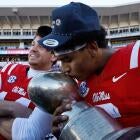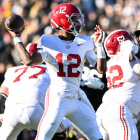


The first regular season of the Pete Golding era ended in a 41-17 win over in-state rival Mississippi State in a game that looked closer than the final score.
Ole Miss, which started the season ranked No. 9, finished 8-4 and will miss the College Football Playoff. Golding's debut season may be best remembered for what could have been in Trinidad Chambliss' final season in Oxford.
There were high highs like a dramatic win over former coach Lane Kiffin on Sept. 19. There were low lows like a blowout loss to Florida and a playoff dream-killing road loss at Oklahoma. Given the expectations, the season could be considered a disappointment and yet not an outright failure.
What's next for Ole Miss? These are the big questions to consider.
Who takes over defensive play-calling?
Golding has already announced that he'll be passing off the defensive play-calling to someone else next season. It was a mistake for Golding, a first-time head coach, to try to balance both jobs from the jump. There's a reason even Golding's former boss, Nick Saban, wasn't calling defensive plays at Alabama, though he was heavily involved in game planning and strategic decisions. At least it only took a season for Golding to realize he erred there.
The name that industry sources have mentioned the most for the role is Arkansas defensive coordinator Ron Roberts. The connection is obvious, given that Golding and Roberts have known each other for more than two decades, dating back to their shared time at Delta State. Still, Roberts has bounced around the last few years and is on his third SEC defensive coordinator job since 2023. At Arkansas this season, Roberts' defense ranks 81st in total defense, 88th in pass defense and 92nd in scoring defense.
If Cal moves on from first-year coach Tosh Lupoi, he is another name who could get traction for the job. Lupoi and Golding worked together for a season under Saban at Alabama. Lupoi's job security has been in question amidst a 3-8 debut season.
Whomever Golding hires for the position, it needs to be someone he trusts enough that he won't be tempted to micromanage and yank the defensive play-calling responsibilities back. It would help the next defensive coordinator to retain Suntarine Perkins, too.
Who starts at quarterback?
Let's start with the obvious: Ole Miss is going to miss Trinidad Chambliss. The terrific quarterback regressed a bit in 2026 and was more turnover-prone, but still had dazzling big-play ability that was frequently there when Ole Miss needed it most. Replacing him won't be easy.
Deuce Knight makes the most sense as an in-house replacement. The former five-star recruit has only thrown 43 passes in his collegiate career, however. The Ole Miss coaching staff has had a season to get an up-close look at what Knight brings to the table. Is what Knight has done in practice enough to turn the offense over to him? And, if so, at what cost?
If Ole Miss prefers a veteran option out of the transfer portal, the pool may be limited. There are more teams that need a transfer QB than there are viable starting quarterbacks available. And the absolute best ones could cost in the neighborhood of what Mississippi State quarterback Kamario Taylor got ($6 million).
Ole Miss showed with Chambliss that it is willing to spend big on a top quarterback. But if you spend $5 million on just an average quarterback, it can sink your roster because of the opportunity cost of where that money could have gone. Retaining Knight at a reasonable cost, noting the lack of college production, could be helpful not only for trying to also keep players like receiver Deuce Alexander but also for adding more offensive weapons.
That's a separate question about whether offensive coordinator John David Baker is the right guy to be feeding the play calls into the QB's helmet, but that's a whole different discussion.
What should expectations be?
With Chambliss and running back Kewan Lacy coming back for 2026, it was reasonable to expect Ole Miss to return to the playoff for a second consecutive season. That's not happening.
But the expectation should be the same in 2027, especially with the playoff expanding to 24 teams. With how Ole Miss finished this season at 8-4, that would be enough to make the playoff next season. Perhaps it is unfair to put the same playoff-level expectations on a team that doesn't have Chambliss at quarterback, but Lane Kiffin raised the bar in his time in Oxford.
If Golding can nail the right defensive coordinator and quarterback decisions, Ole Miss should be in that 8-9 win range again in 2027. The Rebels have an easy non-conference slate that should lead to a 3-0 start. If Ole Miss has any chance of meeting expectations, it will need to win games against Mississippi State, Arkansas and South Carolina, too.
And then it comes down to whether Golding can win two or three games against this group: Alabama, Kentucky, Oklahoma, at LSU, at Tennessee and at Texas A&M.
If he can't, the disappointment of what could have been for 2026 will turn to increased frustration and angst.