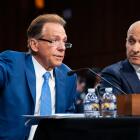


The future of college athletics is extremely uncertain, and Congress is trying to step in with federal legislation. Sen. Ted Cruz (R, Texas) and Sen. Maria Cantwell, (D, Wash.) introduced the Protect College Sports Act last week, and a handful of notable figures within college athletics showed up to testify and express support for the bill in a Senate Commerce Committee hearing on Wednesday.
The bipartisan act would take several steps to address the chaotic nature of college athletics -- especially as it pertains to football and basketball -- while also preserving Olympic and women's sports. Chief amongst those steps would be granting the NCAA limited antitrust protection, so that it could create its own enforceable rules and regulations on issues such as player eligibility and transfer rules.
As reported by CBS Sports last week, the general overview of the Protect College Sports Act and its contents were as follows:
- Create one national NIL law that overrides state-by-state rules
- Give the NCAA and conferences broader antitrust protection against lawsuits
- Create federal oversight and disclosure requirements for NIL deals
- Increase regulation of boosters, collectives and athlete agents
- Allow enforcement entities to review NIL deals for "fair market value"
- Give governing bodies more authority over transfer rules and tampering
- Require schools to provide certain athlete health, safety and academic protections
- Restrict some in-season coaching movement and hiring activity
- Formalize the post-House settlement structure into federal law
- Strengthen the NCAA's ability to enforce compensation and eligibility rules
On Wednesday, legendary Alabama coach Nick Saban, Notre Dame athletic director Pete Bevacqua, former Ohio State and West Virginia president Gordon Gee, Pac-12 commissioner Teresa Gould and Utah football player Lance Holtzclaw appeared in front of the Senate Commerce Committee as witnesses.
Over the course of three hours, those five witnesses addressed the issues currently facing college athletics and weighed in on what must be done to solve them. Among the key topics were reigning in the bidding wars between NIL collectives, regulating player agents, pooling media rights and preserving Olympic and women's sports.
Limiting NIL collectives and pay-for-play
Saban spent 33 years as a college football coach and retired following the 2023 season, when roster budgets were just beginning to explode. He broke down how the price of Alabama's roster has grown since paying players became permissible.
"My first year, we had a collective at Alabama, it was $2.7 million," Saban said. "Next year, $7 million. Next year, $10 million. I retired. Next year, $17 million. Next year, $24 million. Now you have schools that have close to $40 million rosters."
Referring to bidding wars between athletic departments as a "race to the bottom," Saban argued that "if you don't spend to win, you lose your fan base and your revenue, and you lose the other sports."
Saban and Bevacqua were both in favor of limiting the power that singular boosters and collectives have when it comes to throwing money at rosters in order to skirt the revenue-sharing cap.
Speaking of that cap, Bevacqua said the revenue-sharing cap put in place by the House vs. NCAA settlement was "too low." Bevacqua called for a higher cap, asserting that it would allow universities to fund rosters themselves while relying less on pay-for-play deals from outside sources.
"I think we need to fix a more realistic cap," Bevacqua said. "… There's this misnomer that there's a cap. There is no cap. You have a cap outlined by the House settlement, and then you have third-party NIL opportunities. I view it as an equation of 'X' being the cap and 'Y' being the NIL space, equaling the total spend on compensation. I think the more dollars that can be transferred into the cap and paid directly by universities in an incredibly transparent way is going to help clean up the system."
Notably, the Protect College Sports Act provides a plan to regulate pay-for-play deals brokered by collectives and allows all NIL deals to be reviewed for "fair market value." It does not, however, address ballooning coach salaries and buyouts.
Stricter regulations for agents
The duo of Bevacqua and Saban was also loudly in favor of stricter regulations for player agents at the college level -- raising standards to those enforced by pro leagues.
While supporting a cap on agent commissions, Saban laid out cases in which "agents" for college football players were taking 4-6 times as much as their NFL counterparts.
"In the NFL, they're at 3-5%," Saban said. "We have college players paying 20%."
Bevacqua, in favor of a registered database for agents, echoed that stance, saying that teenagers who have never negotiated with an agent have no idea what a fair deal looks like.
"Young men and women -- 17 and 18 years old -- are not used to negotiating with agents or what it means to pay a fair commission are being taken advantage of around the country," Bevacqua said. "We need a database or registry for these agents, and a cap on their commission, to make sure these student-athletes aren't being taken advantage of."
Gee calls out commissioners, suggests pooling media rights
Gee, who served as a president or chancellor of five different universities, got very blunt about how we arrived at the current landscape of college athletics. Gee laid much of the blame at the feet of conference commissioners, whom he accused of viewing college athletics as a product to be profit-driven.
"I think we've turned over too much power to commissioners," Gee said. "They have a very limited notion of what they should be about. The word 'student' is not in their lexicon. The word 'athlete' is -- and the word 'money.' This is an issue we have to get at. … What I do mean to say is I think university presidents need to take charge of this issue."
As the cost of running an athletic department skyrockets, Gee worries about the financial future of colleges and universities more broadly. In his written testimony, Gee pointed out that college sports as a whole are set to lose $5 billion in 2026.
In hopes of making some of that money back, Gee said the antitrust protections in the Protect College Sports Act could allow the conferences to pool their media rights -- much like the major pro sports leagues -- to "growing the pie" from which all universities can earn revenue.
"The real issue for antitrust exemption is to be able to collectively have our (media) rights put together," Gee said. "The whole issue, as I said earlier, is growing the pie. By that I mean doing, frankly, what has happened with the NBA and NFL and others. That's the exemption that's the most important of the antitrust act."
Gould, whose Pac-12 Conference was reduced to ashes before regaining some life with a relaunch coming this summer, said that financial pressures have pushed decision-makers to put the well-being of student-athletes on the back burner.
"In part what I learned is what can happen when you don't keep the well-being of student-athletes at the center of your decisions," Gould said. "What has transpired, not just in the Pac-12 but across a lot of conference realignment and change within our system, is the well-being of student-athletes is no longer at the center because of the economic pressures we're dealing with."
Saving Olympic and women's sports
One of the concerts presented by Cantwell and several witnesses was the decline of Olympic and women's sports. As universities spend more on revenue-generating sports, smaller non-revenue programs are being cut.
In her written testimony, Gould said that those programs face unique challenges as they are forced to operate on smaller and smaller budgets. Additionally, large schools in the power conferences have an inherent advantage when it comes to funding and keeping those non-revenue sports afloat.
"Financial pressures continue to mount as athletics department debt grows, while Olympic and women's sports face disproportionate risks as institutions seek ways to manage escalating costs. The widening structural and financial advantages afforded to autonomy conferences further disadvantage institutions that remain deeply committed to investing in broad-based athletics programs and competing at a high level."
Bevacqua shared Gould's concerns and proposed a potential solution. If the NCAA were to adopt a higher revenue-sharing cap, there could be a provision requiring universities to invest in Olympic and women's sports.
"If universities choose to exceed the cap, tying in some form of subsidy on a certain percentage of the dollar -- maybe 20 or 25 cents per dollar -- that you have to reinvest in Olympic and women's sports," Bevacqua said.
SEC, Big Ten stand opposed
While a number of figures within and around college athletics are backing the Protect College Sports Act, two of the biggest power players are refusing to get on board, at least for now.
Less than 24 hours before the Senate Commerce Committee hearing, the SEC and Big Ten released a joint statement opposing the bill. The conferences argued that the bill would reduce adaptability by giving Congress more decision-making power, would increase litigation and would harm the current revenue-sharing model.
Joint statement on the Protect College Sports Act: pic.twitter.com/0sRlWCSvGY
— Southeastern Conference (@SEC) June 2, 2026
Last week, SEC commissioner Greg Sankey admitted that he hadn't read the bill and wanted to take a deeper look before adopting a stance. Still, Sankey acknowledged that college athletics needs federal legislation because, without it, there is "more fracturing because conferences will have to make decisions."
It just doesn't seem like the Protect College Sports Act was the type of legislation he wanted.