

Tennessee men's basketball players and the players' association Athletes.org released the first collective bargaining term sheet in college sports Tuesday, a blueprint that would allow players to negotiate their own salary cap, require a spending floor and strip schools of up to 100% of their conference payout if they cheat the system.
The historic document arrived the same day that one of the Protect College Sports Act's leading supporters urged the House of Representatives to pass the bill and went after the people behind the idea of collective bargaining as much as the idea itself.
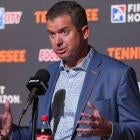
"The principal opponents are agents who now call themselves 'Athlete Advocates,'" Yankees president Randy Levine, vice chair of the President's Roundtable on Fixing College Sports, wrote to House members. "They do not want their egregious fees reduced, as this bill would do and they do not want to acknowledge there is a difference between professional and student-athletes."
He added: "So, it is not the student-athletes who are complaining they have no voice, rather the agents who want to be the group running the Union that want the voice."
The bill and Tennessee's proposed term sheet are competing blueprints for who controls the money in college sports: Congress or the players. The next five weeks could decide whether either is the future.
The PCSA, which passed the Senate 77-22 on Sept. 28, needs House approval by Dec. 17, the chamber's last scheduled day of work. Any amendment sends it back to the Senate. If it is not signed before the new Congress is sworn in Jan. 3, the process starts over in a far different political environment. Democrats won control of the House and Senate last week.
The term sheet is not a contract. Athletes.org said Tennessee's administration "has not agreed to or endorsed these terms," and that the binding structure does not yet exist.
Tennessee athletics director Danny White backed the concept in a news release.
"Collective bargaining is a proven model that works across all of professional sports and, through Athletes.org, athletes can help create a healthy, durable solution for the future of college athletics," White said.
The term sheet is a proof of concept, an exercise in what could be possible in college athletics. Meanwhile, the PCSA is only a House vote away from President Trump's desk.
Criticism of a CBA structure is not new. On Sept. 29, the day after the Senate vote, Levine and Cody Campbell, the chairman of Texas Tech's board of regents and a member of the roundtable, made the same case on a conference call with reporters. Campbell said, "there is no college athlete organization."
"These are groups that have popped up out of an attempt to make money off the system eventually that they saw as going toward collective bargaining and more of a pro-style approach to the college athletic system," Campbell said.
Asked about Levine's letter Tuesday, Athletes.org executive director Brandon Copeland did not address the agent label. He challenged critics to "review the proposals that we've made and tell us where exactly and why it cannot work."
"Because I don't mind being wrong," Copeland said. "I just want more people to come to the table trying to solve this instead of trying to block college athletes' voices out of the equation forever."
What's in the term sheet
Three elected player representatives from Tennessee's men's basketball team, graduate student Tyler Lundblade, junior Campbell Duncan and sophomore DeWayne Brown II, built the proposal with Athletes.org over the summer and negotiated it with Tennessee's athletics department. Among the terms:
- One contract. A single athletic services agreement replaces revenue sharing and school-affiliated NIL deals.
- A cap and a floor. A bargained salary cap, a required spending floor and guaranteed minimum pay for every player.
- Bonuses. Postseason, performance and veteran bonus pools.
- Injury and health. Injured players keep 100% of guaranteed pay, with medical coverage after eligibility and for life after a catastrophic injury.
- Player movement. A 15-day transfer window that opens after the national championship game.
- Enforcement. Schools caught cheating the cap can lose up to 100% of a conference payout. Coaches face fines, suspensions and bans.
- Agents. Athletes.org certifies agents, whose fees are capped at 5%.
- Academics. Schools pay for degree completion if athletics keeps a player out of his intended major.
The two sides split on NIL during the negotiation. Athletes.org wanted no fair-market-value review of deals. Tennessee wanted one akin to what the College Sports Commission currently utilizes. They settled on a two-year system run by a third party, then a review "with intention to sunset" it.
The term sheet and the PCSA are closer than their rhetoric suggests. Both cap agent fees at 5% and keep a five-year eligibility clock. The difference is who polices the agents: college athletics' governing associations under the bill, or Athletes.org under the term sheet.
One word: employee
Of course, collective bargaining has long been a legal question.
"The agents argue the bill does not give student-athletes a voice," Levine wrote. "They make this argument knowing that collective bargaining cannot be achieved without changing many federal and state laws."
Campbell went further on social media Tuesday, citing the National Labor Relations Act, which excludes "any State or political subdivision thereof" from its definition of an employer. He wrote that Tennessee courts and the state's attorney general have held that public employers cannot bargain collectively without a statute granting that authority.
"This can and will never happen in practicality," Campbell wrote.
In Tennessee, appellate courts have ruled against union contracts with local governments, and the attorney general wrote in 1979 that a public employer cannot bargain without legislative authority.
Athletes.org does not dispute the premise. It disputes that it applies. Under its model, schools would not be the employer. A private, multistate entity funded by member schools would employ the athletes and bargain with Athletes.org.
Multiple litigators have vetted the solution, including Jim Quinn, who has represented players associations in multiple professional leagues, Copeland told CBS Sports.
Campbell dismissed that structure, too. Pressed on social media by sports attorney Darren Heitner on why conferences couldn't serve as the employer, Campbell argued that schools would have to pay the conferences, which would then pay the athletes.
"If using a third party intermediary was a legally passable strategy, state employees would have been using it for the last 90 years," Campbell wrote.
Athletes.org's own explainer says players would have to be employees for a salary cap and transfer rules to carry antitrust protection.
The fight comes down to that one word: employee.
The PCSA is neutral on whether athletes are employees, though it wasn't always that way. Sen. Ted Cruz dropped a provision barring employee status because co-author Sen. Maria Cantwell and other Democrats would not accept it. House Majority Leader Steve Scalise has said that gap would have to be addressed through amendments, Roll Call reported.
The bill also gives schools, conferences and associations targeted antitrust protection to enforce its rules on pay, eligibility and transfers. That is the shield Athletes.org says only collective bargaining provides today.
Levine wrote Tuesday that the bill does not close the door for collective bargaining. "If the PCSA passes, there will be nothing to prevent collective bargaining if the laws are changed in the future."
Heitner pressed further on the idea Tuesday: "What prevents Congress from changing the law or adopting an exclusion? How is that different than asking Congress to pass legislation like the PCSA?"
Campbell's reply was one word: "Politics."
The Tennessee players do not see it that way.
"I don't think that those two could coincide, but I think the PCSA is unfair towards athletes in a lot of ways," Lundblade said.
Duncan said the bill's supporters are "trying to cap the amount of money that we can make as players," while coaches "can still make as much money as possible."
In a phone interview with CBS Sports, Copeland pointed to record revenues, ratings and coaching buyouts and said that "instead of people being challenged to either manage their budgets better or negotiate better, they're asking the athletes to take on the burden."
The PCSA's backers have said athletes are on their side. "Similarly, an overwhelming majority of student-athletes support the PCSA," Levine wrote Tuesday. "They do not want to be employees, file tax returns, keep expense ledgers, etc.; they want to be students." On the Sept. 29 call, Levine said the roundtable had heard from "hundreds, if not a thousand student-athletes, and none of them want to be in a union that we've talked to."
The Tennessee reps say those athletes don't speak for players at programs like theirs. Lundblade, Duncan and Brown spent months working through terms with their own athletic department, and Lundblade said it was "unfortunate that none of them had a seat at the table negotiating the PCSA."
"Our experience at UT -- at a primetime university in the SEC -- is a lot different than a lot of the athletes that you saw standing up in front of the PCSA with some of those senators and whatnot," Lundblade said.
None of the five athletes who spoke at a Sept. 14 news conference outside the Capitol supporting the bill played FBS football or basketball. The only FBS football player to speak that day was Temple's Jackson Pruitt, who instead spoke out against it at an event for the American Federation of Labor and the Congress of Industrial Organizations.
The clock is ticking
The PCSA faces opposition on both sides of the aisle. The Congressional Black Caucus condemned the bill the day after the Senate vote over HBCU funding, the lack of employment rights for athletes and limits on their ability to sue. In an Oct. 2 letter, 21 House Republicans objected to the bill's 20-member cap on power conferences and a three-year waiting period for schools that switch leagues.
In the lame-duck session, Republicans hold a 218-214 edge in the House, and Congress has a slew of business to finish first, including government funding that expires Dec. 11. A lobbyist told USA Today on Tuesday that the PCSA is effectively dead.
SEC commissioner Greg Sankey acknowledged Monday on the "Paul Finebaum Show" that "elections have consequences," adding that the SEC is preparing for a future with or without the bill.
Athletes.org is playing the long game. Copeland said officials from other universities contacted the group Tuesday about setting up meetings. Tennessee's football team privately voted to have Athletes.org represent it, according to the term sheet, with that work on hold until the season ends.
Lundblade said the next step is "literally taking this to the SEC and trying to build this thing."
Meanwhile, the PCSA is in a race against time and, of course, partisan politics.
Levine closed his letter with a challenge to the House: "History will remember if you choose wrong. Pass the PCSA."
The answer will come in December, but Athletes.org is planning for a longer fight.
"AO is getting ready to be flying around the country, racking up some frequent flyer miles, hopefully," Copeland said.