
The College Football Playoff's only constant? Debating change
College football now stands alone as the only major American sport that refuses to decide on a postseason format and stick to it.


MIAMI BEACH, Fla. -- There are three certainties in life: death, taxes, and the continued drumbeat around expansion of the College Football Playoff.
As sure as the seasons change and the sun rises in the eastern sky, the 10 conference commissioners and Notre Dame's athletic director will discuss, debate, and campaign through sources and intermediaries about whether the CFP should stay at 12, go to 16 or even balloon to 24 teams.
The 12-team format is only in its second year and with a different seeding structure for Year 2. This year's CFP had a straight seeding format after last year's version seeded the top four conference champions 1-4. The selection committee also used a different strength of schedule metric this year to determine the field. Next year, the format will have a more subtle tweak guaranteeing the Power Four conference champions entry into the CFP as well as Notre Dame if it is ranked in the top 12.
There is a school of thought that perhaps those at the helm of the CFP could let this contract play out for the next six years with a 12-team format and reevaluate whether to expand then. Currently, that is not the plan. There is, instead, a push for expansion among the commissioners.
Tim Pernetti, the commissioner of the American Athletic Conference, pins the holdup of any future plans to a small group.
"I think that's up to two people in the room to come back with something that we'd all sit down and discuss," Pernetti said.
Those two people are Big Ten commissioner Tony Petiti and SEC commissioner Greg Sankey. Petitti declined comment besides a quick insistence that there was more work to be done while leaving a meeting of commissioners the day before the national championship game, and Sankey was unavailable for comment.
As CBS Sports reported earlier this week, a deadlock exists between the two league leaders who hold a plurality of the votes about the future format. The SEC favors 16, and the Big Ten favors 24. The ACC and Big 12 are also in favor of 16, but the SEC and Big Ten must align or the playoff stays at 12.
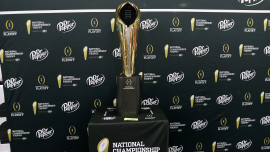
College football now stands alone as the only major American sport that refuses to decide on a postseason format and stick to it. But that is of course the story of college football as it has been incapable of settling on how to crown a true national champion. The old system of sportswriters voting on the champion after the bowl game was inadequate, and once it was replaced with the bowl alliance, and then the BCS, constant tweeks were made. The BCS formula routinely altered which computers were involved in the formula and how things like margin of victory were weighed. Polls and computer rankings also had varying degrees of influence.
When asked by CBS Sports if continued discussions about the postseason format is good for college football -- even while the postseason itself is going on -- Pernetti said, "I don't have an opinion on that." MAC commissioner Jon Steinbrecher straddled both sides.
"I think it speaks to the interest there is in college football," he said. "So I don't view it as a negative, but it would be helpful if sooner rather than later, we come to some conclusions."
The next deadline for the commissioners to make a decision on the 2026 playoff format and beyond is Jan. 23, imposed by ESPN. CFP executive director Rich Clark was firm the deadline is hard and fast, but the commissioners are infamous for blowing through deadlines -- they did so on Nov. 1, when they asked ESPN for an extension on the most recent so-called hard and fast deadline. That extension has led to these discussions on gameweek.
It is said that the only constant in life is change. In the case of the College Football Playoff, it is talking about change. Maybe it'll happen, or maybe it won't.