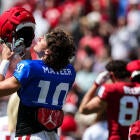


Just about every player enters training camp saying they've never felt better and they're in the best shape of their life. In the case of Oklahoma quarterback John Mateer, seeing is believing.
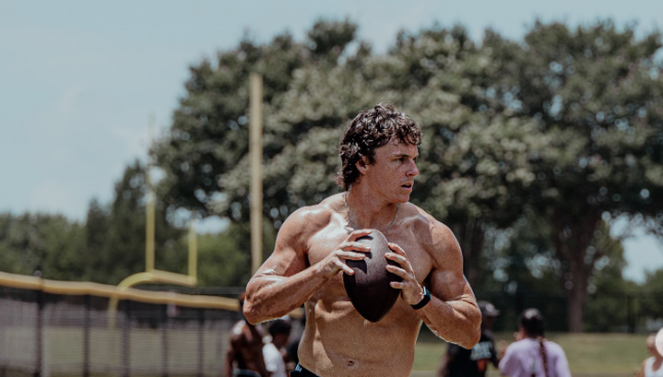
Mateer turned heads over the summer at the Manning Passing Academy in late June for a noticeably more muscular physique. He kept the conversation going by posting multiple shirtless pictures on Instagram:
There was chatter in social media circles, Reddit -- "is that kind of muscle good for throwing?" -- and on a few podcasts that Mateer's strapping physique would affect the fluidity and mobility of his throwing motion.
"Is John Mateer too jacked?" Tom Fornelli asked, perhaps with a scoop of sarcasm. "I don't know if I want my QB being too big ... I'm not trying to get a body-builder quarterback. When you're that big, you're too tight. How are you supposed to unleash a throw down the seam with that -- he's got his pecs getting in the way!"
Below is our attempt to discern whether bulking up could have any impact on how Mateer will steer the Sooners offense through the air.
We asked an expert
Mateer had an up-and-down 2025 season marred by a hand injury suffered in a late September game against Auburn. He returned in time to face Texas in the Red River Rivalry but was a diminished version of himself as a passer for most of the rest of the season until late in the year.
In the offseason, he began working out with his offensive linemen and has put on anywhere from five to 10 pounds. He enters fall camp at a listed 224. Oklahoma did not respond to a request to speak to Mateer, his QB coach or the Sooners' strength and conditioning coordinator.
Pat Powers is throwing out any theory that Mateer added bad muscle this summer.
A former Northern Illinois football analytics staffer, high school football assistant coach and sports science researcher for Driveline Baseball and the NFL, Powers says from a kinematic perspective the concept of Mateer's bulk inhibiting his ability as a passer could not be further from the truth.
"Yeah, that's false," Powers said. "Basketball is a good example where if you see guys say lifting is going to make you less flexible, it's completely untrue. It doesn't bear out in reality. And also, any decent training program is going to take that into account and work on mobility, flexibility, and that type of fitness."
Mateer's listed weight isn't in any way an outlier. Arch Manning is listed at 222, Gunner Stockton is 215 and Byrum Brown in 235. If Austin Mack wins the starting job at Alabama he'd be the heaviest starting QB in the SEC at 237 pounds. According to Powers, getting bigger can actually help Mateer.
"Different players are going to adapt differently, and it's not typically like oh, you put on five pounds, your elbow flexion is going to fall, or your shoulder abduction is going to decrease," Powers said.." It changes player to player, and that's some of where like the kind of ecological dynamics comes in, where a lot of skill adaptation is learning to how your body changes, which is why there's such things as like de-loading weeks and lifting programs, where you're taking a week for your body to recover and kind of adapt to the changes its made.
"So it's not quite a one-to-one of like this happened, so this happened. It's more a balance of general and specific training because all the weightlifting stuff is what's known as general fitness, and then when you get to like the actual throwing exercises, that's specific. So it's basically improving your general fitness gives you more capacity to both practice more and have raw inputs to improve the specific skills."
Ground force = rotational force
Mateer is a former baseball player. In fact, he skipped offseason 7-on-7 football camps as a high schooler to play on the diamond. You can see the baseball background in how he throws a football – his throwing motion is much more sidearm almost as if he's a shortstop turning a double play. But zeroing in on Mateer's arm at all can lead you down the wrong rabbit hole.
While you may think that throwing a baseball is one-to-one with throwing a football, consider that there is much more overlap with hitting. This was applicable to another OU quarterback years ago, Kyler Murray, who was drafted by the Oakland A's before opting to go to the NFL. Murray told The Oklahoman "I can throw a football all day and my arm doesn't get tired," …"If I throw a baseball more than a certain amount of time, it's going to get a little sore."
The reason why has to do with what exactly is happening when a quarterback throws a football, as explained by quarterback guru Yogi Roth.
"We got a phrase that we use at Elite 11 all the time: 'Ground force equals rotational force,'" Roth shared during a 2015 conversation. "[Murray] has a lot of that. If you think of a baseball player when they swing, and the way they generate force with the bat or when they generate force even throwing, it's the same as a quarterback."
Many famous quarterbacks with the types of throwing style you might remember like Brett Favre, Aaron Rodgers or Dan Marino aren't actually doing much work with their arms. They're using more of their core to draw rotational force from the ground and essentially fire it up through their bodies and the ball shoots off their hands almost as a byproduct. The right hip is doing most of the work.
This also makes Mateer different from a similar example of a swole passer people had concerns about, Tim Tebow, whose arm strength wasn't in doubt but his accuracy was because of a long, looping throwing motion. The pitfall of Tebow's for was that it was too "armsy," using too much of his upper body, rather than an efficient lower body. Here's a scouting report on Tebow (who played around 235 pounds) from NFL.com:
"Release is far too slow to fit balls into spots against NFL defensive backs. Release point and mechanics (elongated, wind-mill delivery which comes out too low) likely need to be altered."
So what should you make of tarps-off Mateer?
Nothing much beyond, the odds are he looks like he's in much better shape than you do.
It doesn't mean he'll be too tight to go deep to Isaiah Sategna or Parker Livingstone. In fact, because Mateer runs the ball so much it might help him hold up to the wear and tear in the SEC. But there's a lot that goes into the training and coaching of being a refined passer in the SEC, and 10ish pounds of muscle isn't going to automatically ruin him.