Fantasy Baseball Offseason Reaction: Mets nab Freddy Peralta, Brewers add a couple of intriguing prospects
The Mets continued their recent spree by adding a top-of-the-rotation arm they desperately needed

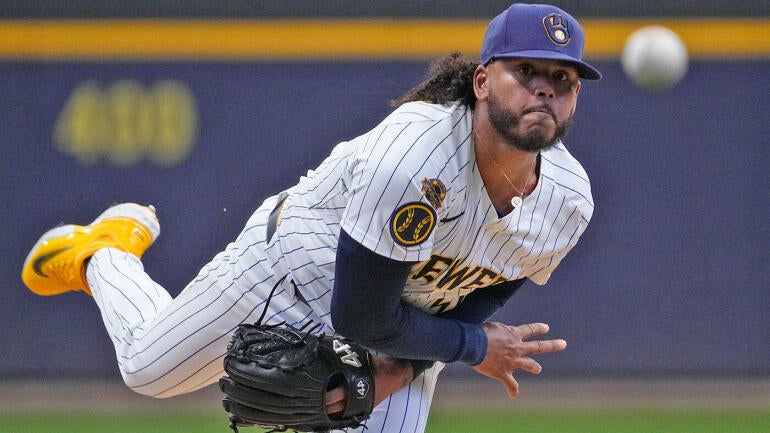
The Mets have regrouped nicely, huh? Their offseason got off to a disastrous start, but they've filled in most of their holes with impact players, the latest being Freddy Peralta, who was acquired in a trade Wednesday night for a pair of top-100 prospects.
Let's dive into the Fantasy implications of this deal for both sides:
Mets acquire Freddy Peralta
Peralta slides right into the top of the Mets rotation with this move. He's not your prototypical, innings-eating ace, but he's typically very good when he's on the mound. There are more ups and downs than you'd prefer – there's a lot of Blake Snell, albeit less extreme on both ends of the spectrum – but at the end of the day, Peralta typically puts in 160-175 innings of a mid-3.00s ERA and 200 or so strikeouts.
And he's moving to one of the few spots around baseball that might not represent a huge downgrade from the one he was in in Milwaukee. The Mets probably won't match the Brewers' 97 wins from a year ago, but this should be a very competitive team, with a good home park and a great defense backing him up. Bo Bichette is unproven at third base, but if he can handle it, the Mets could have plus defense at the key infield positions, plus left field and center field. It's a nice landing spot, if you have to leave one as good as Milwaukee.
Peralta, of course, already costs quite a bit in Fantasy drafts, with his ADP up to 69.1 in NFBC drafts in the month of January. I think that's probably an overpay based on last year's inflated win total and unsustainably low ERA (2.70 ERA compared to a 3.47 xERA), but that doesn't mean I think Peralta is likely to be a bad pick – 200 strikeouts and good, but not great ratios never goes out of style. And his new landing spot should help him sustain his value. As long as his price doesn't keep rising, he represents a solid, albeit imperfect choice for the No. 2 spot in your rotation.
Peralta's value holds steady, so the more interesting side of the deal comes from the prospects the Mets gave up to get him.
Brewers acquire Jett Williams, Brandon Sproat
Let's meet Williams
For one year of Peralta's services, the Brewers acquired a pair of top-100 prospects in shortstop Jett Williams and pitcher Brandon Sproat. Sproat has made his MLB debut while Williams got to Triple-A last season, so they not only got two top-100 prospects, but they got two who could help their team in 2026.
Now, a quick note before we move on: I am, personally, not a huge fan of either of the players the Brewers acquired here. It's giving me shades of the Corbin Burnes trade from a few years ago, one the Brewers haven't gotten much out of. I'll note where my skepticism with each lies, but I'll also lean on others' scouting reports to provide both sides of the argument.
Let's start with Williams, the more highly regarded of the two.
One way Williams fits with the Brewers is his height: He is just 5'7", so he'll fit right in with the likes of Caleb Durbin and Sal Frelick, two other diminutive recent prospect graduates.
And, as you might expect, Williams doesn't hit the ball especially hard – in his brief Triple-A debut in 2025, he had just an 86 mph average exit velocity and 34% hard-hit rate, both of which were solidly below average marks. However, he manages to be functionally about average as a power hitter thanks to a strong approach at the plate and a high pulled-air rate, which helps him take advantage of the shorter fences in left field. The combination of solid contact skills and a proclivity for elevating the ball to the pull side should help him avoid being totally punchless, similar to how Durbin has emerged as a double-digit homer sources despite his diminutive size and exit velocity readings.
Where my skepticism with Williams comes from is the plate discipline side. He tends to be overly passive, which leads to high walk rates in the minors but can be exploited in the majors. It's one thing if you just have preternaturally good swing decisions, but that isn't necessarily the case for Williams – at Triple-A, he was in the 78th percentile in chase rate, but was also in just the 27th percentile for in-zone swings. He lets a lot of strikes go past him searching for the right pitches he can drive, but major-league pitchers are much more willing and able to challenge hitters in the zone if they think they aren't going to hurt them. It's easy to fall behind with that approach.
That's not a death knell for Williams, but there just aren't a ton of players with below average pop who can make this kind of approach work. But there is one notable comp if you want to be optimistic: Geraldo Perdomo, who had below-average quality of contact metrics and the eighth-lowest in-zone swing rate in baseball in 2025, but made it work by making a ton of contact when he did swing, drawing a lot of walks when he didn't, and elevating the ball to the pull side and hitting a lot of line drives.
Williams ranked 64th on Scott White's top-100 prospects list published earlier this week, and he had this to say:
"Williams bounced back nicely from an injury-wrecked 2024, particularly if you just look at his .281/.390/.477 slash line at Double-A and give him a pass for his bumpy transition to Triple-A. He still sells out harder for power than his 5-foot-7 frame suggests he should, though. There's a scrappy leadoff hitter in here -- one who's more likely to wind up at second base than shortstop -- but his current approach presents real batting average risk."
The Brewers have some depth up the middle, but shortstop is pretty clearly their biggest position of weakness with Joey Ortiz coming off a .593 OPS in 2025. They might prioritize Ortiz's steady glove hand in the short term, but if he hits like that again, Williams will have an opportunity to play before long, even if it doesn't seem super likely to come right out of Spring Training -- and Williams does have experience at second base and in the outfield, and flexibility always makes a path to playing time easier to find. And there is some power/speed upside here if he hits (Williams hit 17 homers and stole 34 bases in 130 games as a 21-year-old in 2025), too.
Let's meet Sproat
Sproat's value as a prospect has been on quite a ride in recent years, not unlike Williams. The former second-round pick garnered a lot of hype for his 2024 breakout, but he sputtered during a late callup to Triple-A and then nearly fell off prospect radars entirely when followed that up with a 5.43 ERA through the end of June to open 2025. But he switched up his approach, prioritized a sinker over his four-seamer and became a weak-contact inducing machine, posting a 2.72 ERA in July and August before a September promotion to the majors.
Sproat held his own against big-leaguers, but some of the issues that cropped up early in the season came back. He struggled a bit with his command and didn't miss many bats, with his fastballs proving especially hittable. He has a deep arsenal and throws comfortably in the upper 90s, but Sproat's fastballs just aren't great, especially his four-seamer. He has struggled at times to maintain his velocity deep into games, too, presenting some real relief risk as he has grown up as a prospect.
But he racks up a lot of ground balls, has shown strikeout upside, and has had stretches of really good control before getting to Triple-A. It's not hard to see a solid major-leaguer here, but given that Sproat has been an older prospect and is already 25, I'm not sure there's a ton of upside here, either. Here's what Scott had to say about Sproat while ranking him as his No. 93 prospect:
"Sproat has fallen about 60 spots from last year's top 100, his ordinary fastball shape having been exposed with his move up to Triple-A, but he began emphasizing his sinker as the year went on and partially salvaged his stat line with a 2.44 ERA, 0.93 WHIP and 10.7 K/9 over his final 11 starts. He probably won't be much of a bat-misser at the highest level, which limits his ceiling, but he does excel at inducing weak grounders."
There's a path for Sproat to make the Brewers rotation out of spring, but he's probably on the outside looking in for now. It's a nice landing spot on a team that tends to wring the most out of flawed young pitchers, and I could see Sproat having an outcome like Quinn Priester's, who emerged as a useful, albeit-kind-of-boring pitcher in 2025, with a 3.32 ERA but only 7.6 K/9.
That ain't nothing. But it's not something Fantasy players need to get excited about until we see some signs of success against major-league hitters. Sproat is pretty easy to pass on in 12-team leagues, and even in 15-teamers he probably shouldn't be drafted until we know he has a rotation spot.