Every now and again, Scott White will highlight some of the more notable changes to his rest-of-season rankings. You'll find said rankings here and are urged to bookmark them if you haven't already. There's no better resource for gauging player value throughout the long season.
The season is halfway over. The time for blind trust is all the way over.
What makes predicting baseball so difficult is that regression doesn't adhere to a timeline. A player can seem out of sorts for weeks, months or even an entire season before suddenly snapping back into place. The reasons why are variable. Could be a mechanical issue or unreported injury. We don't always even get an explanation. Just one day, he's broken, and the next day, he's fine.
But the season goes on, and if you're navigating it from the premise that literally anything can happen, you're basically frozen in place. Breaking free requires you to weigh the likelihood of a particular thing happening, and it stands to reason that the longer a trend persists, the likelier it is to continue.
My role compels me to take a stance on every player by way of rankings, so I'm well practiced at measuring best-case outcome against likeliest outcome and finding the happy medium in between. That medium gets a little sadder, though, the longer a player falls short of expectations.
With that in mind, I've decided to drop Cal Raleigh another few spots -- behind William Contreras, Ivan Herrera and Dillon Dingler in Rotisserie and also Liam Hicks in Head-to-Head points -- in light of his continued misery. It was always a long shot he'd come anywhere close to the 60 home runs he hit last year, so you can save your I-told-you-sos. What's weird is that he hasn't even resembled the reliable 30-homer guy he was before then. It goes beyond the .167 batting average, too. Every aspect of his hitting profile has gone wrong, from the inflated strikeout rate to the collapsing exit velocities. Even a fresh start following a month-long absence for an oblique strain hasn't set him on a proper course. He's 8 for 43 (.186) with a 30 percent strikeout rate since returning.
So yeah, a continued move down for this season's top-drafted catcher is warranted, but you'll notice I haven't buried him either. He's still eighth at the position (ninth in Head-to-Head points), which shows I'm allowing some room for a rebound rather than taking his numbers at face value. I don't know what the future holds for Raleigh. Maybe he'll be exactly this bad all season. But I do know that hitters as talented as he is typically find their way back. My ranking for him should indicate what I'm OK forfeiting to see that possibility through. Samuel Basallo, yes, but Dingler, no.
Another in this same boat is Rafael Devers. He's performed better than Raleigh, but the strikeout rate that seemingly peaked last year has only gotten worse this year. He's become a batting average liability and one-note slugger in the mold of Jake Burger. I don't rank him as low as Burger because there remains a fleeting hope that he regains some of his former hitting prowess from his days with the Red Sox, but he's barely inside my top 20 at first base, just ahead of surging youngsters Bryce Eldridge and Jac Caglianone.
The 10 biggest rankings moves for this week
- Don't think I've been aggressive enough in moving down Raleigh and Devers? Well, the other side of the coin is someone like Pete Crow-Armstrong, who was batting .224 with a .676 OPS as recently as May 29. He was coming off a miserable second-half performance the year before, making him a popular bust candidate to begin this year, so it would have been easy to bury him when his numbers looked that bad one-third of the way into it. But now he's batting .284 with an .882 OPS and is on a 33-homer, 39-steal pace. I think what the past couple years have shown is that Crow-Armstrong, like so many free-swingers, runs extremely hot and cold. You'll like the final balance of his numbers, but you'll need to resist getting too high or too low on him along the way. Right now, with his production at its peak, he's the third-best outfielder in both scoring formats. I'm comfortable calling him top 10 the rest of the way.
- Or how about Trevor Rogers? It would have been even easier to give up on him when he had a 6.84 ERA and 1.56 WHIP at the end of May, particularly since his 2025 represented a rare departure from mediocrity, but then in June, he had a 2.05 ERA and 0.91 WHIP, with his last two (and best two) outings coming against the top two offenses in baseball, the Dodgers and Nationals. So he's back in the rosterable range at ... 76. Wait, only 76 for a guy who had a 1.81 ERA last year? Yeah, if he's back to that, it'll be too low, but the trouble with Rogers is that I can't tell what distinguishes the good from the bad. Other than the top-line results, what's actually changed from April and May, and how can I feel confident it'll continue? I can't, so I remain only lukewarm.
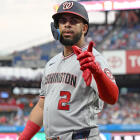
- Aside from Crow-Armstrong, there has been no hotter batter in June than the Nationals' Luis Garcia, who has homered 11 times for the month, including six times in his past seven games. A look under the hood reveals genuine growth for the 26-year-old, who's swinging 1 mph faster on average and hitting the ball 2 mph harder on average. Naturally, he has moved way up my rankings. He currently clocks 17th at second base, a surprisingly strong position, just behind Sam Antonacci. Why behind when he's now outpacing Antonacci, not to mention Casey Schmitt, who I rank four spots ahead? Well, you never want to rank a guy at his hottest. Even with genuine growth, Garcia won't sustain his June pace for the rest of the season. He also has the severe disadvantage of sitting against left-handers most of the time. He was out of the lineup as recently as Thursday and Friday because of it. By the way, if you think 17th at second base is low, I could only get Garcia as high as 31st at first base. That position is stacked.
- You know how I said you should never get too high or too low on Crow-Armstrong? The pitching equivalent is Sonny Gray, who has reiterated this many times over. I'll admit I was pretty down on him early. He was averaging just 4.8 K/9 through his first six starts, so while he was keeping his head above water, I feared a collapse was coming. But then he started emphasizing his sweeper again, which is far and away his best swing-and-miss pitch, and his K/9 rate has recovered to 9.7 in his past nine starts. The specifics don't really matter. Gray is a gamer who has always found a way over his 14-year career, even if it doesn't always look the same. I've moved him up from 40th to 30th at starting pitcher, ahead of George Kirby, Framber Valdez and Carlos Rodon.
- You know who else has dropped behind Gray? Gerrit Cole. Wow, has he looked different since coming back from Tommy John surgery. But actually ... not really. That's what's strange about it. The velocity, selection and movement of his pitches has been fairly normal (except for a sparsely used changeup), but the swing-and-miss has tanked. One of the best bat-missers of his era now has a 7.7 percent swinging-strike rate, which would rank fourth-to-last among qualifiers. I suspect this will normalize as he continues to shake off the rust, but I have no idea how long it'll take. Better to rank him alongside other troublesome pitchers like Freddy Peralta, Trey Yesavage and Kyle Bradish.
- For most of this season, and even dating back to his short time in the majors last year, Joey Cantillo appeared to have just one legitimate weapon, a changeup, and struggled to throw strikes consistently. His past two outings have introduced a harder curveball that he's spammed close to 50 percent of the time. The results have been eye-opening -- a 1.29 ERA, 0.64 WHIP and 11.6 K/9 between the two starts -- and exciting enough to make him a must-add across the board. Sustainability is obviously a major question, but the jump from 98th to 66th in my rankings is entirely justified.
- Speaking of substantive changes leading to immediate results, Sean Burke has been throwing his fastball 1-2 mph harder over his past three starts, and the result has been a 1.89 ERA, 1.05 WHIP and 10.4 K/9. Skepticism over whether he can keep it up is reasonable, but he's gone from afterthought to needing to be rostered in most leagues, putting him 75th in my starting pitcher rankings.
- Skepticism in Foster Griffin is rapidly diminishing as he wraps up a June in which he put together a 1.15 ERA in five starts, striking out nine over seven-plus innings in his final two. It's not that his overall 2.93 ERA is perfectly sustainable. It doesn't need to be for him to live up to my new ranking of 63rd. I do think, though, that when you break him down point for point, from the competent bat-missing (right around a strikeout per inning) to the plus control (2.3 BB/9) to the weak contact quality (87.7 mph average exit velocity), he comes out looking a lot better than his 3.89 xERA. I was saying this even before his big June, but it helped to bolster my belief.
- The doubts about Josh Hader way back on Draft Day went beyond just how much time he was projected to miss. The nature of his biceps injury, combined with some diminishing velocity in recent years, raised the question of how much life he has left in him. Suffice it to say he's put those concerns to rest, even though he hasn't regained any of the lost velocity, striking out 19 while allowing just two hits in his 12 innings of work. He's back in my top five at relief pitcher, ahead of notables like Raisel Iglesias, Aroldis Chapman and Andres Munoz.
- Endy Rodriguez hasn't fully overtaken Henry Davis as the top catcher in Pittsburgh, but he's well on his way. You need only compare the on-base percentages (.404 vs. .244) to deduce that much. Rodriguez has done more than just walk a lot, though. He's slugging .482, with an ISO in excess of .200, and is hitting the ball 92.3 mph on average, with a pull-air rate that's well in the red. He's showing real signs of a breakthrough, in other words, which isn't the biggest shock if you remember how he took the minor leagues by storm in 2022, slashing .323/.407/.590 with 25 homers across three levels. Injuries dealt him a blow soon after, and it may have taken him this long to get back to 100 percent. You don't need to bother with him yet in one-catcher leagues, but he's now my 18th-ranked player at the position, ahead of notables Salvador Perez and Yainer Diaz.