Fantasy Baseball Today: How Eugenio Suarez's return to Cincinnati could complicate Sal Stewart's 2026 outlook
Plus, why Great American Ball Park lifts Suarez's upside

51 days until Opening Day ...
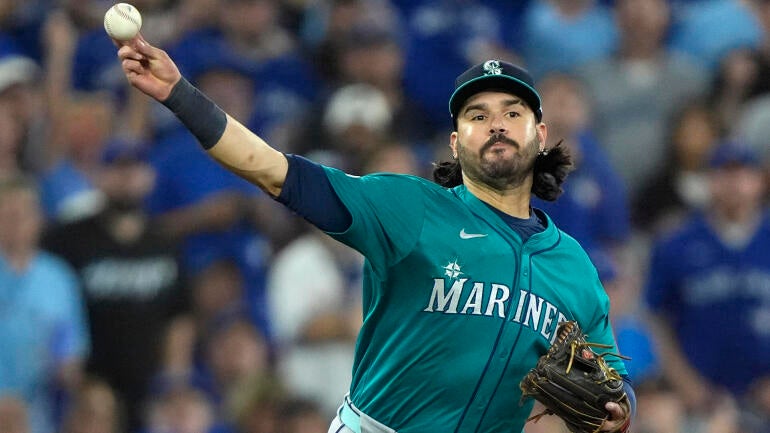
Eugenio Suarez has been one of the toughest players to rank in Fantasy Baseball this offseason, and he got harder to rank the longer he sat out there on the free-agent marketplace. We know Suarez can be one of the best power hitters in baseball, but we also know through two separate stints in Seattle that his value can be very dependent on his home park.
In the end, all that worrying was for nothing, as Suarez settled on a one-year deal to return to Cincinnati, where he first established himself as a star. And it's just about the best possible landing spot for his Fantasy value. Great American Ballpark is one of the three best hitter's parks in baseball, and based on Statcast data, it is the one he would have hit the most homers in for his career by far. Per Statcast's xHR stat, Suarez would have hit 346 homers if he played every game of his career in Cincinnati, compared to 313 for the next-best park and 264 for the average of the other 29.
This also isn't theoretical. Suarez spent the first half of his career in Cincy, and while it took him a few years to establish himself, he would go on to hit .250/.343/./496 with a 38-homer, 100-RBI pace over his final five seasons with the Reds. The Reds lineup itself is a bit iffy, but Suarez should provide a nice boost, and we can be pretty sure Great American Ballpark isn't going to hold him back, at least.
That doesn't mean Suarez comes without risk in 2026 drafts, of course. It just means that the risks aren't external. If Suarez is going to have a bad season, it won't be because his home park is holding him back, the way Seattle's T-Mobile Park clearly did in his two stints there, including at the end of last season.
The risk here comes from Suarez's age (he'll be 35 midway through the season) and his skill set. There's always been a lot of swing-and-miss here, and it's led to some ugly seasons even during his peak – in 2021, his final year during his first stint with the Reds, he hit .198/.286/.428 with 150 combined runs and RBI in 145 games, something even his 31 homers couldn't really overcome. And that was when he was 29.
That's why you shouldn't draft Suarez based on his 49 homers and 118 RBI from last season. He might do that again, and he might even do it with a .250-ish average, which would make him pretty easily worth a top-50 pick. But he might hit .228 with 30 homers and just not be worth the trouble, at least at that kind of price.
The answer, then, is to downgrade him a bit. He was the No. 40 player in Roto leagues last season, but you shouldn't draft him at that cost. But as the No. 75 player? He's well worth drafting around that price as the No. 6 third baseman in most drafts, and his move back to Cincy locks that up.
Unfortunately, it also locks up a bunch of playing time. That's not a bad thing for the Reds, who need competent hitters to help their lineup take the next step. However, this was already a team with some playing time questions, and they just got a lot more pronounced for one guy in particular: Sal Stewart.
Stewart is a popular sleeper/breakout pick for Fantasy, but with Ke'Bryan Hayes and Matt McLain expected to be locked in at third base and second base most days, Stewart's path to everyday at-bats just got a bit more unclear. He could still be the primary option at first base (and I would expect that to be the plan), but now he doesn't have the fallback of regular DH duty to lean on. It puts more pressure on his bat to play immediately, especially with Spencer Steer still around as a viable option at first base if Stewart doesn't hit.
Of course, if Stewart does hit, I don't think this will actually be an issue. He is potentially the team's second or third-best hitter, and while he has only played 38 games at Triple-A, it's not like he looked like he had much left to learn at that level – he hit .315/.394/.629 as a 21-year-old last season, which is impressive even for the inflated offensive environments of the International League. The best version of this Reds lineup is almost certainly one that features Stewart playing up to his highest potential, and they should give him that opportunity unless he absolutely flops in Spring Training.
Which is possible! There is certainly a bit more risk to drafting Stewart today than there was a few days ago. But there was always a risk that he would fall on his face and end up sent back to Triple-A. That risk is mitigated by his obvious talent, his positional flexibility – neither Hayes nor McLain should be viewed as a guarantee for 600 plate appearances given their deficiencies as hitters – and, most importantly, his cost. Stewart's ADP in 117 January drafts on the NFC platform was 203.4, and while that's not literally nothing, it's cheap enough that there just isn't much risk. He might bust at that price, but that price is cheap enough that it won't seriously impact your ability to win this season.
Which is to say: I still think Stewart is a fine sleeper. If anything, this move only figures to make him an easier pick, since it will likely serve to further depress his price. Stewart has 20-20 upside in this ballpark, and if he hits the way we expect him to, I think any questions about his playing time will disappear one way or the other. He has to make himself indispensable to the Reds, but if he does, there is significant upside here. More than enough to make him worth whatever downside risk might be there.
So, don't react to this move by taking Stewart off your sleepers list just yet. Maybe we'll hit a point this spring where the path to playing time just doesn't materialize, and we have to reassess the situation. But for now, Stewart remains one of the better cheap, high-upside picks you can make.