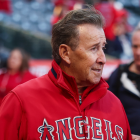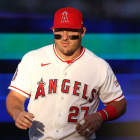


Outgoing Los Angeles Angels owner Arte Moreno earlier this week agreed to sell the franchise to Stan Kroenke for a reported sum of $4 billion. That sale price would be a record for a Major League Baseball team, coming in just ahead of the recent sale of the San Diego Padres for $3.9 billion. Amid the backdrop of the ongoing negotiations on a new collective bargaining agreement (CBA) -- negotiations in which owners and the league are pushing for a cap on payrolls -- this is a noteworthy development. Publicly, owners and MLB claim that a cap will improve competitive balance and parity, but there's other motivation: lowering labor costs and, the thinking goes, improving franchise values.
Consider, though, the case of the Angels and that $4 billion sale price. This is a franchise that:
- Recently clinched its 11th straight losing season;
- Hasn't made the postseason since 2014;
- Hasn't won a playoff series or even playoff game since 2005;
- Has employed seven managers since 2018;
- Has shed roughly half a million in paid attendance per year since 2019;
- Squandered the legendary peak of Mike Trout and the first six years of Shohei Ohtani's MLB career;
- Shares a general market with the industry-standard Dodgers;
- Plays in a 60-year-old ballpark.
And just to reiterate the above, the record-breaking transaction took place even as uncertainty over the next CBA imperils the 2027 season and as negotiations provide no assurances as to what the labor-management structure of the league will look like moving forward. This should not be the kind of environment and suite of circumstances that lead to a record-breaking sale, but the same could be said of the small-market Padres and their outsized payroll obligations. One might be tempted to suspect that MLB owners are doing just fine.
One might further be tempted to suspect just that when informed that Moreno purchased the Angels from the Walt Disney Company for a relatively paltry $180 million back in 2003. That means Moreno, in buying and then selling the Angels after more than two decades of ownership, realized an annualized return of roughly 14.4%. That return not only whips the usual stock market return; it's also higher than the estimated annualized returns realized on the sales in recent years of the Denver Broncos and Washington Commanders in the NFL and the Boston Celtics and Phoenix Suns of the NBA. Doing just fine, they are.
This is important because MLB owners have undertaken a bit of a whisper campaign in which they've complained that MLB franchises aren't selling for the "revenue multiples" that NFL and NBA franchises are. MLB franchises, though, aren't cash businesses. They're investment vehicles (which explains why so many hedge-funders are trying to get in on the act). And as investments, MLB franchises are doing very well when resold. Still, the internal belief -- or at least the belief that owners and ownership proxies are claiming to have -- is that not being in a capped league is keeping MLB franchises from reaching the revenue-multiple heights of the NFL and NBA, the leagues to which MLB is terminally addicted to comparing itself.
There are problems with that line of thinking, though. First, with the exception of the publicly traded Braves and Blue Jays, we don't know the financials of MLB teams. We don't know what their revenues actually are. That's especially the case these days, what with the abundance of team-owned (or gifted) real-estate developments surrounding ballparks and team-owned regional sports networks. Even before all that, teams could easily massage and distort their finances for public consumption and in order to sway opinion. Second, MLB already has a soft cap of sorts on payrolls via the Competitive Balance Tax, or CBT (non-technically and more accurately known as the Luxury Tax). In what remains a puzzling concession on the part of the MLBPA so many years ago, the CBT also doesn't have any kind of payroll floor, which wouldn't be the case with a capped system. Yes, the Dodgers regularly blow past the top CBT threshold, but their present revenue situation flows heavily from a legal bankruptcy wrinkle that almost certainly will never be repeated.
Beyond all that, any bearishness toward MLB franchises -- not that there's much evidence of such bearishness -- is much more likely to be a consequence of the league's fractured and scattershot media-rights platform, which, not coincidentally, commissioner Rob Manfred badly wants to address. Speaking of bearishness and the lack thereof, consider these figures:
- Padres: $3.1 billion
- Angels: $2.8 billion
Those are the 2026 Forbes estimates for the franchise values of the Padres and Angels, the two most recent sales in MLB. You'll note that each figure significantly lags the same-year sale price. Forbes does excellent work every year on this front, but forensic accounting has its limits, especially when finances are as opaque as MLB's are. Taken together, the Padres' and Angels' eventual sale prices were more than one-third higher than those valuations from not even six months ago. Draw your own conclusions as to how the market feels about the prestige and investment worthiness of owning an MLB franchise.
MLB and its owners will continue to cast the league as a troubled one desperately in need of a cap and, in the service of that, a labor war. However, you're free to follow the money -- particularly how much money has flowed from Kroenke to Moreno -- and see it for what it is. It's strong evidence that doesn't fit the notion that MLB and its constituent franchises are anything but healthy, lucrative, and coveted.