

September has arrived and games with postseason implications are being played every night around the league. Teams on the wild-card bubble are fighting for their seasons, others are battling for division titles and/or Wild Card Series byes, and some are auditioning young players with an eye on next season. It's a land of contrasts, this sport. Every team is playing for something different.
Here now are three trends worth keeping an eye on as we get into the regular season's final month.

Raleigh's better late than never adjustment


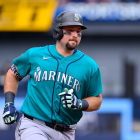
It took almost five months, but Mariners catcher Cal Raleigh is finally beginning to look like the player who finished second in the AL MVP voting last season. Monday's home run was Raleigh's sixth in seven games and eighth in 14 games. That barrage earned him AL Player of the Week honors last week. He'd hit eight home runs in his previous 65 games prior to this little hot streak.
Raleigh's recent power surge comes after adjusting his hand position at the plate. Specifically, Raleigh raised his hands up higher in his batting stance, creating better rhythm with his swing and a more direct path to the baseball. It's subtle, but you can see it here:
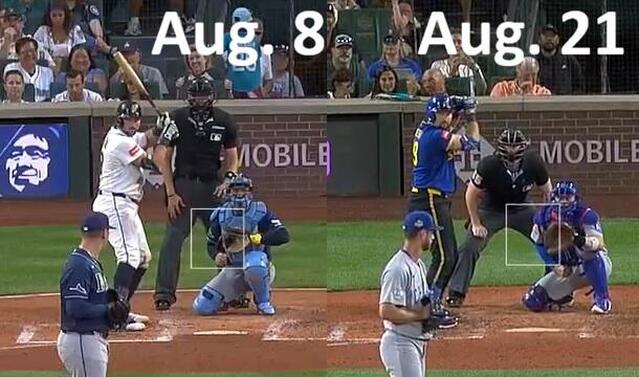
"I get (my bat into the hitting position) every time, but it's just, how early can I do it?" Raleigh told MLB.com last week. "I don't have to worry about getting it back on time. By being a little higher, a little more back, I'm a little more in that position from where I fire from. I don't really have to go searching or be on the perfect timing every time. I can have more room for error, for being on time for the fastball and a little more back on the offspeed."
The adjustment shows up most in Raleigh's in-zone contact rate. In his last 13 games, Raleigh has missed with 16.0% of his swings in the strike zone, which is exactly the league average. In his previous 13 games, it was 21.4%, and it's 21.5% for the season overall. Raleigh is making more contact with pitches in the zone. The home runs are a byproduct of that.
Going into Tuesday, the Mariners had lost five straight and 24 of their last 37 games. They're crashing and burning. Raleigh's adjustment and power binge is (probably) too late to save Seattle's season, but it at least looks like he's arrived at a solution. He can go into the offseason understanding what he needs to do and feeling good about things, not searching for answers. It's not nothing.
"Physically, I'm trying to get my hands back sooner, and I feel like I'm doing a better job of that," Raleigh told MLB.com. "And then mentally, it's just been about, like I said, that belief and just having that hope and that optimism every single day. Not getting too down, not getting too up, and trying to just be ready and prepared for the game."

Phillies cutting down on strikeouts
At 21-7, the Phillies had baseball's best record in August, and they're still very much in the NL East race. They went into Tuesday only four games behind the Braves in the loss column with seven important head-to-head games coming up. The division title could come with a Wild Card Series bye. Those seven games will be enormous for both teams and their World Series hopes.
The Phillies have been much better offensively the last few weeks. They hit .236/.303/.398 as a team and averaged 4.37 runs per game in the first half. Since the All-Star break, it's a .258/.336/.409 team batting line and 4.88 runs per game. Luis Arraez has been just OK since coming over the deadline. Alec Bohm, Bryce Harper, and Bryson Stott have led the way offensively of late.
The single biggest difference in Philadelphia's offense has been the reduction in strikeouts and overall swing and miss. Arraez, owner of baseball's lowest strikeout rate, has certainly helped in that department, though one player doesn't explain a team-wide improvement this significant:
| Phils 1st half | Phils 2nd half | MLB average | |
|---|---|---|---|
Strikeout rate | 23.5% | 18.9% | 22.1% |
Swing-and-miss rate | 26.3% | 22.7% | 25.1% |
Swing rate | 49.3% | 47.4% | 47.6% |
Chase rate | 33.6% | 31.3% | 30.4% |
An entire team shaving roughly four percentage points off their strikeout rate and swing-and-miss rate in-season is a remarkable turnaround. The Phillies are swinging and chasing out of the zone a little less often, too, which has helped, but, more than anything, they're simply getting the bat on the ball more often when they do swing. Perhaps it really is the Arraez effect?
"You see the change that he brings, and how guys go up to him and talk to him and ask him, whether it's hitting advice or just talk a little baseball and how he helps," lefty Jesús Luzardo told the Delaware County Daily Times about Arraez recently. "Whether it's me pitching and other guys pitching as well as the other guys in the lineup, I think he's been a huge help to us."
Another reason the Phillies are striking out less: fewer two-strike counts. Their hitters saw a two-strike count in 54.7% of their plate appearances in the first half. It's 51.5% in the second half. The MLB average is 52.7%. You can't strike out when you're not in a two-strike count. The Phillies have seen fewer of them the last few weeks, and their team strikeout rate has dipped accordingly.
The Phillies are at minimal risk of missing the postseason. The question is whether they're the NL East winner or a wild-card team. Either way, they have a chance to be a handful in October. Their top three starters are excellent (Luzardo, Cristopher Sánchez, Zack Wheeler), their closer is dominant (Jhoan Duran), and now the offense is clicking thanks to fewer whiffs and strikeouts.
"I definitely think that that can translate to the postseason," Bohm told the Daily Times. "Obviously everybody knows when we get deep into the postseason, we're facing the best arms on the planet. So I think being able to string stuff together and not just rely on one big three-run homer, and just kind of waiting and hoping for that, being able to grind out at bats, maybe get a starter out earlier, maybe force the bullpen into the game early and get a couple walks in and get a big hit instead of just relying on homers."

Angels improved under new coaching staff
The last few weeks have brought needed change to the Angels, who will officially extend the sport's longest postseason drought to 12 years in short order. GM Perry Minasian was let go in July and replaced by experienced interim John Mozeliak. In August, Mozeliak cut ties with pitching coach Mike Maddux and several assistants, citing insufficient use of modern tools. The analytically inclined Tim Leveque was installed as interim pitching coach.
"I think there was becoming some level of frustration with the inconsistency of that," Mozeliak said after Maddux was let go (via ESPN). "And so ultimately that's when we started thinking about, 'Do we need to make a change?' I do feel like we have a lot of great resources that we could be taking advantage of."
Since the changes to the coaching staff, the Angels have seen a marked improvement in their pitching performance both on the surface and under the hood, even after trading co-ace José Soriano for prospects at the Aug. 3 trade deadline. Here are the before and after numbers heading into Tuesday's action:
| Under Maddux | Under Leveque | |
|---|---|---|
ERA | 4.53 | 2.67 |
FIP | 4.29 | 3.38 |
xERA | 4.33 | 3.47 |
K/BB | 2.10 | 3.00 |
It's not a big sample at all (19 games under Leveque) and there is little chance the Angels have a true talent sub-3.00 ERA pitching staff, but there has been real improvement in the team's command of the strike zone (shown by FIP and K/BB ratio) and the quality of the contact they'ved allowed (shown by xERA, or expected ERA). Better process has led to better results.
The biggest change under the new coaching staff has been the decline in fastball usage. It's funny: velocity is at an all-time high, yet teams throw fewer and fewer fastballs each year because non-fastballs are harder to hit. The league is hitting .260 and slugging .415 against fastballs this season. It's .220 and .364, respectively, against breaking balls and offspeed pitches.
Under their old coaching staff, the Angels threw 49.2% fastballs, the ninth-highest rate in baseball. That's down to 42.4% with the new coaching staff, the fourth-lowest rate in baseball. The Angels have stepped out of the Stone Age and are now pitching the way successful teams pitch. Their new analytically inclined coaching staff has them moving in the right direction.
To be sure, the Angels deserve zero benefit of the doubt here. Maybe new owner Stan Kroenke will save the franchise, but we need to see it to believe it at this point. These last few weeks, though, are the first time in a long time that they look like a competent organization behaving in a way that is in line with the rest of the league. It's a sign of progress, even if only a small one.