

The St. Louis Cardinals, thanks in part to a 3-8 record in the second half, are facing a different kind of dilemma leading up to the Aug. 3 trade deadline in Major League Baseball.
The Cardinals emerged as surprise contenders this season despite the offseason trades of notable veterans like Brendon Donovan, Willson Contreras, Sonny Gray, and Nolan Arenado. The youth movement had arrived, the rebuild was on, and it was assumed, with good reason, that St. Louis under first-year president of baseball operations Chaim Bloom would not be especially relevant in the standings. Yet it has been for much of the season. It still is to a real extent, but that says more about the low bar for the third wild-card spot in the National League than it does the Cardinals. Monday night's home loss to the Cubs dropped them to .500 for the first time since April 13, when they were 8-8.
The Cardinals were never likely to be aggressive buyers leading up to this deadline because the focus remains on the long-term. There was, however, a "hold" path had the team continued playing well and entered deadline week better off than it presently is, which is 53-53 with a -5 run differential. Maybe there was even a way to push Bloom to soft buy and add an odd bullpen piece or two.
The present reality, however, is that the Cardinals are 9-15 in July and 13-21 since June 17, and that has put before them a different deadline question: sell or sell big?
It remains to be seen which path Bloom will take and how it will be received by a remaining roster that, as noted, still has designs on the postseason. The recent downturn, though, means it's probably a matter of degrees of selling rather than a question of selling at all. Given that reality, let's take a look at what the two paths might look like in St. Louis as Aug. 3 nears.
The basic sell
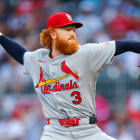
This path, which will almost certainly happen to some extent, chiefly involves moving right-handed starter Dustin May.


No, the top-line numbers seen above don't bellow "coveted deadline target" from the rooftops, but consider what lies beneath. After 20 starts, May boasts an FIP of 3.16, a figure that would rank 10th in MLB if May had a qualifying number of innings (note that he's just two innings shy of qualifying status at this writing). He's also added 1.5 mph to his average fastball velocity relative to last season and expanded his repertoire under the Cardinals' guidance. He now has four pitches that grade out as above-average offerings according to Stuff+. That's in addition to the fact that he has stayed off the injured list this season. Interested parties are going to pay much more attention to all of the above, which speaks to May's projectable value going forward, than they will his ERA. On top of all that, he's owed merely the balance of a $12 million salary for 2026, and his mutual option for 2027 is effectively meaningless.
Rentals such as May, who don't come with additional years of team control, tend not to command huge returns at the deadline, at least if they're not of the superstar variety. Perhaps, though, the looming uncertainty over collective bargaining agreement negotiations and what the 2027 season will look like (or if there will even be one) could increase the going rates for such players. If the Tigers, who still have realistic designs on a playoff push, opt not to trade back-to-back Cy Young winner Tarik Skubal, then that should strengthen May's market.
The other walk-year players of note are both veteran relievers: lefty JoJo Romero and right-hander Ryne Stanek. Romero is presently on the IL with appendicitis, but being on the IL -- especially when it's not an arm injury for a pitcher -- isn't necessarily an impediment to a trade. Romero, 29, over the last three seasons has an ERA+ of 142, and for his career, he's limited left-handed batters to an OPS of .587. As for Stanek, his overall 2026 numbers aren't especially strong, but he's been trending upward of late. He still has one of the biggest fastballs in the game, and he can still miss bats. Stanek's contract includes a $6 million club option for 2027. The Cardinals may not trade both of them because their bullpen has been spotty and somewhat shallow this season, but at least one of them figures to be dealt along with May.
The deeper sell
This is where we get into players under team control beyond 2026. If the Cardinals dip into this pool of tradables, then it's fair to think of Bloom's 2026 deadline work as being of the "deeper sell" variety.
The biggest name within this St. Louis cohort is probably that of veteran outfielder Lars Nootbaar.


Nootbaar, who turns 29 in September, missed much of the season after undergoing surgery on both heels. Since returning, though, he's improved upon his disappointing 2025 season and been in vintage form when it comes to getting on base, showing strong quality-of-contact indicators, and playing capable defense at all three outfield positions. Nootbaar at least can be a heavy half of a corner outfield platoon on a contending team, and he has two full seasons of team control remaining before he reaches free agency.
On another level, the Cardinals are likely ready to promote prospect Joshua Báez, who at the age of 23 leads the minors (by a wide margin) with 31 home runs in 90 games at Triple-A. If there's one sure way to sate a fan base frustrated by the trade of a popular veteran by Nootbaar, it's by swiftly replacing him with a ballyhooed prospect.
Elsewhere, the Cardinals are no doubt getting calls on All-Star closer Riley O'Brien.


O'Brien's light on track record, but in the end, he's a reliever who touches triple digits and has a swing-and-miss sweeper to go with strong groundball tendencies and closing experience. He's also not eligible for free agency until after the 2030 season. The Cardinals certainly aren't pressed to trade O'Brien, but he could fetch a worthy return.
Beyond Nootbaar and O'Brien, the Cardinals could also look to ease their organizational logjam at catcher by moving Pedro Pagés, Jimmy Crooks, or prospect Leo Bernal (top prospect Rainiel Rodriguez isn't going anywhere, and other teams may not view Iván Herrera as a catcher). As is the case with Nootbaar and O'Brien, however, these are all controllable names, and thus there's no immediate urgency.
That, rather than buy or sell, is the unknown for the Cardinals. Do they part with just the pending free agents and table other decisions until the winter, or do they do that and dip into their reserves of trade candidates with years of control remaining and further bolster their rebuilt farm system? We'll know soon enough how Bloom has decided to approach his first trade deadline as the Cardinals' lead decision-maker.