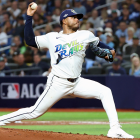
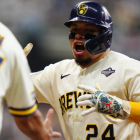
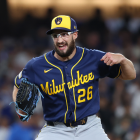
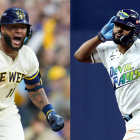
When the Tampa Bay Rays return home Monday for the first World Series game at Tropicana Field since 2008, they will give the ball to one of their shortest-tenured players. Right-hander Freddy Peralta, acquired from the New York Mets at the trade deadline, will start Game 3. It will be his first start since his stellar performance in Game 6 of the ALCS, which earned him ALCS MVP honors.
"It feels so good because the way that we've been working on the little things in general," Peralta said after Game 6. "Everybody, not only the pitching coach and all that, I mean everybody from the trainers, people that helped me to feel better with the massage and all that, it's been amazing. Great communication. They've been awesome with me. They've been giving the best of themselves to make me feel good on the field every day."
A year ago, Peralta led the league with 17 wins and finished fifth in the NL Cy Young voting with the Milwaukee Brewers, the team he will face as Tampa tries to mount a comeback from down 2-0 in the series. As they tend to do, the Brewers traded Peralta in the offseason, a year before he was scheduled to hit free agency. Peralta went to the Mets, disappointed, was traded to the Rays at the deadline, and has since surged.
| with Mets | with Rays | |
|---|---|---|
Starts | 22 | 10 |
Innings per start | 5.2 | 5.5 |
ERA | 4.99 | 3.25 |
WAR | 1.2 | 0.8 |
"His three months or four months in New York probably didn't go the way he wanted or the way he performed his first five years (in the league)," Rays manager Kevin Cash said before the World Series. "... I give Freddy a lot of credit for being a good pitcher and being vulnerable enough to say, 'I wasn't comfortable doing some things and I want to get back to my strengths.' He guided that through the entire two months he's been with us, and he took off in September and has continued to take off in October."
The Rays are as good as any team at taking a player, accentuating his strengths, and getting the best out of him. Peralta is no different. This isn't a case of a good pitcher having a few rough months and then getting his season on track. The Rays took Peralta into the lab and made several important changes that have led to this success.
Here's how Tampa fixed Peralta in their brief time with him after the trade deadline.
Mechanical changes
It starts with the delivery and introducing a common trait for Rays pitchers. They take away the full windup and have the pitcher pitch exclusively from the stretch. Ace Drew Rasmussen is the best example of this. Peralta might be the second best. As soon as the Rays got their hands on Peralta, they took away his windup and got him to pitch from the stretch to simplify things.
Here's how it looked before and after the change. This is the first pitch of Peralta's final start with the Mets, and the first pitch of his first start with the Rays (GIFs synced at release):
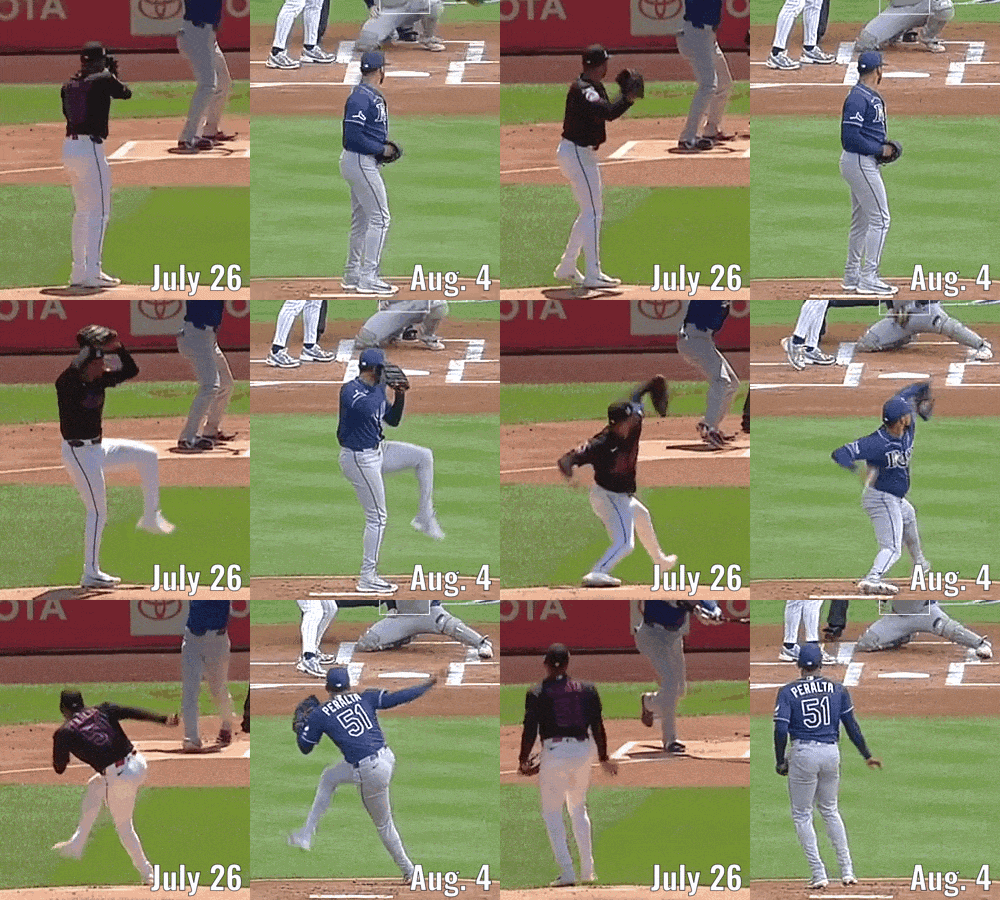
Pitching from the stretch improved many things for Peralta, including his command. Location+ is a metric that grades pitch locations not just on whether they're on the edges of the zone, but whether the pitcher puts that pitch in the right part of the zone. Is that four-seamer at the top of the zone? Is the changeup down and away? You won't score well for hanging a slider just because it's a strike.
Peralta posted a solid 104 Location+ with the Mets, which is comfortably above the 100 MLB average. With the Rays, it jumped to 111, which is better than his 2025 rate (108 Location+) and would have been one of the highest marks in the game for the full season. Peralta went from good location with the Mets to great location with the Rays, thanks in part to his new delivery.
The Rays also helped Peralta raise his arm angle a bit, something that is very difficult to do in-season and an adjustment pitchers usually work on in the offseason or Spring Training. He also added extension and drive toward the plate, meaning he's getting further down the mound and releasing the ball closer to the hitter.
| Arm angle | Extension | |
|---|---|---|
2025 | 38 degrees | 6.8 feet |
with Mets | 33 degrees | 6.5 feet |
with Rays | 35.3 degrees | 6.7 feet |
With the added extension and higher arm angle came more velocity and more vertical break on the fastball, which is "life" up in the zone. The Rays took away his windup, but they did not create an entirely new Peralta. They simply got him back to the 2025 version of himself, and it all starts with the delivery. Pitching from the stretch has allowed him to execute at a much higher level.
"When I got here, when I sat here with (pitching coach) Kyle (Snyder) and (bullpen coach Jorge Moncada) and Cash, they told me, 'You're gonna do what you want to do here, and we are going to help you to do it. And we know what you need to do to make those adjustments,'" Peralta told MLB.com in September. "We just put everything on the table. I just followed all the instructions, and it's what I am right now."
Pitch selection
In addition to the mechanical changes, the Rays also tweaked Peralta's pitch mix, specifically getting him to use his changeup more often. This is a Rays staple. Their pitchers threw an MLB-leading 20.6% changeups in 2026. The next team, the San Diego Padres, threw only 16.3% changeups. The gap between No. 1 and No. 2 was the same as the gap between No. 2 and No. 13.
Peralta's changeup usage jumped from an already healthy 20.8% with the Mets to 29.7% with the Rays. Against right-handed batters specifically, it jumped from 15.8% to 22.2%. Same-side changeups are another Rays specialty. Usually, you throw changeups to hitters on the other side of the plate, but not Tampa. They love same-side changeups and Peralta has bought in.
| with Mets | with Rays | |
|---|---|---|
Fastball | 53.4% | 52.1% |
Changeup | 20.8% | 29.7% |
Curveball | 14.7% | 12.1% |
Slider | 11.1% | 6.1% |
Between the combination of swings and misses and weak contact, the changeup is Peralta's best-performing pitch, so the Rays have him throwing it more often. "Throw your best pitch more" is a pretty simple concept, but not always something pitchers and teams will adhere to. The Rays got Peralta to pull back on everything else, throw more changeups, and the results have followed.
"We were trying to make adjustments," Peralta said Saturday about his time with the Mets. "We knew, we understood, and we spoke with each other about it. I remember that we were doing the right thing because we were preparing in the right way, but we couldn't do what we were supposed to do."
How much has Peralta improved, really?
There are some elements of Peralta's performance with Tampa that likely would not continue across a full 162-game season. That isn't to say he's been lucky -- I hate that term -- but baseball is a game of ebbs and flows, and right now Peralta is riding a wave in which the outcomes have gone in his direction. Over time, they would likely even out, but they haven't yet.
Here are some more numbers:
| with Mets | with Rays | |
|---|---|---|
xERA | 3.86 | 3.74 |
BABIP | .313 | .232 |
HR/FB% | 13.0% | 7.8% |
Expected ERA (xERA) estimates a pitcher's ERA and factors in contact quality allowed (exit velocity, etc.), and it views Peralta as basically the same pitcher with the Rays as he was with the Mets. Despite similar contact allowed, he's given up way fewer hits on balls in play (BABIP) and fewer home runs on fly balls (HR/FB%). By comparison, Peralta had a .243 BABIP and 10.4 HR/FB% in 2025.
You would expect Peralta to have a lower BABIP with the Rays than with the Mets for two reasons. One, the Mets were a poor defensive team this season. It was appaulingly bad at times. The Rays rate as an above-average defensive team, especially in the outfield. Peralta has a low BABIP with the Rays in part thanks to his teammates, who are great at catching the baseball.
"That's a huge part, man," Peralta said about Tampa's defense Saturday. "Sometimes I face hitters that I understand in the moment that I have to -- OK, I tell myself, just whatever I'm going to throw, just put it in the zone. Just looking for the hitter to hit the ball because I know and trust all the guys I have behind me, and it's been working pretty well. I just trust them."
The HR/FB% rate is more difficult to explain. Tropicana Field is more home run-friendly than Citi Field, per Statcast's park factors, plus Peralta made road starts at Coors Field, Citizens Bank Park, and Sutter Health Park in Sacramento with the Rays. He pitched in some home run-happy parks yet gave up fewer homers. Peralta may have caught some breaks in the home run department.
Ultimately, none of this matters right now. It has no bearing on how Peralta will perform in Game 3 or a potential Game 7. His BABIP and HR/FB% rate are not guaranteed to regress back to his true talent level this week. They were low during his stint with the Rays, yes, but it happened and it helped Tampa win games. Now he and the Rays just need to continue for another start or two.
"I love that kid, man, I just do," Brewers manager Pat Murphy said about Peralta before that World Series. "If you're around him every day, like this kid is just joyful. It's just a beautiful spirit that comes to do his job. He doesn't look at himself as better than others. He's just a great teammate. If you can't be around him for a while and not feel warm ... Just a matter of time before Freddy broke through because he was great for us for so many years."