
Kyle Tucker contract: Breaking down Dodgers deal details, including opt outs and deferrals
Kyle Tucker is signing a deal with the Dodgers that has the highest present-day average annual value in MLB history

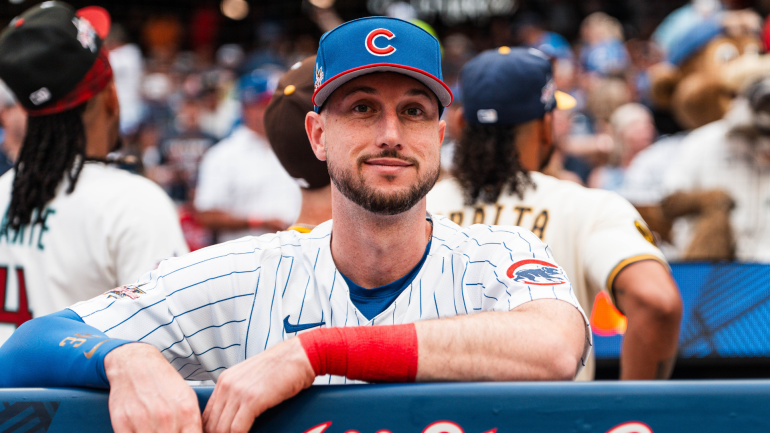
The rich have once again gotten richer. On Thursday night, the Los Angeles Dodgers and top-ranked free agent Kyle Tucker agreed to a massive four-year contract worth $240 million. There are a modest $30 million in deferrals, per The Athletic, broken down into $10 million per year from 2027-29, as well as a $64 million signing bonus, according to ESPN. The deferrals lower the present-day value down to $57.1 million per year, otherwise it would have been a record $60 million annually. Tucker can opt out after the 2027 and 2028 seasons.
Tucker reportedly had a 10-year offer at unknown money on the table from the Toronto Blue Jays, but he instead took a short-term, high-dollar contract with the two-time defending World Series champions. Here are the highest average annual salaries in baseball history:
- Kyle Tucker, Dodgers: $57.1 million (after deferrals)
- Juan Soto, Mets: $51 million
- Shohei Ohtani, Dodgers: $46.1 million (after deferrals)
- Max Scherzer, Mets: $43.3 million
- Justin Verlander, Mets: $43.3 million

The Mets offered Tucker four years, $220 million, according to the New York Post. In the end, Tucker took more dollars on a similar short-term deal from the team that has won the last two World Series and doesn't have questions about clubhouse chemistry hanging over its head. Not hard to understand why the Dodgers won this bidding war, though I'm sure passing up Toronto's reported 10-year offer was a difficult decision.
Last week, we examined what a short-term contract for Tucker could look like. Alex Bregman's three-year deal worth $40 million a year with the Boston Red Sox, which included opt outs after each year, felt like the floor for Tucker, and he beat that handily. He's two years younger now than Bregman was when he signed with Boston, and he's coming off a better year (4.5 WAR vs. 4.2 WAR). Here's what we wrote about the Dodgers being a potential landing spot for Tucker last week:
It's definitely not great for the rest of baseball that Tucker aligns almost perfectly with what the two-time defending World Series champions need. Specifically, they must improve their outfield defense and they need another middle-of-the-order bat. A short-term arrangement with Tucker would also keep a path clear for top prospects Josue De Paula and Zyhir Hope down the line. The Dodgers offered Bryce Harper a four-year, $180 million contract back in the day. Why not try something similar with Tucker?
Tucker is the eighth nine-figure contract on the Dodgers roster, joining Ohtani, Mookie Betts, Freddie Freeman, Tyler Glasnow, Will Smith, Blake Snell, and Yoshinobu Yamamoto. Add in the Edwin Díaz signing earlier this winter, and Los Angeles is up to a $398.6 million competitive balance tax payroll for 2026, per FanGraphs. That is actually a bit below last year's $417.3 million mark, which led to a record-smashing $169.4 million CBT bill. Point is, this is once again a $500 million roster between payroll and tax.
Including deferred payments owed in the future, the Dodgers have over $2.1 billion in contracts on their books at the moment. They can thank Ohtani and his unmatched revenue-generating ability for that, plus winning pays for itself. The Dodgers have been very good for very long, and they have two straight years of World Series revenue coming in. It is true that not every team (no other team?) could spend this way. It also true few other teams would spend this way if they had the chance. No team invests in its roster like Los Angeles.