Anfernee Simons trade grades: Celtics earn 'B' for landing Bulls' Nikola Vučević
The Celtics take a step toward ducking the luxury tax while adding a big man

By
Sam Quinn
•
4 min read
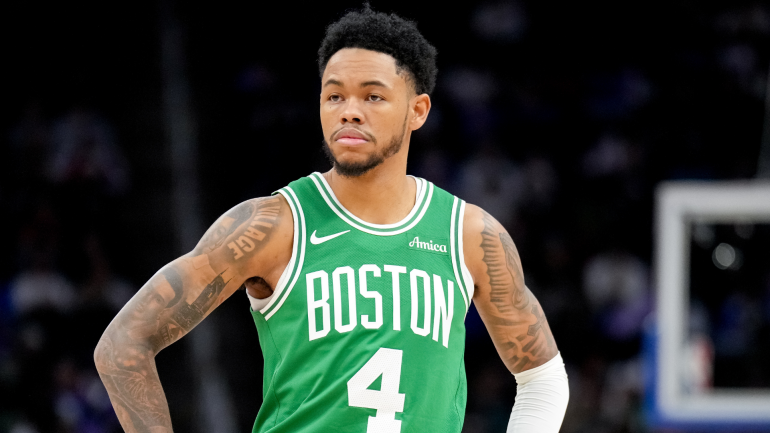
The Boston Celtics are trading Anfernee Simons and a second-round pick to the Chicago Bulls for Nikola Vučević and a second-round pick, according to ESPN. The deal is the latest in a string of trades the Bulls have made at this year's deadline (follow live updates here), as Chicago has not only added Mike Conley and Jaden Ivey, but taken on money for multiple teams in exchange for draft capital. Boston, meanwhile, addresses its meaningful hole at the center position with a former All-Star that fills in a stylistic gap left behind by Al Horford and Kristaps Porziņģis, and in the process, took a step towards reaching its financial goals.
So, how'd these teams do in the deal? Let's grade the trade.

Boston Celtics: B
Let's start with the obvious: the Celtics needed center depth. While Neemias Queta has thrived as the starter this season, Luka Garza was not going to cut it in the postseason. Enter, Vučević. While his defensive vulnerabilities have been problematic in the playoffs in the past, he'll likely have an easier time with the Celtics because of their defensive infrastructure and the fact that he'll likely be in a smaller role.
He is, critically, a stylistic curveball from Queta. Boston has thrived with shooting centers in the past, and while Garza has been playable for them this season, he's not Al Horford or Kristaps Porziņģis. Vučević is a much more reliable option as a shooting big man, and his presence allows the Celtics to toggle their playing style pretty readily. Queta is a rim-protector, a screener and a rim-roller. While neither he nor Vučević are complete big men, they do different things well and off Boston some needed variety. The duo should complement one another very well, though they'll likely never play together.
The deeper implications of this trade, however, are financial. The Celtics entered Tuesday around $12 million above the luxury-tax line. Getting below the line this year would be extremely meaningful to Boston moving forward. The Celtics are a repeater tax team. If they can duck the line this year and next, they'll reset the repeater clock entirely. Considering how punitive the repeater tax is and how pricey keeping this team together (and adding to it) will likely be, resetting that clock is going to mean a ton moving forward.
The Celtics didn't do that fully here. They got about halfway home. As of right now, the Celtics are $5.9 million above the tax. Using Simons to clear the first $6 million or so is a start. The next $6 million, however, is much harder. Boston doesn't have bad money to dump. More than half of their roster makes less than $3 million. They could find some savings by trading some of their minimum players and replacing them with pro-rated minimum free agents, but it's hard to imagine them saving $6 million that way. That's why Jusuf Nurkić had been a popular hypothetical Boston center target. Though he makes plenty, the gap between his salary and Vučević's is big enough that the Celtics would have had a pretty straightforward map to ducking the tax afterward. Realistically, there are two paths to doing so now: trading Sam Hauser, or re-trading Vučević.
For now, we have no indication that either move is in the offing. Hauser is a beloved, homegrown reserve and Vučević actually addresses a need for them. If the Celtics don't make a follow-up trade, they've at least set themselves up to add another player. The Celtics are now below the first apron, at least. That means they are allowed to sign a free agent who was making more than the non-taxpayer mid-level exception when he was waived, or, in layman's terms, a buyout player. There isn't an obvious target out there now, but with the blockbusters flying left and right, it's entirely possible that some helpful veteran finds himself on the market, and the Celtics could use their newfound flexibility to add that player. Still, the priority should be ducking the tax.
Losing Simons stings. Though he started out the year slowly, he was finding his footing in Boston after spending most of his career on Portland teams that weren't true contenders. They'll miss his scoring, but if Jayson Tatum comes back, well, that's an easy replacement. Ultimately the Celtics were unlikely to pay Simons for the long haul, so as much as it stings to lose him from this year's team, it was a price they needed to pay in order to secure a center and start the process of ducking the tax.

Chicago Bulls: B-
The broad concept makes sense for Chicago. They're also getting a good second-round pick in the deal (Chicago will reportedly get the most favorable of the Pelicans, Blazers, Knicks and Wolves second-round picks this June). The Bulls are going nowhere this season. Sure, they'll probably earn their obligatory Play-In berth, but their ambitions, for now, don't go much further. So Chicago has wisely decided to use this deadline to act as a financial facilitator, and the team has broadly done well in that role thus far.
The draft capital the Bulls have accumulated is small, but it adds up. The real prize so far was their addition of Jaden Ivey in a trade with Minnesota and Detroit earlier Tuesday, but we're not grading that deal here. Overall, this is just a smart use of resources. The Bulls aren't forcing win-now moves and they're not being stingy with tier cash. They're making the most of what they have, and will likely continue to do so with a Coby White trade before the deadline. Good overall work.