The pros of Lakers' LeBron James era outweigh the cons, despite Jeanie Buss' reported frustrations
Jeanie Buss was reportedly frustrated by some of the actions of the Lakers superstar

By
Sam Quinn
•
7 min read
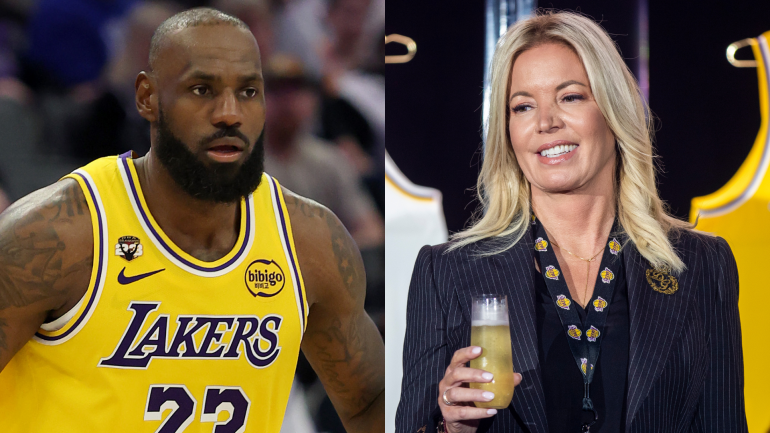
Among the many, many revelations from the reported feature this week by ESPN's Baxter Holmes on the Succession-esque family feud engulfing the Los Angeles Lakers for was that team governor Jeanie Buss has been harboring a fair bit of resentment toward LeBron James, the player singularly responsible for pretty much every good thing that has happened for the team since she became governor.
According to Holmes, Buss "privately grumbled" about James' "outsized ego and the overt control that he and Klutch Sports, which represents both James and Anthony Davis, exerted over the organization at times." She disliked that James was considered the team's "savior," she "privately bristled" about a lack of accountability from James for his part in the disastrous Russell Westbrook trade, and she felt that James did not show enough gratitude for the team drafting his son, Bronny, in 2024. At one point in 2022, Buss even reportedly considered trading James to the Clippers or denying him a contract extension.
Buss has since issued a public statement on the reporting. "It's really not right, given all the great things LeBron has done for the Lakers, that he has to be pulled into my family drama," Buss said. "To say that it wasn't appreciated is just not true and completely unfair to him."
What makes all of this so interesting, though, is that, to an extent, Buss' reported grievances were entirely valid. They were also, frankly, ridiculous. So let's take this as an opportunity to discuss what employing LeBron James actually entails, for better or for worse. Many, many elements of doing so are probably immensely frustrating for the team in question. It is also, without any remote question, worth the trouble.
LeBron James is the face of player empowerment. He kicked off that era of NBA history when he went on television to announce he was signing with the Miami Heat, but it's been the story of his entire career. He tried to get Erik Spoelstra, who has since gone on to become a Hall of Fame-caliber coach, fired less than a quarter of the way through his first season in Miami. He signed only short-term contracts with Cleveland in order to pressure the Cavaliers into the most aggressive possible roster-building maneuvers and when they didn't live up to those desires he publicly campaigned for them to do so through the press.
That's a posture he's maintained with the Lakers, who, not coincidentally, have frequently targeted players he's wanted (most notably, Westbrook) or clients who share his agent, Rich Paul. At one point, the two parties were so intertwined that Paul publicly referred to the Lakers as "us" and when pressed about why he'd do that despite representing players across the league, he responded by saying "I've got six guys on the team," before shaking his head and adding "c'mon."
Employing LeBron James means giving LeBron James input. That's just part of the deal. Sometimes, that input is welcome. Anthony Davis would not have been a Laker without LeBron's recruiting. Other times, it's detrimental. The Westbrook trade is the obvious example. The Heat went out of their way to trade up to draft Shabazz Napier in the 2014 NBA Draft because James called him "his favorite player in the draft." James proceeded to leave the Heat, and Napier had a forgettable career. James is, by any estimation, a basketball genius. That has not given him infallible roster-building instincts.
Davis was a home run for the Lakers. Many of the Klutch clients they added afterward were not. The decision to break up their championship center tandem in 2020 in order to sign Montrezl Harrell didn't pan out. The Lakers still regret paying Talen Horton-Tucker in 2021 only to let Alex Caruso leave for similar money, though in fairness, there was no cap mechanism preventing them from signing both, just cheapness on the part of Buss. And this doesn't account for the intangible effects LeBron's power can have on an organization. Remember when the Lakers got blown out in Indiana right before the 2019 trade deadline as fans chanted "LeBron's gonna trade you" at his young teammates? That's drama teams don't want to deal with.
And yet, it's drama that any team would be lucky to deal with. Why? Because it means you get to have LeBron James on your team. This isn't complicated. There is virtually no degree of drama or dysfunction that outweighs the benefits of having arguably the greatest basketball player who has ever lived leading your team. The proof is in the pudding here. Every team James has ever played for has won a championship. The Cavaliers and Heat wouldn't trade those banners for everything.
There's a segment of Lakerland that likes to pretend that James "only" winning a single championship in Los Angeles means that he somehow hasn't been worth everything that comes with him. That's Lakers exceptionalism at its finest. Go ask the Jazz or Pacers or Magic or Suns what they'd be willing to tolerate to win a single title. The fact that the Lakers had 16 of them before James arrived doesn't diminish the 17th.
That's part of what makes this story so ridiculous. You don't get to be frustrated with the price you paid for that 17th banner when you never would have hung it without doing so.
Jeanie Buss took over the Lakers in 2013, when her father, the legendary Dr. Jerry Buss, died. In the five full seasons she presided over that did not include James, the Lakers went 126-284 and never made the playoffs. They tried recruiting other stars. Nobody wanted to play for them. Their first pitch with LaMarcus Aldridge went so badly that they had to scramble for a second one just to save face. Their brand had fallen so hard by 2016 that Kevin Durant didn't even grant them a courtesy meeting.
This was not all Jeanie's fault, of course. Her brother Jim was running basketball operations alongside Mitch Kupchak for most of that period. She fired them and replaced them with Magic Johnson, who quit out of nowhere two years later and publicly blasted his replacement, Rob Pelinka, who has, at best, been a below-average general manager ever since. The news from Holmes that Buss had paid out large bonuses to members of her inner circle upon the sale of the team was hardly a surprise for anyone that has followed this team closely under her stewardship. The Lakers have never beaten the family business allegations. Rumors of an unclear organizational hierarchy and basketball decisions being made by Buss cronies with questionable credentials have been a constant.
The job of an owner is to build an organization that is capable of sustainably winning, that empowers the right people to make sound decisions guided by a clear, agreed-upon long-term plan. Buss has been running the Lakers for more than a decade now, and with James or without, she hasn't done so. The Lakers were a mess a decade ago. They are a mess today. And they'll probably remain a mess until new owner Mark Walter cleans house and installs his own people like he did for his dynastic Dodgers.
Were things perfect during the James era? No. As we covered, quite a bit went wrong and James is responsible for plenty of it. But when you hear that the Lakers are frustrated with how much control James and Klutch Sports exert over the team, ask yourself whom you'd trust more to wield that control: the guy who made nine NBA Finals in the 10 years before joining your team, or the people who took over a franchise that had won 10 titles in three decades prior to their ascension only to then park that blue ribbon franchise in the lottery?
If LeBron James hadn't signed with the Lakers, they likely would have gone down the path that the New York Knicks did prior to the hiring of Leon Rose: desperately flailing for years, failing to lure stars, utterly directionless. Virtually every good thing that has happened for the Lakers since 2013 can be tied to James in some way. They had Anthony Davis because he recruited him. They have Luka Dončić because they had Davis. Maybe James could have shown more gratitude after the Lakers spent a late second round pick on his son. The Lakers owed him far more for pulling them out of the gutter when no one else would.
All of this is essentially why the player empowerment era was possible. Both players and owners are capable of creating and sustaining organizational dysfunction. The difference is that players are capable of making up for it on the court while owners can't. For all of the drama James has brought the Lakers, he's more than made up for it with his production in purple and gold. Buss, nor any other owner, can say the same. James really was the savior for the Lakers in 2018. He saved them from dysfunction that Buss at best enabled and at worst created. Now the hope is that Walter, with his sterling track record with the Dodgers, can save them by erasing that dysfunction altogether.