

Every few years, we get to November wondering how a quarterback nobody was talking about over the summer suddenly became a first-rounder.
- Joe Burrow wasn't a first-round prospect entering his final season at LSU; in fact, he had to transfer out of Ohio State because Dwayne Haskins beat him out for the starting job.
- Jayden Daniels wasn't viewed as a future No. 2 pick before his second year at LSU, and like Burrow, he had to transfer to even get that chance.
- Daniel Jones entered his final season at Duke with virtually none of the hype that follows a future top-10 selection. Eight months later, the Giants took him sixth overall.
Burrow, Daniels and Jones didn't take the same path to the first round, but their eventual landing spots would've been difficult to predict before their final college seasons. That got me wondering whether we're looking at this the wrong way: Instead of arguing every summer about which well-known name should be QB1, could we identify the quarterbacks most likely to become first-round picks before everyone else catches on?
That's the question I wanted to answer with the 2027 class. I went through every draft class back to 2015 and looked at the quarterbacks who made big late-career jumps, the supposed first-rounders who slipped and the strange cases where the league's evaluation ultimately went somewhere the numbers didn't. Then I went back to my 2027 notes to see where the history matched what I'd seen on tape -- and, maybe more importantly, where it didn't.
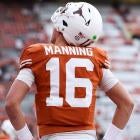
For context: Based on my summer scouting, Dante Moore and Arch Manning are my top two quarterbacks, and both carry top-five grades on my overall board. Brendan Sorsby and Julian Sayin round out my current first-round quarterbacks, followed by Jayden Maiava and Darian Mensah early in Round 2. That's the scouting baseline for our purposes here. Now let's see what history thinks.
let's go! pic.twitter.com/N7sdDJ1Y8I
— ryan wilson (@ryanwilsonCBS) July 10, 2026
Also: Ran Carthon, my co-host on the "With the First Pick" podcast, and I have already done deep dives on our favorite quarterbacks in the 2027 draft class, and you can check that out below:
Meet FRED: Our First-Round Readiness Score
I built a model around the question I really wanted to answer: How close is a quarterback to looking like a future first-round pick? The result is the First-Round Readiness Score -- or FRED, for short.
FRED looks at the things that have historically separated first-round quarterbacks -- passing efficiency, touchdown and interception rates, QBR, experience and, importantly, a quarterback's best three- and five-game stretches.
The idea isn't to predict whether he'll succeed in the NFL; it's to measure how much his college performance, at that point in his career, resembles what we've historically seen from future first-round picks.
The scale is intentionally easy to read: 50 is the historical first-round threshold. But for what we're trying to learn here, when a quarterback gets there may be just as important as whether he gets there at all. The most revealing FRED score turned out to be the one before his final college season because it tells us which quarterbacks had already started playing like future top picks with another season still to go.
And here's where FRED gets interesting: 22 quarterbacks in our historical sample had played enough football to reach a FRED score of 50 before their final seasons. All 22 became first-round picks. That doesn't make 50 a magic draft grade -- and we'll get to the exceptions in a minute -- but the timing matters.
One quarterback in the 2027 class is already there. Ohio State's Julian Sayin leads the way at 55.3, followed by USC's Maiava (43.4), Oklahoma State's Drew Mestemaker (40.4), Miami's Mensah (39.4) and Sorsby (35.4). For perspective, Patrick Mahomes was at 55.7 entering his final season at Texas Tech, Burrow was at 58.6 before his 2019 breakout and Josh Allen was at 51.6 for Wyoming. Most recently, Daniels was at 49.5 before his Heisman campaign.
I'll occasionally use one other number: Historical First-Round Probability, which looks across a quarterback's broader college résumé. Think of it as a second opinion; for identifying who may be on the verge of making the leap, FRED is the headline number.
How developed were recent QB classes before their final seasons?
| Draft class | Best preseason FRED scores | Top-3 avg. | QBs ≥50 | Eventual Round 1 QBs |
|---|---|---|---|---|
2020 | Tua Tagovailoa (87.1); Jordan Love (61.2); Joe Burrow (58.6) | 68.9 | 4 | 4 |
2022 | Kenny Pickett (54.4); Sam Howell (29.2); Matt Corral (17.1) | 33.6 | 1 | 1 |
2024 | Caleb Williams (79.5); Drake Maye (78.0); Bo Nix (68.8) | 75.5 | 5 | 6 |
2025 | Jaxson Dart (54.7); Dillon Gabriel (39.4); Kyle McCord (38.9) | 44.3 | 1 | 1 |
2026 | Fernando Mendoza (55.7); Cade Klubnik (36.4); Carson Beck (21.2) | 37.8 | 1 | 1 |
2027 | Julian Sayin (55.3); Jayden Maiava (43.4); Drew Mestemaker (40.4) | 46.4 | 1 | ? |
That's what makes this class so interesting. The top three QBs have an average FRED score of 46.4, third among the six classes in the table above, and actually ahead of the 2025 and 2026 groups. But there's still a sizable gap between them and the loaded 2020 and 2024 classes, which entered their final college seasons with top-three averages of 68.9 and 75.5. Sayin has already crossed 50, but Maiava and Mestemaker haven't. So this isn't quite 2022, but it isn't 2020 or 2024, either.
There is an important distinction: Ty Simpson isn't missing from the 2026 row because his score was bad; he just hadn't played enough snaps to have a meaningful FRED score. Kyler Murray is an even more extreme example. He entered his final Oklahoma season having attempted just 18 passes over the previous two years, then won the Heisman and went No. 1 overall.
Not enough information isn't the same thing as a low score. That's important when we're trying to figure out young quarterbacks such as CJ Carr, but it's much harder to use as an explanation for experienced players who remain well below 50.
FRED isn't magic -- and Cam Ward proved it
All 22 quarterbacks in the historical sample who reached 50 before their final seasons became first-round picks. But the 22-for-22 finding sounds almost too clean, so I tried to break it.
And ... I found three exceptions, although all three were right on the doorstep. Daniels was at 49.5 before his final season, Zach Wilson was at 48.9 and Josh Rosen was at 48.5. All three became first-round picks, though only one appears to have the makings of a franchise quarterback.
FRED still can't tell us whether NFL teams believe the traits, age, competition, medical history and everything else about a player should put him in the first-round conversation. But it's a pretty good indicator. Daniels, Wilson and Rosen didn't clear 50, but they didn't miss by much. That's a much different starting point than a quarterback entering his final season at 10 or 20 and needing to make the kind of leap Cam Ward eventually did.
Ward is the real reason 50 can't be treated as a magic number.
Ward entered his final college season with a FRED score of 6.8. His Historical First-Round Probability was only 18.3%. Put simply, his body of work to that point looked very little like that of the quarterbacks who historically became first-round picks. Then he transferred from Washington State to Miami, and everything changed.
| Cam Ward | Wash St. (2023) | Miami (2024) | Change |
|---|---|---|---|
FRED | 6.8 | 49.3 | +42.5 |
Adjusted YPA | 8.1 | 10.4 | +2.35 |
QBR | 62.7 | 84.0 | +21.4 |
Offensive SP+ | 31.0 | 44.2 | +13.2 |
Ward didn't just put up bigger numbers at Miami. His passing efficiency jumped, his QBR exploded and the offense around him improved dramatically. Bill Connelly's Offensive SP+ (which measures an offense's efficiency while accounting for the quality of the opponents it faced) jumped from 31.0 at Washington State to 44.2 at Miami. That moved Ward from an offense well below what we typically see around first-round quarterbacks to one comfortably within that range.
His FRED score jumped, too. And the scouting notes filled in what the numbers couldn't: arm talent, creativity, pocket movement, throws from different platforms and a quarterback whose game appeared to be maturing. Ward never reached 50, but he showed Tennessee enough on tape to make him the No. 1 pick -- and it was absolutely the right decision.
That's the exception worth remembering with this class. A low starting point isn't a death sentence, and Ward is proof that a quarterback doesn't have to reach 50 for the NFL to ultimately see a first-rounder. But he also shows just how much has to change when a quarterback enters his final season nowhere close to it. A quarterback sitting at 5 or 10 doesn't need a nice season. He needs to make us rethink the player we thought we were evaluating in August.
So who should we be watching in 2027?
My big board starts with Moore and Manning, but history is much more interested in Maiava. Moore's FRED score is 19.2, while Manning is at 3.2 (you read that right).
Maiava is already at 43.4, second in the class. His 0.38 EPA per dropback is already above the 0.35 median for historical first-round quarterbacks, and his broader Historical First-Round Probability is 54.3%, first in the class. The USC quarterback hasn't reached 50 yet, but history says the arrow is pointing up for the upcoming season.
That doesn't make me ready to put Maiava ahead of Moore. The tape is why Moore is my QB1, and it's as good as anyone's in the class. His deep big-time-throw rate ranked in the 99th percentile, and his 38.3% Deep Alpha Rate -- essentially the percentage of his deep throws that resulted in a completion or big-time throw -- ranked in the 100th percentile.
But his second-read passing grade was only 63.5, and his pressure grade fell to 51.0 compared with 92.6 from a clean pocket. Moore also finished at 0.21 EPA per dropback and 7.9 adjusted yards per attempt, both below the 25th-percentile marks for historical first-round quarterbacks.
His path isn't simply getting his EPA to, say, 0.35. It's showing he can more consistently maintain that high-level play beyond his first read and when the pocket isn't clean -- two areas where the tape hasn't yet matched what we see from him at his best.


With Manning, the disconnect is even more pronounced. In my notes, I saw a quarterback who navigates the pocket as well as anyone in the class, throws comebacks and deep hinges with anticipation and creates outside of structure -- and he was noticeably better at all three over the second half of the season.
Early on, though, he played hurried in the pocket, skipped reads and rushed throws, and made enough head-scratching decisions to leave you wondering what all the hype was about.
The numbers tell us he still has plenty to prove: 0.20 EPA per dropback, 8.9 adjusted yards per attempt and a 32.9 Offensive SP+, nearly 10 points below the historical first-round median. I want to see the late-season version become the weekly version.
Maiava is where scouting and history begin to converge. USC's 38.9 Offensive SP+ is already close to the historical first-round range, which begins at 39.2. His win rate remains below the typical first-round level, and history tells us that matters: First-round quarterbacks have typically won a lot of games before the NFL ever gets involved.
But if the passing holds, the offense gets better and the tape answers the remaining questions in my scouting report, history also tells us not to be surprised if Maiava is one of the QBs we're talking about very differently by November.
There are also some well-known names where the numbers are considerably more skeptical.
LaNorris Sellers is the clearest example. His FRED score is 11.9 and his Historical First-Round Probability is 13.5% despite the first-round buzz that has followed him for much of his college career because of his size, arm and athleticism. That's a significant disconnect for a player with his physical tools, and it makes his 2026 assignment fairly straightforward: The passing production has to start catching up to the traits.
Sam Leavitt doesn't have an eligible 2025 FRED score after his injury-shortened seven-game season left him at 239 attempts, 11 short of the model's 250-attempt minimum. Demond Williams Jr. is at 22.6, Josh Hoover at 12.5, Drake Lindsey at 8.6 and Nico Iamaleava at 1.5. None of that means they can't become first-rounders. Ward proved that. But it does mean a modest step forward almost certainly won't be enough, particularly for the more experienced players in the group.
And then there are the names history is telling us to watch a little more closely. Sayin is the glaring example because his 55.3 FRED score is the best in the class -- and the only one at or above 50 -- to go along with his 0.39 EPA per dropback last season.
Mensah ranks fourth in the class with a FRED score of 39.4, and his move to Miami gives him a chance to make the kind of late-career jump we've seen from previous first-round risers (like, say, Ward).
Trinidad Chambliss is already at 29.7 with 0.36 EPA per dropback; his biggest question is whether he can do it again over a larger sample. Mestemaker is at 40.4 after transferring from North Texas to Oklahoma State, and he's gotten there in just 13 career games. A full season gives us a chance to find out whether that early production was the beginning of a legitimate first-round rise.
And then there's Sorsby, who is the strangest case of all. His FRED score is 35.4, fifth in the class, but his gambling issues mean he won't play in 2026 and won't get another season to answer the remaining on-field questions.
When I watched him this summer, I saw first-round ability -- a big arm, athleticism and one of the better downfield passers in the class -- but also questions about working through reads, accuracy and anticipation. Now that evaluation is essentially frozen.
What happens next
There will still be exceptions, which is why none of these numbers gets veto power over the tape.
But FRED can also provide useful context when a quarterback's final season changes how we remember him. Several QBs we remember as unconventional first-round prospects had already reached 50 before their final seasons. Mahomes and Allen were above 50, Love was at 61.2 and Maye topped them all at 78.0.
Their circumstances were atypical, and in some cases their final seasons created more questions than answers, but they'd already played like first-round quarterbacks much more than we may remember now. Love's final season at Utah State was worse than the year before. Maye's final season at North Carolina didn't come close to matching his sophomore year, either. Neither suddenly stopped being a first-round talent.
Sometimes the better question isn't whether a quarterback improved every year; it's whether he'd already shown enough that one uneven season shouldn't erase it.
Ward gives us the opposite extreme. He started nowhere close to 50, made an enormous leap without ever reaching it and gave the NFL enough evidence to take him No. 1.
That's why my scouting notes work with the historical model rather than answer to it. If Manning continues to improve while his historical profile remains ordinary, that's a disagreement worth understanding. If Maiava keeps improving, history may have been onto something before the rest of us. And if a quarterback enters 2026 with a low FRED score and begins answering the concerns that held him back in August, those numbers should eventually move with the tape.
And we're going to find out. I'll revisit this exercise around midseason to see who's moving toward the historical first-round range and why, then we'll do it again after the season. Maybe somebody makes the Burrow or Daniels leap. Maybe we find another Ward who changes the evaluation without ever crossing 50.
We're not trying to name the 2027 first-round quarterbacks before the season starts. We're trying to know what they have to become, what it should look like when it starts happening -- and which clues actually matter along the way.
If the next Burrow or Daniels is somewhere in this class, the goal is simple: This time, don't wait until November to notice.