
Forget free agency: Why the Bills should make a Julio Jones-style trade up for Carnell Tate
Buffalo's championship window and Josh Allen's prime make aggression at WR a necessity, not a luxury

Here's the uncomfortable truth for the Bills: Their roster is good enough to win 12 games, but it might not be explosive enough to win a Super Bowl.
That distinction matters more than ever in an AFC defined by elite quarterbacks, vertical offenses and razor-thin playoff margins. Which is why this draft -- and specifically what Buffalo does at wide receiver -- feels less like a luxury discussion and more like a defining moment in franchise history.
If Carnell Tate is on the board, even when the Titans are on the clock at No. 4, the question shouldn't be, "Can the Bills afford to move up?"
It should be: Can they afford not to?
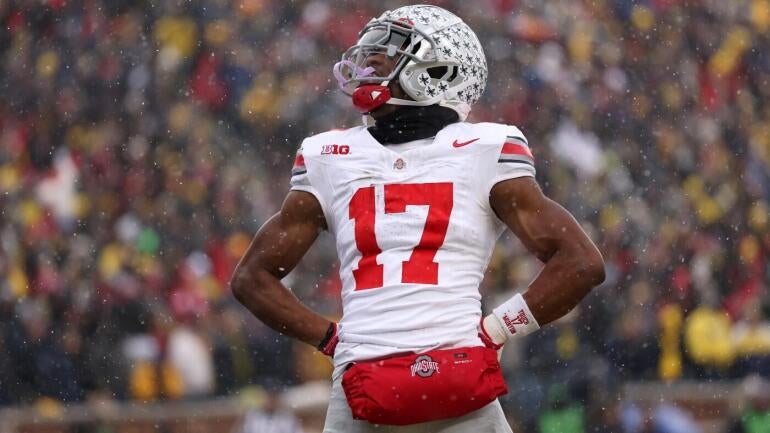
That brings us to Tate -- the Ohio State standout who didn't just elevate his game in 2025 but forced his way into the WR1 conversation in a class where true difference-makers may not be available when Buffalo goes on the clock at No. 26.
We caught up with Tate at the NFL Scouting Combine, and what stood out wasn't just the production or polish, but the intentionality -- the preparation, the mindset and the very real understanding of what comes next. He spoke openly about his ambition, his "money year," and even the idea of catching passes from a certain No. 17 in Western New York.
For a team firmly in its championship window, the path to a Lombardi Trophy may not run through patience. It may require a Julio Jones–style leap of faith up the board to snag a receiver who literally refuses to drop the ball.
The 'money year'
Carnell Tate didn't treat 2025 like just another season; he treated it like a deadline.
At Ohio State -- where five-star receivers are the norm and playing time and targets are earned -- Tate entered his junior year with a clear understanding of what was at stake.
"It was a mindset year," Tate told Ran Carthon and I during an appearance on the "With the First Pick" podcast. "And then also just go out there and leave it all on the field to prove to the world who I was exactly as a person and as a receiver. And then it was also my money year. Like we all said, that junior year is your money year if you want to go to the league ... and my goal was to go three [years in college] and out."
Tate more than delivered on that promise.


He measured 6-feet-2¼ and 192 pounds at the combine and played bigger than that last fall. His tape is littered with high-point grabs over helpless defenders, contested catches in traffic and runs away from defensive backs once has the ball in his hands. And he accomplished all that with exactly zero drops, something he was happy to confirm when I asked him about it.
"None."
Tate's 40-yard dash time of 4.53 only added to the intrigue. In fact, Bills general manager Brandon Beane joked about it in real time.
Bills GM Brandon Beane on Ohio State WR Carnell Tate: “He’s pretty slow I probably wouldn’t take him early” 😂#BillsMafia 🦬 pic.twitter.com/4vdKojBmSy
— Buffalo Fanatics (@BfloFanatics) February 28, 2026
The sarcasm was obvious -- and so was the subtext: When a prospect checks as many boxes as Tate, the stopwatch almost becomes an afterthought.

The Wide Receiver U pedigree
New Bills head coach Joe Brady has some experience with elite wide receiver play; in 2019, he was the offensive coordinator on that LSU team that included Joe Burrow, Justin Jefferson and Ja'Marr Chase.
(In case you're wondering, there's no question in Brady's mind that the 2019 LSU squad is the best to ever do it, whether it's the 2025 Hoosiers, the 2001 Canes, or whoever else you want to include in the conversation. "Not even close" were the first words out of his mouth when I brought it up.)
Brady has spoken in glowing terms about Keon Coleman's future in Buffalo, but there's also no denying that the Bills could stand to upgrade the WR room alongside Coleman and Khalil Shakir -- the de facto No. 1 wideout last season, even if he's better suited to be a No. 2 or No. 3.
Tate lined up alongside Marvin Harrison Jr., Emeka Egbuka and Jeremiah Smith and is the latest in a long line of pass-catching greats to come out of Columbus -- like Garrett Wilson, Chris Olave and Jaxson Smith-Njigba. And Tate might end up being the most dynamic playmaker of that distinguished group.
In my mind, Tate is a plug-and-play WR1. And even if that's too rich for you, even if you see him more as an NFL WR2, that's OK too. Because fit matters, and what better fit for Tate's skillset than an Allen-led offense?
And this isn't just me making stuff up; Tate is on record saying he would love to catch passes from Allen (hardly some bold proclamation, but it did give me a reason to bring it up).
"I love the idea," Tate told us on the podcast. "Any receiver would love the opportunity to play with a great quarterback who's competing at the highest level, who's in ... the prime of his career right now and is putting the ball wherever you need it.
"It would be a blessing to catch passes for him."
It would also be a blessing for Bills fans -- and Allen -- if Buffalo made a move to go get Tate.
That's where things get tricky -- but also where they become crystal clear.
The Julio Jones blueprint
To understand why a team like Buffalo would even consider a massive move up the board, you have to look back to April 28, 2011.
The Atlanta Falcons were coming off a 13-3 season. They had a franchise quarterback in Matt Ryan, a productive No. 1 receiver in Roddy White, and a veteran future Hall of Famer in Tony Gonzalez at tight end. On paper, the offense was already very good.
But general manager Thomas Dimitroff believed it wasn't explosive enough. So he did something bold, something expensive, something that at the time drew skepticism across the league.
Atlanta traded up 21 spots, from No. 27 to No. 6, to draft Julio Jones, and the cost was substantial:
- 2011 first-round pick (No. 27)
- 2011 second-round pick (No. 59)
- 2011 fourth-round pick (No. 124)
- 2012 first-round pick (No. 22)
- 2012 fourth-round pick (No. 118)
In return, the Falcons got a generational receiver. The Browns, meanwhile, used those assets on a collection of players who never approached Jones' impact. The haul -- along with subsequent trades -- led to Cleveland drafting DT Phil Taylor, WR Greg Little, FB Owen Marecic and QB Brandon Weeden (the 2012 first-rounder). The Browns also used a fourth-round pick as part of a trade to move up for RB Trent Richardson.
Dimitroff later admitted that even Bill Belichick cautioned him about the move, warning he would be "tied to this for the rest of [his] career."
He was. And it became one of the defining decisions of that era.
Atlanta went 10-6 in Jones' rookie season, reached the NFC Championship Game in 2012 at 13-3, and by 2016 -- with Jones as the offensive centerpiece -- Matt Ryan won MVP and the Falcons were 20 minutes away from a Lombardi Trophy.
Fortune favors the bold, especially when that boldness lands a true difference-maker like Jones.

Why Tate and Allen makes too much sense not to happen
The parallels between the 2011 Falcons and the current Bills are hard to ignore.
Buffalo has that dude at quarterback. The roster is deep (and the defense should be much improved with everyone healthy). The team is consistently in the playoff mix. And the season-ending conversation always circles back to the offense's ceiling.
Since Brandon Beane took over in 2017, the Bills have found value at wide receiver -- but rarely elite, early-round value. Keon Coleman (33rd overall) is the highest-drafted receiver of the Beane era, followed by former fourth-rounders Gabe Davis and Khalil Shakir.
The last time Buffalo had a true, coverage-dictating No. 1 was when Beane traded for Stefon Diggs — a move that immediately accelerated Allen's development and helped unlock the offense.
Elite quarterbacks don't just elevate receivers. Elite receivers elevate the entire structure of an offense. We've seen it with Tyreek Hill and Tua Tagovailoa, Ja'Marr Chase and Joe Burrow, and, of course, Julio Jones and Matt Ryan.
The Bills now face a similar inflection point. The knee-jerk reaction to a substantial move up the draft board is some version of "that's way too expensive and not worth it." But a closer inspection suggests just the opposite.
Yes, for the Bills to move from No. 26 to, say, No. 4 would be prohibitive, at least on the surface. It would likely cost Buffalo its 2026 first-round pick, its 2027 first-round pick and a mix of second- and third-round selections.
Is that a steep price to pay?
Yes. But let me frame the question this way: are you worrying about that price after a January playoff win over the Chiefs, Ravens or Broncos to reach the Super Bowl for the first time since 1994?
First, it's tough to hit on every first-round pick. Ask the Browns how much harder it was to hit on the five players they drafted after moving down in that deal with Atlanta. Put another way: a handful of average players does not equal one Hall of Fame talent.
Tate represents a chance to reset the clock with a player who is younger, cheaper and arguably more technically sound than anyone currently on the roster -- or on the free agent market.
For as good as Carnell Tate is on the field, evaluators consistently bring up something else first: his mindset, professionalism and approach to the game. The production is obvious. The polish is evident. But the maturity -- especially in a high-pressure receiver room -- continues to stand out in conversations with folks around the league.
And that matters for a team built to win now.
The Bills are not rebuilding. They are not retooling. They are maximizing the prime years of their franchise quarterback.
Allen is playing at an MVP level. The defense should rebound with better health and new leadership. The infrastructure is in place. What the offense lacks is a young, explosive, plug-and-play receiver who can tilt coverages and create explosive plays.
The Bills are too good to pick high. Too close to do nothing. And too deep into the Allen era to settle for incremental upgrades at wide receiver.
If Carnell Tate is within striking distance on draft night, this decision won't ultimately be remembered for the picks it cost. It will be remembered for whether Buffalo had the conviction to act while its Super Bowl window was still open.
Because if now isn't the time to be aggressive for a WR1, when is?