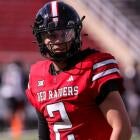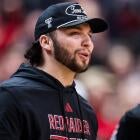

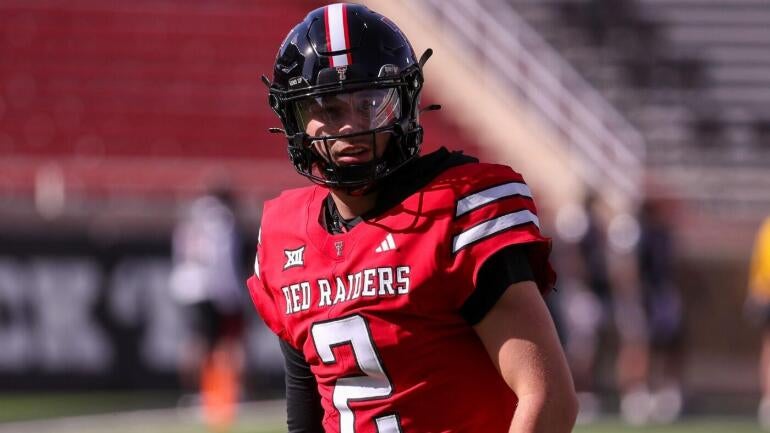
If you isolated Brendan Sorsby's on-field profile from everything else -- and good luck trying to do that -- there are plenty of moments when the Texas Tech quarterback looks like a future first-round pick.
He has a big arm. The athleticism shows up both on tape and in the numbers. He pushes the ball downfield as well as anyone in the 2027 class, consistently creating explosive plays without sabotaging drives with sacks or reckless decisions. Spend enough time watching him, and it's easy to understand why some evaluators think he has the tools to become a franchise quarterback.
Then the rest of the picture enters the conversation.
The gambling history isn't a footnote. It will matter, and likely more than anything else in this evaluation. I've also heard doubts from people around the league about whether Sorsby truly loves football in the obsessive, all-consuming way teams want their franchise quarterbacks to love it. For some teams, those concerns may be enough to eliminate him from consideration entirely. The harder part is reconciling them with what shows up on the field.
Sorsby doesn't have to be the best quarterback in the class for this to matter. Dante Moore's vertical passing profile is difficult to ignore. Arch Manning brings a combination of pedigree and upside that few prospects can match. And Julian Sayin may ultimately emerge as the class's cleanest projection if he continues to build on his 2025 debut.
The more uncomfortable question is this: If the off-field complications didn't exist, would we be talking about Sorsby as a legitimate first-round talent?
After spending the past several weeks studying the 2027 quarterback class, I think the answer is yes.
The challenge for NFL teams will be deciding what to do with that information.

The football case for Sorsby
The deep-ball numbers were the first thing that caught my attention.
Using PFF data from every draft-eligible quarterback in the 2027-2030 classes, I wanted to answer a simple question: Which quarterbacks consistently created NFL throws without making NFL mistakes?
Deep Grade measured overall effectiveness on throws traveling 20 or more yards downfield, while Deep Alpha Rate identified passers who generated big-time throws (BTT) without offsetting them with turnover-worthy plays (TWP).
In simpler terms: Which quarterbacks produced more of the throws NFL teams covet than the mistakes they fear?
Sorsby, it turns out, landed near the top of the list.
| QB | Deep Grade | Deep Alpha Rate | BTT | TWP |
|---|---|---|---|---|
Dante Moore | 98.5 | 38.3% | 25 | 2 |
Julian Sayin | 97.3 | 32.7% | 19 | 1 |
95.7 | 32.8% | 25 | 3 | |
Brendan Sorsby | 92.4 | 26.5% | 21 | 3 |
Arch Manning | 91.5 | 14.9% | 17 | 6 |
91.1 | 23.9% | 20 | 3 |
The numbers reinforce the point. Sorsby wasn't just surviving the exercise; 21 big-time throws against just three turnover-worthy plays makes that clear. And while it wasn't enough to elevate him into the very top tier of the class, it was enough to keep digging.
The trait that travels
Quarterbacks don't just lose games with interceptions. Sometimes they lose them by turning manageable situations into disasters.
Pressure-to-sack rate is a useful quarterback metric because it captures something traditional box scores miss: how often a quarterback turns pressure into a drive-killing sack.
Among the quarterbacks in this study, Sorsby's pressure-to-sack rate was the lowest at 6.1%.
The implication isn't that he never made mistakes. It's that when things started to deteriorate around him, he had an unusual ability to avoid making them worse. He created explosive plays while limiting negative ones. In a class filled with physically gifted passers, that stood out.
And then the second-read data arrived.
The case against
The same quarterback who looked so good pushing the ball downfield and avoiding sacks struggled once the first answer disappeared.
When I looked at how quarterbacks performed after moving off their initial read, Sorsby's profile suddenly became more complicated. His 52.3 PFF grade and 43.8% completion percentage weren't just mediocre relative to the rest of this class; they lagged behind several quarterbacks already considered among the favorites to come off the board early.
| QB | Second-read grade | Comp. % | BTT | TWP |
|---|---|---|---|---|
Julian Sayin | 90.2 | 68.3% | 0 | 0 |
88.5 | 60.0% | 3 | 2 | |
Trinidad Chambliss | 79.5 | 58.3% | 2 | 2 |
CJ Carr | 77.8 | 60.0% | 1 | 2 |
76.0 | 44.9% | 1 | 2 | |
Arch Manning | 67.9 | 53.2% | 4 | 3 |
Dante Moore | 63.5 | 67.7% | 3 | 5 |
Brendan Sorsby | 52.3 | 43.8% | 0 | 2 |
This wasn't a quarterback who methodically worked from one answer to the next. The numbers suggested that once Sorsby had to move beyond the play's original design, his efficiency and decision-making suffered in ways they simply didn't for quarterbacks like Sayin, Mestemaker or Chambliss.
The issue wasn't creativity; it was sequencing. Once the play moved beyond its original design, Sorsby could be a tick late getting to the next answer, trust his arm a little too much or predetermine throws that should have been abandoned altogether.
At first, it felt like the missing piece. Maybe this was the tradeoff hiding in plain sight: The same instincts that fueled Sorsby's improvisational creativity also made it harder for him to consistently find the next answer within structure.
Looking back through my notes from Sorsby's 2025 season, I realized I'd essentially written two scouting reports.
One described a quarterback capable of buying time, throwing from different arm angles and creating explosives when plays broke down. He was tough, athletic enough to escape pressure and comfortable operating in scramble drills.
The other described a quarterback with happy feet who occasionally drifted in the pocket, trusted his arm too much and could be a beat late working through the progression. He could lock onto targets too early. Timing routes occasionally suffered.
The film wasn't contradicting the data. It was explaining it.
The quarterback in the middle
The easiest way to sort quarterbacks is to separate them into familiar archetypes.
There are the point guards: Joe Burrow, CJ Stroud and Jared Goff. They get to the right answer, deliver the football and move on to the next play.
Then there are the creators -- the quarterbacks who occasionally frustrate coaches because they trust themselves enough to attempt throws most players wouldn't consider: Josh Allen, Brett Favre and Ben Roethlisberger.
Sorsby doesn't fit neatly into either category. Allen, in particular, is one of the most physically gifted quarterbacks in recent NFL history. But stylistically, my notes occasionally drifted toward "early Josh Allen" while watching Sorsby -- not because the talent is comparable, but because of the willingness to trust his arm, play outside structure and occasionally live with the consequences.
The result is a quarterback who can look brilliant one snap and reckless the next.
What are you really buying?
Quarterback has become as much an intellectual and emotional investment as a physical one. Teams aren't just drafting arm talent; they're assessing how a player handles adversity, absorbs coaching and adapts once NFL defenses force him to win in different ways.
Former Titans general manager and my co-host on the "With the First Pick" podcast, Ran Carthon, believes Sorsby's situation presents NFL evaluators with a unique opportunity.
"The tape is the tape in terms of evaluating him and his physical traits," Carthon said on a recent episode. "But now you get to evaluate how he deals with adversity. Knowing that he has this cloud looming over his head ... how does he respond to that?"
"You rarely get to see that for a lot of players," Carthon continued. "But we'll really get to see how he handles adversity this year."
In other words, Sorsby's scouting report won't be limited to Saturdays. Every road environment and every reminder of the controversy surrounding him becomes part of his file. The same spotlight that could derail his season may also provide teams with information they almost never have before making a franchise-altering decision.
For better or worse, on-field production won't be the only thing NFL teams are grading this fall.
The cost of uncertainty
The most straightforward projections are usually the easiest. Dante Moore's profile is relatively uncomplicated after his 2025 season. Arch Manning's strengths and weaknesses have been debated publicly for nearly a year. And Julian Sayin could ultimately emerge as the quarterback teams point to when they talk about smooth transitions to the next level.
Brendan Sorsby offers no such comfort.
What you see on the field suggests a quarterback with first-round ability. The off-field questions could keep him from ever getting that opportunity.
One NFL evaluator told me the gambling issues don't necessarily reshape an organization's view so much as reinforce it. If a team already views Sorsby as a legitimate first- or second-round talent, those concerns may not be enough to take him off the board. But for teams that see him more as a Day 3 prospect or developmental backup, the added uncertainty could be enough to remove him from consideration entirely.
Those realities don't change the talent. They change the tolerance for risk.
Quarterback evaluations are supposed to provide clarity. Sorsby's doesn't. The film says he can play, the numbers often agree, and some evaluators may ultimately decide none of that matters.
Nothing about this is easy, and maybe that's the point. The quarterbacks worth debating the longest are often the ones who reveal the most about the people making the decision.