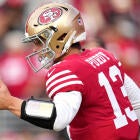


Three games into 2026, Drake Maye looks nothing like the quarterback who just helped New England win 14 games.
We live in a world of hyperbole and overreactions, but this is not that. Maye threw eight interceptions in 17 regular-season games during the Patriots' improbable run from a four-win outfit in 2024 to representing the AFC in the Super Bowl seven months ago. He already has six through three games in 2026, against just one TD pass. His completion percentage has dropped from 72.0% to 63.8%, his yards per attempt from 8.9 to 7.3, and his passer rating from 113.5 to 58.6.
The most troubling part isn't that the Patriots offense has been worse. It's that Maye has been a big reason why.
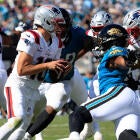
Sunday against Jacksonville was the latest manifestation of it. Maye finished 14 of 25 for 199 yards with no touchdowns, two interceptions and a lost fumble in a 35-6 loss.
oh no Drake Maye... pic.twitter.com/uwCHx632lv
— Arye Pulli (@AryePulliNFL) September 27, 2026
That came after three fourth-quarter interceptions against Seattle in Week 1 and another bad pick against Pittsburgh a week later. The Seattle game is what makes the slide so jarring: Maye was 17 of 22 with a TD, no interceptions and a 105.7 passer rating through three quarters before it all imploded in the final three possessions.
It was like you could see him regressing in real time. And that would have, in fact, been a real-time overreaction following the loss in Seattle, but the last nine quarters have been some bad, bad ball.
So two things:
1.) What happened?
2.) Can it be fixed?
If you're looking for excuses, there are reasons Maye has looked worse than he has, and they have little to do with Maye himself. The Patriots have played a much tougher schedule. A.J. Brown's unavailability changes what the passing game looks like. Losing guard Mike Onwenu cannot be overstated. Receivers aren't always separating, and the protection has been shaky, too: coming into the Jaguars game, Maye faced a 43.5% pressure rate, according to PFF, fourth-highest among starting QBs.
But here's the problem: pressure can cause bad plays. Being without a No. 1 receiver can reduce the margin for error. A tougher schedule can lower production. But none of this explains why your franchise quarterback is suddenly turning the ball over like it's part of the job description.
That's where this gets concerning, because Maye's second season wasn't a fluke. The analytics backed it up. As a rookie, Maye averaged minus-0.03 EPA per dropback, averaged 6.7 yards per attempt and posted a 3.5% turnover-worthy-play rate.
In Year 2, everything improved.
Drake Maye | Year 1 | Year 2 |
Completion % | 66.6% | 72.0% |
Yards/attempt | 6.7 | 8.9 |
TD-INT | 15-10 | 31-8 |
Passer rating | 88.1 | 113.5 |
EPA/dropback | -0.03 | +0.28 |
TWP rate | 3.5% | 2.7% |
Big-time throw rate | 3.7% | 4.9% |
That's what makes this different from some of the obvious cautionary tales. (Going to warn you now, this is gonna get ugly, so buckle up.)
I went back through quarterback seasons from 2015-25, looking for players who improved from Year 1 to Year 2, then regressed in Year 3. Mitchell Trubisky and Blake Bortles are two of the cleaner examples.
Trubisky, the second overall pick in 2017, went from a 77.5 passer rating as a rookie to 95.4 in Year 2, threw 24 touchdowns and helped Chicago win 12 games. Then Year 3 arrived: 17 touchdowns, 6.1 yards per attempt and an 83.0 rating.
Bortles, taken with the No. 3 pick in 2014, had an even bigger Year 2 statistically, throwing for 4,428 yards and 35 touchdowns. A year later, he was down to 23 touchdowns, 6.2 yards per attempt and a 78.8 rating.
The difference is that Maye's 2025 season was considerably more convincing. He wasn't simply amassing stats. His EPA improved substantially, his turnover-worthy plays went down, and the deep ball became a real weapon: Maye completed 61.8% of his throws 20-plus yards downfield, one of the highest rates in the league. That looked like legit franchise-QB development, not a false positive.
The biggest difference so far isn't that Maye suddenly can't make NFL throws. He can. It's the mistakes that largely went missing last season that have come back, almost as if they're making up for lost time.
And if you remember Maye going back to North Carolina, some of this feels familiar. The 2022 version was more settled -- working through reads, throwing with touch and anticipation, creating when protection broke down -- while the 2023 tape raised more questions about his feet, accuracy and decision-making, especially when he drifted into pressure or tried to make a harder play than he needed to. He was still the third overall pick in 2024, behind only Caleb Williams and Jayden Daniels, but there were some concerns about how he played last season in Chapel Hill.
Maye appeared to put any such questions to rest last season. Now, after an uneven postseason and three weeks of the '26 regular season, we're asking them again.
And it's why history matters. Sometimes Year 3 exposes something Year 2 masked. Sometimes it's just a temporary detour. Other times it's more than that.
QB | Year 2 | Year 3 | What happened next? |
Mitchell Trubisky | 95.4 rating, 24TDs, 12 INTs | 83.0, 17/10 | Never returned to Year 2 level |
Blake Bortles | 35 TD, 88.2 rating | 23 TD, 78.8 | Brief rebound, never sustained it |
Josh Freeman | 25/6, 95.9 | 16/22, 74.6 | Career quickly declined |
26/9, 95.6 | 13/15, 79.3 | Never became long-term high-end starter | |
25/8, 95.2 | 21/14, 88.5 | Eventually rebounded | |
MVP: 36/6, 113.3, 7.8 YPA | 26/9, 99.3, 7.3 YPA | Later returned to MVP level |
If you're among the glass-half-full contingent, the Lawrence comparison might be the most useful, with two important caveats: his rookie season came in the Urban Meyer mess, and his Year 3 slide was complicated by injuries. Lawrence dealt with knee and ankle injuries, a concussion and a shoulder injury as Jacksonville collapsed from an 8-3 start to 9-8. So when Lawrence slipped from 25 touchdowns and eight interceptions in Year 2 to 21 and 14 in Year 3, there were plenty of reasons beyond simple regression.
That's not especially comforting for Maye, who, as far as we know, is healthy and can't lean on similar excuses to explain away the start to his 2026 campaign.
Lamar Jackson is another reminder that Year 3 regression doesn't have to become the new normal. His MVP sophomore season was ridiculous: 36 touchdowns, just six picks, a 113.3 passer rating and 1,206 rushing yards. A year later, those passing numbers slipped: 26 touchdowns, nine interceptions and a 99.3 rating, while his YPA fell from 7.8 to 7.3. That's still very good quarterback play – just nowhere near his Year 2 level. He's back to playing at an MVP level, and truth be told, the Patriots would gladly welcome Jackson's version of a "down Year 3."
The other group, meanwhile, is where the warnings lie.
Trubisky never recaptured his Year 2 form. Neither did Bortles. Marcus Mariota went from 26 touchdowns and nine interceptions in Year 2 to 13 touchdowns and 15 interceptions a year later, and that second-year promise never became a reality. Josh Freeman went from 25 touchdowns and six interceptions to 16 and 22, and his career unraveled not long after.
That's the range of possibilities here, which is why three games aren't enough to tell us how this ends. But three games are enough to say something is wrong, because the mistakes have been persistent and the turnovers have spiked. (Three games become seven if you add in the four uneven postseason games from earlier this year.)
The Patriots can help Maye. They can protect him better. Getting Brown back on the field matters. You can't do anything about that first-place schedule, but Maye played with less during stretches of last season and still found a way to elevate the offense.
But none of that erases the fact that he has thrown six interceptions in three games, and that's on Maye to fix. The biggest issue is how those mistakes are happening: he looks less settled, more hesitant and more willing to force throws when the first answer isn't there.
Drake Maye: “I can’t get out of my own way.” pic.twitter.com/cESkGjujVC
— Chad Graff (@ChadGraff) September 27, 2026
The encouraging part for New England is that nobody has to imagine what the good version of Maye looks like. We've already seen it. For an entire regular season, Maye played at an MVP level and got the Pats to the Super Bowl.
So, were his first two seasons the beginning of something special, or the best version of Maye we'll ever see? History says quarterbacks can come back from a third-year regression. It also says sometimes Year 3 is when a temporary slump starts to look more permanent.
Maye has 14 games left to answer a simple but consequential question: Is he Trevor Lawrence or Mitchell Trubisky?