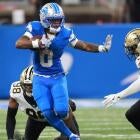


From Walter Payton to Emmitt Smith to Adrian Peterson to Derrick Henry, the NFL has always had prominent names at running back, but the depth of the position is cyclical. When the league was experiencing a higher volume of 4,000-yard passers, the number of running backs exceeding 1,000 rushing yards fell. But the tide may be turning and embracing the feature back once again.
Over the last four years, the league has averaged 15 rushers exceeding 1,000 rushing yards each season. The previous five years saw just 9.6 rushers accomplish that feat each year. The numbers are obviously slightly boosted over the last four seasons due to the implementation of a 17-game schedule. But there are 18 on pace for 1,000 rushing yards this season, with a handful of others, including Saquon Barkley, close. The usual suspects are among that group, but so too are the likes of Kyle Monangai, Bhayshul Tuten and Cam Skattebo.
CBS Sports' Pete Prisco wrote a story in September about the passing game diminishing over the last decade. Some of the reasoning applied in that article also translates to the run game. Before diving into the change and why it helps the run game flourish, let's look at the raw data.
All data is from TruMedia and is based on the regular season
What the data says
Through Week 3 of the 2026 NFL regular season, teams are averaging 61.5 offensive plays per game. The average had been 63.1 over the past decade. When slicing the pie, designed quarterback runs have dropped precipitously each of the past five years. Quarterbacks like Lamar Jackson are still effectively scrambling, but those opportunities and more are being funneled to running backs. Last season's pass attempts per team (545.0) was the lowest over the last decade. With the exception of the 2023 season, the percentage of run plays has risen every year since 2019.
Why teams are running more
The Vic Fangio effect
As Prisco discussed, disciples of Eagles defensive coordinator Vic Fangio have pervaded the league and spread the two high safety look, which limits explosive plays in the passing game. The number of explosive plays last season was the lowest since 2017. Defenses are content to give up small gains, expecting offenses to grow impatient and make a mistake pushing the ball downfield.
If the opposition puts fewer or lighter players in the box, then running the football is an effective counter.
Offensive line play and creative defensive formations
For quite some time, there has been a narrative that there are not enough quality offensive tackles in the NFL. The institution of the transfer portal and NIL, which encourages players to change colleges, has had a two-fold impact on the unit in the pros. In some cases, a change of scenery exposes some players to more resources and better coaching. In other cases, a lack of continuity may impede a lineman's development.
Prisco also wrote how defensive coaches, such as Jesse Minter, Mike Macdonald and Brian Flores, have done a great job giving the opposition exotic pre- and post-snap looks. NFL teams have had a greater willingness to transition a lineman from the position they played in college to a new one in the NFL, which I wrote about in 2025. As a result, little details like communicating and handling those aforementioned twists and stunts by the defensive line can often get lost in translation.
Running the football is one way to mitigate those communication issues. Leaning on the defense in the run game is often more natural for linemen than asking them to hold up against more athletic pass rushers.
Improved starting field position and the rise of the kicker with a leg cannon
The new kickoff rules instituted in 2024 have led to improved average starting field position, with the average field position being 30.2 yards or greater since the rules took effect. It had never reached the 29-yard line over the prior decade.
Meanwhile, the number of made field goal attempts of 50+ yards has exploded. On average, there have been 172.5 such kicks over the last four years. Before then, there had never been more than 120 in a season dating back to 2016. The league is on pace for 198 made attempts from 50+ yards this season.
Between the improved starting field position and the success of kickers from 50+ yards, an offense may need less than 37 yards to be in field goal range. Offenses are incentivized to take those small incremental gains as opposed to hunting the big plays.
Lighter defensive personnel
For years, defenses had incorporated lighter personnel to combat the spread nature of the NFL pass game. Teams were taking a third linebacker off the field in favor of a nickel defensive back. There has been a higher volume of sub-250-pound edge rushers and sub-250-pound rushers, in general. With less mass in the box, heavier offensive personnel can move bodies around in the run game.
One of the more overly-discussed NFL trends this offseason was the usage of two-plus tight ends. The league utilized two-plus tight ends on 33.2% of offensive snaps last season -- a full 3% higher than the previous 10-year high set in 2024. Through three weeks in 2026, that number is even higher (35.1%).
Fourth down aggressiveness has risen
From the COVID season through the 2025 season, NFL teams went for it on 4th down 20.3% of the time. Over the prior four years, dating to 2016, the average was 14.1%. The evidence is circumstantial for distance, stage of the game, offensive effectiveness, etc., but it usually evens out over the course of the season. Although this year's average is lower through Week 3, it is still significantly higher than the pre-COVID timeframe.
Why is this relevant? Teams have an additional down to achieve 10 yards for a first down. A team must average 2.5 yards per play as opposed to 3.33 yards, which opens the door to more rush opportunities. In the past, a third-and-7 may have been an obvious passing situation, but if a team knows it's going for it on 4th down, then running the football on third down to open the playbook is a consideration.
What does it mean for the value of the position?
For quite some time, the running back position had been devalued. Prominent players at the position met to strategize contract objectives when some teams employed the strategy of not extending a running back after the player's rookie contract, franchising the player to maintain control for an additional year or short-changing the player in long-term negotiations. As a result, teams often favored players at more premium positions early in the NFL Draft, because it was more likely that player would sign a second contract with the team. There was greater value in having an elite performer at wide receiver, edge rusher or offensive tackle. For example, the franchise tag rate, which weighs the 10 highest-paid players at each position, for a wide receiver is roughly $27.3 million this season, whereas the running back number is roughly $14.3 million.
What could recent trends do for the value of the running back position? Teams have always shown a willingness to take a running back early in the draft if the talent is there. Arizona selected Jeremiyah Love No. 3 overall in the 2026 NFL Draft. Teams have also been more willing to extend running backs recently, but the average annual salary still lags behind other positions -- a fact that likely will not change until the average career expectancy gives teams more confidence in offering those long-term deals. Players like Saquon Barkley reaching free agency is good for the earnings potential of the position.