
Explaining the Olympic hockey rink controversy: Why it might jeopardize the NHL's return to the Winter Games
Substandard rinks may jeopardize the NHL's return to the Olympics

•
6 min read
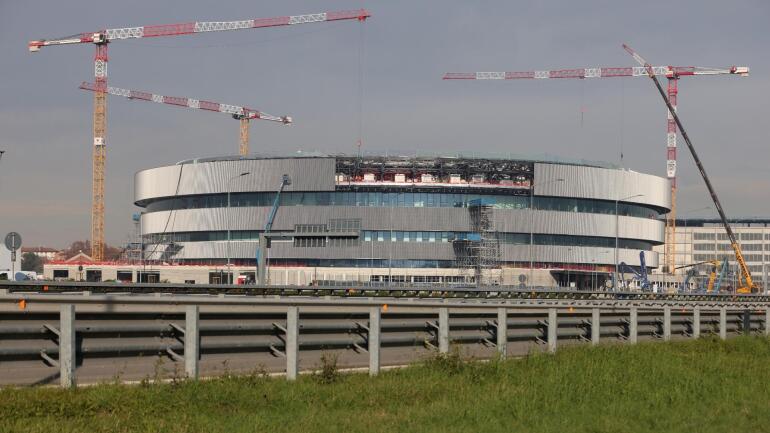
Lately, there has been a lot of talk about rink size as it pertains to the NHL's Olympic return in 2026. A recent report from The Athletic revealed that -- among other issues -- the new rink being constructed for the Milan Cortina Olympics would be smaller than those used for NHL games.
The NHL, NHLPA, IOC and IIHF all agreed that the ice surface used for the 2026 Olympics would be built to NHL specifications. That will no longer be the case, and it has sparked some trepidation from league officials. After all, why would the NHL and team owners want to send star players overseas to play on a sheet that makes an already dangerous game even more dangerous?
Because of the questions about rink size (and slow construction of the arena as a whole), there is at least a little doubt about whether NHL players will return to the Olympics for the first time in 12 years after all. The scheduled completion date for the new arena is Feb. 2, which is just three days before the women are set to begin and nine days before the men's tournament begins.
As this Olympic ice rink saga unfolds, here is everything you need to know, from the size discrepancy to what star players like Nathan MacKinnon and Matthew Tkachuk have had to say about it.
How big are NHL and traditional Olympic rinks?
NHL rinks are 200 feet long and 85 feet wide. That's been the case for almost 90 years as the league standardized its rink size back in 1929. In the past, Olympic rinks have been considerable bigger than NHL rinks, measuring 197 feet long and 98.4 feet wide.
Throughout the years, the common misconception has been that the larger Olympic ice sheets lead to more skill and action because there's more space. However, players almost always drift to the "cleaner" ice on the outside while vacating more dangerous scoring areas. Smaller ice sheets force more action because they force the players on top of one another, and there's a shorter distance from any point in the offensive zone to the net.
How big is the 2026 Olympic rink?
The rink for the 2026 Milan Cortina Olympics has been constructed to be 196.85 feet long and 85.3 feet wide. That means it has the shorter length of older Olympic venues while also being just a few inches wider than an NHL rink.
If there is a concern from the NHL and its individual teams, it's that their best players will be playing intense best-on-best competition in a Cracker Jack box. Based on what we saw in the 4 Nations Face-Off last February, players won't be shying away from big hits in the spirit of friendly international competition, and now they will have even less room to maneuver.
However, there is some good news on this front. The 2022 Olympics, which did not include NHL players, were played on the same ice sheet as the one being built in Italy. On top of that, the Nashville Predators and Pittsburgh Penguins just played two Global Series games in Sweden on a rink with the same dimensions and no one seemed to notice.
If those in charge of managing the rink just cut the neutral zone short, players will have roughly the same amount of space in the offensive zones. That may make for increased physicality between the blue lines, but it may be the best way to lessen the impact of the smaller ice sheet.
What is the NHL saying?
At the NHL Board of Governors meetings in Colorado this week, NHL deputy commissioner Bill Daly addressed concerns about the Olympic rink. Daly acknowledged there was a "different interpretation" of what was meant by an NHL-sized rink but added that there were "positive reports" about the progress.
"I actually do think most of my information is more on the positive side than the negative side," Daly said, per NHL.com. "The buildings are supposed to be done by Feb. 2, so we have some time, and the latest reports I was getting, I was at the table in the meeting, were positive."
Daly added that the NHL's ice technicians are helping out with the construction of the new rink, including maintaining the quality of the ice so that it's up to NHL standards.
"We have offered and they are utilizing our ice experts and technicians and outside providers," Daly said. "We're basically moving everybody there to try to help get this done in a way that is acceptable for NHL athletes."
Despite some progress being made, Daly made it clear that the NHL wouldn't send its players if the conditions were deemed to be unsafe. If that were to be the case, Daly said the league's priority would be player safety, no matter the ramifications of pulling out of the event.
"Obviously, if the players feel that the ice is unsafe, we're not going to play," Daly said. "It's as simple as that. Whatever flows from that, flows from that. I'm not really all that concerned about it."
Is there a contingency plan?
The short answer here is no -- at least not publicly. There are other rinks nearby, including the arena used for the 2006 Turin Olympics and multiple rinks in Switzerland. However, moving the hockey tournaments would create another host of issues. Dozens of teams full of players and staff would need lodging, rinks likely have events scheduled already and fans have already made plans to attend games at the current site. Moving the site for hockey might be possible, but time is running out.
What are the players saying?
The Athletic recently spoke to players about the smaller rink size, and while most said there would be differences to the game, few expressed any real concerns about safety. Colorado Avalanche star Nathan MacKinnon said the smaller ice sheet could make a big impact in the premium areas of the ice.
"If you have a foot less space, it can be a big difference," MacKinnon told The Athletic. "If you get a foot closer in the slot, I think that could be a big difference. But it's the same for everybody."
Then again, does any of that really matter when we're talking about the best players on the planet competing for a gold medal?
"It'll change things, but who cares?" MacKinnon added.
Martin Necas, MacKinnon's teammate in Colorado and a star for Czechia, said he is actually looking forward to the compressed game. He thinks it will be a better product for the fans anyway.
"It's not a big deal," Necas said. "To me, I think it's better that it's smaller than if it'll be bigger. I think it's going to be even better for the fans. It's going to be super quick, super fast-paced. I'm excited."
On their "Wingmen" podcast, Matthew and Brady Tkachuk talked about the impact of a smaller rink. Matthew kind of echoed Necas' sentiments, saying that there will be more action and contact.
"I actually don't mind it being a little smaller," Matthew Tkachuk said. "Not only am I not fast, so it works for my game, but I think there's gonna be more action. I really don't think it's gonna be as big a difference as people think. ... I think they should be happy about it. I think there's gonna be more chances. There's less space, so more physicality."
Brady Tkachuk said he would play anywhere, including "on a lake" or "in a park." Besides, this is the first opportunity many players have gotten to play in the Olympics.
"We're going there," the younger Tkachuk brother said. "We're going to play. It's something we've dreamt of. It's been too many years without it."
As for the safety concerns, it's fair to say those are not on the top of Matthew Tkachuk's mind.
"Even if it's not safe, I still wanna play," he said. "I don't give a shit."