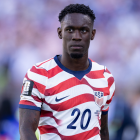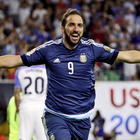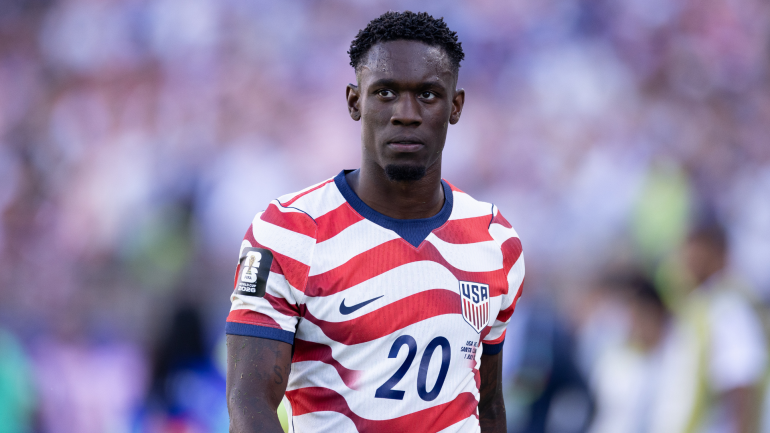
However unavoidable it might be, it is never a great thing when the discourse around sports revolves around the referees. This World Cup has moments of brilliance from the athletes that rightly draw our attention on a regular basis. But, by the time the U.S. men's national team hit the road for their final training session before their World Cup round of 16 clash against Belgium on Monday, the dust seemed to have settled, and however unfair it may have seemed to some, and no matter the number of memes that had been spawned, star forward Folarin Balogun's red card in Wednesday's round of 32 win against Bosnia and Herzegovina meant he would miss the Belgium match. He had graciously accepted the punishment and the team had been preparing for life without him with a historic trip to the quarterfinals on the line.
Then, an unprecedented decision was announced while the team rode the bus to training on Sunday morning. Days after it seemed like the process was complete, FIFA's independent disciplinary committee instead put Balogun on probation for a year and granted him permission to take part in Monday's game against Belgium, the rarely-used Article 27 of FIFA's disciplinary code essentially giving the committee discretion to do as they chose. It was of great relief to the USMNT and a point of contention for Belgium, but it forced the question: How exactly did we get here?
The road to red card drama
Balogun's red card, a studs-up challenge on Bosnia and Herzegovina's Tarik Muharemovic, was already considered harsh because the USMNT forward had his back to the opponent and no idea he would be there at that exact time. The process from there, though, was not supposed to be up for debate. It was made clear post-match by members of FIFA's and U.S. Soccer's staff that there was no appeals process for a single-game ban, which Balogun was guaranteed to serve. An independent body always reviews such matters, though, and the only question they would have to answer is if Balogun deserved a multi-game ban. It was always unlikely that he would miss additional games if the U.S. team advanced because the independent committee usually makes that choice in the case of serious foul play, but the USMNT had the right to appeal to reduce the ban to a single game if Balogun's suspension was extended. On Friday morning, U.S. Soccer confirmed what many knew to be the most likely scenario, Balogun would only be suspended for the Belgium game, but would be available again if the team advanced to their first quarterfinal in 24 years. Case closed.
That's when things got weird.
It is why FIFA's announcement on Sunday morning caught just about everyone by surprise. If the disciplinary committee's work was complete, what prompted them to review the case again? The specifics are now shockingly murky, the exact opposite of what any disciplinary body should aim for to ensure as much belief in the system as possible. It is one thing to shroud the identity of the members of the committee in complete mystery, but the confusion around their well-documented processes is another thing entirely – especially now that FIFA is instead trying to deny what, or who, caused a sudden change in heart on the Balogun decision rather than explaining the rationale behind it.
Within hours of Sunday's breaking news, multiple reports suggested that members of the administration of U.S. President Donald Trump called FIFA president Gianni Infantino in the hopes of tipping the scales in Balogun's favor. On Monday morning, Trump himself said he placed a phone call asking for a review.
"I saw the play, and I'm a person that loves sports and that wasn't a foul," Trump said during a meandering answer on the topic without ever actually uttering Balogun's name. "That wasn't even an infraction, this referee, who is a little bit suspect if you check his past. He made a call that nobody could believe. He's our best player [Balogun], or one of our best players. And he gave him a red card. I didn't know what that meant. Yes, I asked for a review by FIFA."
Infantino, now a longtime member of Trump's orbit, denied that the U.S. president had anything to do with the decision in the only statement FIFA has issued since lifting Balogun's ban while evading any formal explanations on why the decision was made.
"FIFA's judicial bodies are independent," Infantino's statement read in part. "They operate autonomously, apply the FIFA Disciplinary Code, and decide cases based on the applicable regulations and the specific facts before them. Their independence is essential to the credibility and integrity of football, and this must always be respected. Yes, I regularly discuss matters related to the FIFA World Cup with the President of the United States, and on this matter, I did receive a call from President Donald Trump, just as I receive calls from heads of state, government officials, football stakeholders and business executives from around the world on many different issues. During our conversation, I explained that there was an ongoing legal process involving FIFA's independent judicial bodies and that the case would be decided in due course by the competent bodies."
Whether or not Trump influenced the decision or not, the fact that he is taking a victory lap about it has brought an incredible delegitimization to the independent committee's processes, which is even more glaring because the head of state admitted he has no clue what a red card is and later rejected the notion that you could be suspended for the next game for being sent off, one of the least controversial policies in the rules of the game.
Things are so fraught that FIFA continues to make up the process as it goes along. On Wednesday evening, there was no appeals process to speak of. On Monday morning, though, FIFA entertained and then rejected an appeal from the Royal Belgian Football Association on the Balogun decision, another inane dash of bureaucracy thrown into the pre-game rigors of a World Cup knockout game that instead pulls us further and further away from what should be the main topic of conversation. One team will earn a coveted spot in the World Cup quarterfinals in Seattle on Monday evening, an impressive accomplishment for Belgium if they manage it and a downright historic one for the U.S. if they pull off the feat instead.
Belgium have earned the right to be the favorites but the USMNT are right to like their chances against their round of 16 opponent, both because the World Cup co-hosts have played strongly at this tournament and will be at full strength but also because the Red Devils have stumbled at times en route to the last 16. This is a more inconsistent version of Belgium than the ones they have faced in the last decade or so, their golden generation almost entirely behind them. With or without Balogun, it has been realistic to believe that the USMNT could very well pick up a game-changing win on Monday with the eyes of an adoring country fully fixed on them – and around 70,000 ready to cheer them on fervently at Seattle's Lumen Field.
Will the Balogun decision taint any USMNT win?
Hours before kickoff, though, their performance, however good or bad it turns out to be, is already marred by FIFA's mismanagement of the situation. It would be one thing if FIFA was transparent from the start about embarking on some sort of appeals process, or if U.S. Soccer had done the same because they were engaged in the procedure all along. More secrecy is rarely a good thing in judicious processes in sport or otherwise, and now it's a stain now marking the remainder of the USMNT's World Cup run, no matter how long it stretches. That will also be true for Balogun himself, who had rightfully earned his position as America's new favorite athlete. With three goals so far for the USMNT, Balogun was in the midst of a dream first World Cup and instead has his face plastered atop articles and on TV screens as someone else's confusing and controversial decisions impact his own ability to play without his say. If he has a standout performance on Monday, he will have to unfairly bear the weight of others' choices rather than enjoying a well-earned career highlight.
USMNT head coach Mauricio Pochettino, like his players, celebrated Balogun's return but could not help but reflect on the strangeness of the position his team was placed in along the way.
"Ultimately, we aren't playing the victim," Pochettino said on Sunday, "but we certainly aren't the villains of this story, either." The situation opens up a remarkable can of worms, though, so much so that other teams have rightly decided it is open season to try random appeals of their own. FIFA has no processes to review yellow card suspensions, but France have now asked FIFA to rescind Michael Olise's booking in their round of 16 win over Paraguay on Saturday because if he gets another in Thursday's quarterfinal against Morocco, he would miss the semifinals should they advance.
It is a ridiculous request to make, but France are right to test the waters since it is FIFA who set the ridiculous tone first, not them. It is no wonder that Belgium head coach Rudi Garcia quipped that he "didn't know that July 5 was equal to April 1 at FIFA," the sport's governing body ensuring a World Cup they would consider to be a rousing success would instead descend into sporting chaos, the one thing it is truly tasked with avoiding. FIFA is undoubtedly used to ensuring there will be jokes at their expense, but England's Thomas Tuchel cracked a joke that Trump's appreciation of their star striker Harry Kane could help grease the wheels on an appeal for Jarell Quansah's red card in their dramatic 3-2 win over Mexico on Sunday, an unpleasant subplot after one of the great games of the World Cup thus far.
There is simply no upside to how FIFA conducted itself over the last several days, again facing accusations that it is an organization that is swayed far too easily by outside political influences who are not only unqualified to chime in but are motivated simply by their own interests. Even with Balogun likely to play a big role in the USMNT's clash with Belgium, there are really no winners in this situation.
"I think that's a big mistake by FIFA," Norway head coach Staale Solbakken reflected after his team's big win over Brazil on the opposite side of the country. "I think it's not a great conclusion. He's got the red card and the VAR concluded that it was a red card. He was sent off. That means you are suspended for one game. I think what's really is bad about that situation can be that it will be over [the] United States now. Because if they beat Belgium, it will have [that] extra thing about it.
"Bad, bad, bad, bad, bad decision that will hurt the World Cup. I feel also sorry for the United States, because if they win, that will always hang in the balance for it."