USWNT star Sam Coffey's Man City move highlights Europe's growing pull as NWSL confronts talent outflow
Coffey fulfills a personal professional goal and the NWSL continues to lose top tier talent to Europe

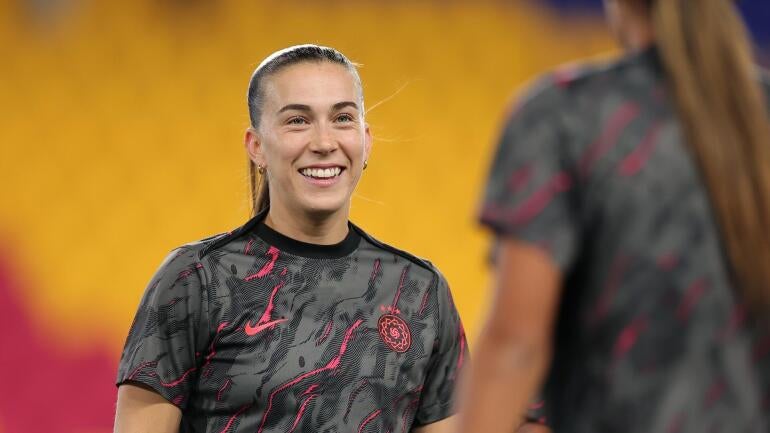
In an ongoing trend of talent departures from league to league, WSL in England has pried another one of the National Women's Soccer League's prime players.
In a move that adds more gasoline to the raging fires of pro league debates, Manchester City announced they have signed U.S. women's national team midfielder and former Portland Thorns captain, Sam Coffey, on Wednesday. Coffey departs the NWSL on a three-and-a-half-year deal through 2029 with the WSL side. The transfer is reportedly worth $875,000.
While Coffey had two years remaining on her Thorns contract, the player was often transparent about her lifelong dream to one day play in Europe. She echoed the sentiment in a farewell video, referring to the move as something she "simply has to pursue."
A message to Portland, from Sam ❤️
— Portland Thorns FC (@ThornsFC) January 14, 2026
And from all of us, to you, Sam Coffey. Thank you for making Portland your home. Thank you for giving 110% every single day.
We wish you nothing but the best in England! pic.twitter.com/FmwTflhaLS
What does it mean for Portland?
There was an argument that during the tempestuous 2024 season, the Thorns' return to the 2024 playoff appearance was fueled by forward Sophia Wilson's undeniable offensive production in front of the goal. A similar debate could paint Coffey as the catalyst for the Thorns' elevated run in 2025.
The 27-year-old midfielder captained the Thorns to the 2025 NWSL semifinals and led the team in minutes played. She was a crucial component in Portland's midfield and was a central leadership figure for the club following retirements by Christine Sinclair, Becky Sauerbrunn, and Meghan Klingenberg. Coffey leaves the NWSL club a 2022 NWSL Championship winner and earned three NWSL Best XI selections (2022, 2023, 2025).
Her departure exposes an immediate gap in the midfield, but it's just another question lingering around the club as it builds towards the 2026 season. There are also the bigger holes Coffey's absence will leave behind in terms of leadership, on-field performance, and off-pitch efforts.
"While the Thorns organization did everything it could to keep Sam in Portland, we thought it was important to support her ambitions while we continue building a team capable of competing for championships. We are grateful for her contributions and wish her success as she pursues her next opportunity," said president and general manager of soccer operations Jeff Agoos.
In the early days of the new year, Portland have just four midfielders listed on their current preseason roster. Venezuela international Deyna Castellanos, Canadian international Jessie Fleming, Olivia Moultrie, and the recently signed Shae Harvey out of Stanford University. There's the possibility that the 10 forwards currently on the preseason roster may fluctuate positionally, but that is an immediate conundrum for whoever the next Thorns' head coach will be.
What does it mean for Manchester City and WSL?
The move symbolizes the shift of power club dynamics in England between Chelsea FC, Arsenal, and Manchester City. Kerolin, the former 2023 NWSL MVP, who joined Manchester City in January 2025, was another domino to fall in favor of the Chelsea rivals, shortly following Vivianne Miedema's arrival at the club in July 2024 from Arsenal on a free transfer.
Coffey's arrival only boosts the international power on the roster as she joins Kerolin, Miedema, Bunny Shaw, and Yui Hasegawa, among others. Manchester City currently control the WSL table with 33 points, with six points over Chelsea and 10 points ahead of Arsenal.
"Sam's reputation as one of the world's best speaks for itself, and we're delighted she's chosen to come here ahead of other potential suitors,' said City's director of women's football Therese Sjogran.
"We believe she has all the qualities needed to thrive at City and, more broadly, the WSL, and we're excited to see how she can elevate our already superb squad of players. Sam is playing at the top of her game, and I think her decision to come here shows the incredible progress we've made as a Club and the ambitions we have moving forward."
There's no doubt Manchester City are now the team to chase on the table, and now they have to maintain the expectations they've set for themselves.
The NWSL will be fine
A year ago, after Naomi Girma's departure, I claimed the NWSL would be fine, and I still mean it. But after repeated movement, even I'll admit my own sentiment behind it has shifted.
The thing about Coffey's departure is mostly its timing. Ultimately, it was a move that was going to happen once the right opportunity came along. She's been as open and honest about how playing in Europe is a dream of hers, and the transparency does the NWSL a big service. If anything, it'll allow NWSL to commit to the messaging that this was ultimately what the player wanted.
It also brings an entire year full circle in which the league lost multiple U.S. national team players and plenty of its league starting-level players.
Rising transfer fees, which some English clubs can offer with the resources of their men's clubs, have tipped the player movement scale. Over the last year, the league has struggled to grapple with its own identity in a search for financial mechanisms, like salary cap restrictions in the name of competitive parity. The playing level the NWSL views as one of assets, if not its greatest.
The introduction of a "High-Impact Player" rule, voted on by the board in December, hasn't exactly resolved anything either. The HIP rule was a partial response to the ongoing contract saga with Trinity Rodman, another player the league has failed to re-sign at the moment.
There was a deal in place in December between the winger and the Washington Spirit, which was a four-year deal that included backloaded portions of her contract. NWSL Commissioner Jessica Berman vetoed the contract, claiming the potential new contract violated the spirit of league rules. Rodman is currently unattached to any club as the season looms closer.
The new HIP mechanism allows teams to spend an additional $1 million on players who meet specific "star" criteria. The ability to offer competitive salaries, as the global transfer market rises, remains a hurdle for the women's leagues around the world, though the NWSL specifically has seen an increase in players leaving for teams overseas.
NWSL clubs will be able to exceed the league's current salary cap by $1 million and use the HIP funds toward single or multiple player contracts. The HIP threshold will also increase annually alongside the salary cap, which is currently $3.5 million and set to rise to $5.1 million by 2030.
No player has been signed utilizing the new rule since it was approved, though Denver Summit FC recently announced they signed USWNT midfielder Lindsey Heaps and alluded to the possibility of using the mechanism when she arrives midseason.
The NWSL Players Association recently filed a grievance challenging the NWSL "High Impact Player" rule. The NWSLPA is seeking immediate rescission of the rule, claiming "a player compensation rule implemented without bargaining and in violation of the Collective Bargaining Agreement and federal labor law."
However, in the case of Coffey, you can never actually veto personal ambition. Now the league is in the midst of losing an identity that it never cemented in the first place. If you're the league of parity it is because you have talent on the rosters to claim that. The NWSL is well on its way to becoming a league of trends, instead of innovation.
Once upon a time, there was an allocation system that distributed and paid the contracts of USWNT, Canada, and Mexico internationals to NWSL clubs, then those partnerships shifted as the league grew. In an attempt for more control in roster building, allocation money was introduced for 2020, then its expiration date was issued, and now it's sort of back in a larger, separate, more exclusive amount, as HIP money.
One of the HIP rule criteria a player can meet is "marketability," a metric measured by whether or not a player is on SportsPro Media's Top 150 most marketable players, a list that somehow favors European players. It is perhaps the trend the NWSL is failing to escape the most.
Though trends have always been part of the league. Once, NWSL was the home of several Australian women's national team members, and now it is the home of multiple Brazilian players. It once promised to trend towards more women in head coaching positions, and there will now be three in 2026 instead of two as the league expands to 16 teams. There's even a new trend of former MLS coaches in the league, with Denver's Nick Cushing and Kansas City's Chris Armas hired this offseason.
Trends fade and become memories. Sometimes they are recalled when true innovation is lacking, and the need for some kind of inspiration is necessary. While they come and go, it's still what NWSL audiences, new and old, will keep an eye on.
Hopefully, the loss of a homegrown captain in her prime is a clear enough signal that retaining its USWNT assets will be the league's defining challenge of the moment. Over recent years, it's been facility infrastructure, resources, and match schedule management. As the league changes, the challenges it faces will change too.
From Girma to Kerolin, even to players whose moves haven't quite worked out in Crystal Dunn and Jenna Nighswonger, you cannot deny that the most pressing challenge is the imbalance of players leaving to competing leagues versus incoming players from those same leagues.
Alongside losing multiple players to overseas competition, the league has mostly failed to lure overseas talent to the NWSL, at least at the rate players have left overseas in one year. I do still believe the NWSL will be fine, but what league that is proclaiming to be the best in the world wants to be just fine?
The USWNT will be better than fine
Coffey's departure overseas now adds another starting caliber U.S. women's national team player abroad. Alongside Emily Fox, Girma, and Heaps, that makes four players who have been regulars across starting lineups for head coach Emma Hayes since her managerial arrival ahead of the Paris Olympics in 2024.
You add in Catarina Macario, Alyssa Thompson, and Phallon Tulis-Joyce, who have been consistent features in the starting XI in just 2025 alone, that builds up to seven players. And if you're the type that loves a "this young athlete is ready to start right now' debate, you can consider Lily Yohannes as the eighth USWNT player.
That would mean more than half of a starting caliber lineup for the USWNT plays their club soccer overseas. Removing NWSL from that equation, the national team is going be better than fine or even OK. Concacaf rivals might be back to fearing the Stars and Stripes once again in the months leading up to the World Cup qualifiers in November.