25 Things for Spring: College football teams, names, storylines to know entering the 2026 season
The most important developments in college football this spring won't just happen on practice fields. They'll unfold in locker rooms, courtrooms and the corridors of power in Washington

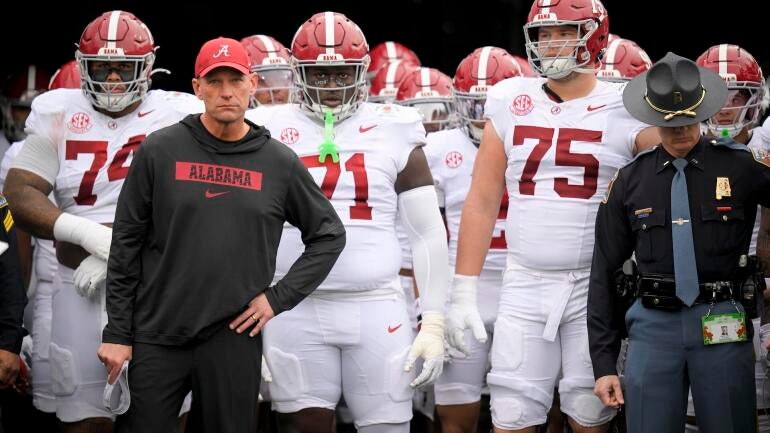
Spring football has changed dramatically over the last decade. In the past, coaches utilized 15 practices to develop depth and integrate freshmen and newcomers. Then, they'd give the fans what they want with a scrimmage featuring their top returning stars.
Today, it's a full-on reset for most programs. Player movement in the transfer portal, along with rising turnover in the coaching ranks, has made spring practices essential for coaches to install schemes and reestablish their programs' identities.
Thirty-three FBS programs head into spring drills with new head coaches, with countless new faces on the coaching roster and support staffs. Even the blue-bloods are not immune, including college football's new blood, Indiana. The Hoosiers are still riding high as the first 16-0 national champion in the modern era, fresh off bucking convention and shattering outside expectations, a reminder that anything is possible in this new era of NIL and free agency.
But can they sustain that momentum?
What about mainstays like Dabo Swinney? The Clemson coach hit the reset button this offseason, but the changes he made seem a little too familiar.
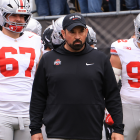
Alabama needs a new quarterback. Notre Dame is college football's new villain.
And the most interesting storylines might be what's developing in courtrooms, boardrooms and the marble halls of Congress.
So before the games count and before the playoff debate inevitably reignites, here are the 25 most pressing storylines shaping college football this spring. As always, it's the power struggles that will define the season long before kickoff in September.
1. Spring games return
Coaches are paranoid by nature. They're also relentless copycats.
Last spring, at least 17 power-conference programs either canceled their spring games or morphed them into glorified practices that barely resembled live football. Many feared other coaches would watch those spring games, evaluate players and poach their rosters during the spring transfer portal window. Now that the spring portal is no more, at least seven schools are bringing their prototypical spring scrimmages back online for 2026. Among the notable returns: Auburn, Nebraska, Oklahoma and Texas.
"We want to do it," Nebraska's Matt Rhule said. "It's a great thing for the fans. It's a great thing for people who want to come watch us play, and once they kind of changed the calendar, we went back to a more traditional setting."
2. ACC QB musical chairs
Stability isn't the ACC's strength at quarterback this year. Only five starters return (and some at new schools). The rest of the league went shopping.
Eleven programs are expected to roll out transfer quarterbacks this fall, turning the conference into a proving ground for second acts and fresh starts. We'll get our first read on them this spring.
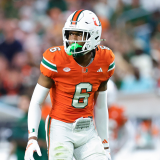
The headliner is Miami's Darian Mensah, who guided Duke to the ACC Championship Game and threw for nearly 4,000 yards last season. Miami already looks like a national contender again.
The anchors returning to the league are Cal's Jaron-Keawe Sagapolutele, SMU's Kevin Jennings and NC State's CJ Bailey. It's a top-heavy group, but the depth across the league is apparent with Clemson's Christopher Vizzina, Georgia Tech's Alberto Mendoza (Indiana) and Wake Forest's Gio Lopez (UNC) as prime candidates for breakout seasons in the fall. Keep your eyes on this group.
3. The Indiana (Re)model
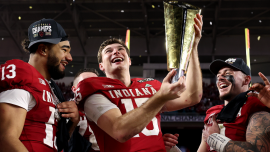
Well, Indiana did it. The Hoosiers are national champions, and as the sport continues to wonder how Curt Cignetti lifted the program from the bottom to the top in two seasons, the coach has moved on to a bigger question: Can they do it again?
There are important departures to account for this spring. The defense loses cornerstone pieces, and the offense must replace two receivers and a pair of running backs who were central to the title run. But the offensive line brings back three starters, including Big Ten Offensive Lineman of the Year Carter Smith, providing a stabilizing force that gives the Hoosiers a fighting chance.
The tell won't be the spring depth chart. It'll be Cignetti himself. Listen closely. What he says, and how he carries it, will reveal whether Indiana is beginning a run or a rebuild.
4. Is Clemson's reset more like a soft reboot?
Dabo Swinney still isn't interested in adapting to your version of college football.
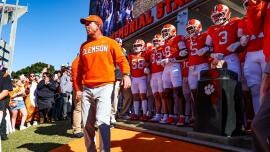
The Clemson coach stirred the pot this offseason by publicly accusing Ole Miss of tampering -- receipts in hand -- underscoring his ongoing resistance to the sport's new order. Yes, he signed 10 transfers, the most he's ever taken at a program that once treated the portal like a last resort. Yes, he fired offensive coordinator Garrett Riley after two uneven seasons. On the surface, that looks like evolution.
But do we buy what Swinney is selling?
Swinney replaced Riley with Chad Morris, his former right-hand man from 2011-14, back when Clemson's rise was just beginning. The Tigers went on to win two national titles after Morris left, and Morris hasn't exactly been in high demand since. This feels less like innovation and more like comfort food.
Is this the final act of a stubborn dynasty, or the reset of a two-time national champion who still knows which levers to pull? Right now, it looks more like a reboot no one asked for than a bold reinvention.
5. The real American
The American has separated itself as the premier Group of Six league. Now it has to prove it can stay there.
Four of its top head coaches bolted for power-conference jobs this cycle, and three didn't leave quietly. They brought their best players with them to Auburn, Oklahoma State and Arkansas, forcing a hard reset at the top of the league.
South Florida pulled perhaps the best hire by convincing Ohio State's Brian Hartline to Tampa, Tulane looked inward and promoted Will Hall, and North Texas leaned on retread Neal Brown. Those programs are well prepared to reload, particularly Tulane and USF.
But upheaval creates opportunity. Navy, stable and disciplined, suddenly has a lane to enter the playoff conversation if it can capitalize on the chaos.
The uncertainty isn't limited to the sidelines. Commissioner Tim Pernetti, widely viewed as a forward-thinking leader, is reportedly a finalist for the NFLPA job just two years into his tenure. If he departs, the league loses an architect in the middle of a crucial rebuild.
6. Michigan's reawakening
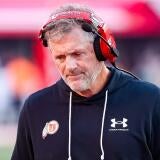
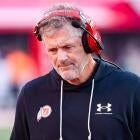
Michigan has been tangled in noise the last few years, and Kyle Whittingham should reset the room. You'll hear a lot about Whittingham providing a steady, disciplined hand and reinforcing high standards that slipped out of the Wolverines' grasp under Jim Harbaugh and Sherrone Moore.
But what I'm more interested in seeing is the development of rising sophomore QB Bryce Underwood in Jason Beck's jet-fueled offense. If he can turn Michigan into a top-15 offense overnight as he did at Utah, the Wolverines could be a contender in the Big Ten next fall.
7. Another Buckeyes rebuild on defense
Expectations do not rise and fall based on returning starters at Ohio State. Still, this spring feels like a recalibration for the Buckeyes.
Brian Hartline, the wunderkind assistant responsible for a generational run of receiver recruiting and development, is now the head coach at USF. On defense, Ohio State replaces eight starters from a unit that allowed only 9.3 points per game.
History shows we shouldn't discount the Buckeyes.
Matt Patricia stepped in as defensive coordinator last season and replaced a wave of starters from the nation's top-ranked defense -- only to produce the nation's No. 1 scoring defense again. The roster is still deep and built to win championships.
Replacing and replicating the production of Caleb Downs and Arvell Reese, along with Kayden McDonald, is going to be difficult, but it's certainly doable with this roster.
8. Freshman QB phenoms poised to start?
Two of the top three quarterbacks in the 2026 class could be starters next fall. We get our first glimpse at them this spring.
The most likely candidate to emerge as a starter is Vanderbilt's Jared Curtis, who famously flipped from Georgia to Vanderbilt and stayed in Tennessee. Replacing Diego Pavia was never going to be easy, but the excitement around a five-star freshman could ease -- and maybe later exceed -- expectations.
If you stay in the state, it seems increasingly possible that Tennessee could lean on freshman Faizon Brandon. The Vols failed to pick up a high-quality transfer in the portal, and Joey Aguilar lost his fight against the NCAA for another year.
9. Eyes on Texas
Texas and Texas A&M have proven to be worthy of the playoffs, and both enter the spring with arguably their best teams yet in the playoff era.
All politics are local, and it doesn't get much fiestier than Horns-Aggies this fall. Texas A&M is fresh off a disappointing first-round loss in the playoff to eventual national runner-up Miami, and the Longhorns missed the field for the first time in three years. Which team pushes past the other this season could define the rivalry for the next several years.
Texas solidified its contender status in the portal by surrounding quarterback Arch Manning with transfer receiver Cam Coleman and running backs Hollywood Smothers and Raleek Brown. Steve Sarkisian shocked many when he fired his defensive coordinator to hire veteran play-caller Will Muschamp.
The message emanating from Austin is clear: the time is now for Texas to strike as a championship contender.

10. The NCAA goes to Washington
Everyone wants the chaos to end in college sports. Spending is at an all-time high. Olympic and non-revenue sports are staring at insolvency. Athletes are transferring freely, cashing NIL checks and, in some cases, suing the NCAA for additional eligibility.
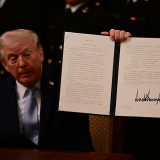
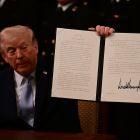
Simply put, the rules only matter to those who choose to follow them, and many are opting to take their chances against the system. College leaders want Congress to step in and provide antitrust protection. President Donald Trump's growing interest in the issue has heightened the stakes in recent months, prompting him to establish a commission on college sports and to invite leaders to the White House for a summit.
Getting Washington's power brokers aligned on the tangled machinery of college athletics was never going to be easy. Blending antitrust law, labor questions, Title IX implications, state NIL statutes and broadcast economics is something unique only to college athletics.
And that's all before politics enters the room. In that arena, persuasion is rare and position changes are rarer.
Still, this spring feels consequential.
11. Kiffin's world
Lane Kiffin captivates and frustrates in equal measure. He thrives in the spotlight, and he'll have plenty of it in Baton Rouge this spring while breaking in a roster powered by the nation's No. 1 transfer class.
LSU should contend right away under the former Ole Miss coach, especially with a big-money staff and a 40-man transfer haul that includes 14 blue-chip additions, headlined by former Arizona State quarterback Sam Leavitt. But the "Portal King" still has to fuse veterans with newcomers, build chemistry and establish a championship standard fast in a place known for short attention spans fueled by championship dreams. The real work starts on the practice fields this spring.
12. March Madness in the courtroom
College basketball owns March. College football owns the court.
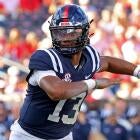
While brackets are being busted, eligibility rules are being challenged in college football -- and the NCAA keeps finding itself in front of a judge. Tennessee quarterback Joey Aguilar fought for an extra year and lost. Ole Miss quarterback Trinidad Chambliss went the other direction, securing an additional season after a Mississippi judge ruled in his favor.
Now, Virginia quarterback Chandler Morris is stepping into the fray. The 25-year-old is seeking a seventh year of eligibility after the NCAA denied his appeal in January, prompting him to file suit. Get ready for a high-profile legal showdown in a sport where the rulebook increasingly feels negotiable.
13. Oklahoma State's extreme makeover
The newest game on the coaching carousel isn't subtle: hire a coach, bring his former players to campus and flip the roster overnight. Indiana proved the blueprint works. Now others are chasing it.
Oklahoma State may have hit it big with Eric Morris.
The North Texas coach made a splash in Stillwater, upgrading one of the worst FBS rosters in the country by bringing in 53 transfers, including 16 from his Mean Green. Quarterback Drew Mestemaker and running back Caleb Hawkins were among the best in the Group of Six, and there's reason to believe their success will translate well in the Big 12. How it all comes together this spring is worth monitoring.
14. A new day in Happy Valley
Coaching changes don't happen often at Penn State, and Matt Campbell's arrival provides the hardest reset on the program since Bill O'Brien arrived 14 years ago.
The former Iowa State coach signed 39 transfers and brought along some of his own players, including veteran quarterback Rocco Becht. If anyone tells you they know what Penn State is going to look like next season, they're lying. That's why this spring in Happy Valley is crucial for Campbell, who is starting over himself for the first time in 10 years.
15. Bluegrass revival
Kentucky fans should be stoked about Will Stein. The former Oregon offensive coordinator landed a top-tier transfer class before he finished his tour with the Ducks, pulling the nation's No. 11 class, including five blue-chip prospects.
Considering Stein's history with quarterbacks at Oregon and his motivation to lift his home state, Kentucky, back on the map, the Wildcats could be a sneaky candidate for an overnight turnaround. The culprit of Kentucky's downward trend was offense and quarterbacks under Mark Stoops. That shouldn't be a problem for Stein.
16. The endless CFP debate
Don't expect chatter surrounding the format of the CFP to die down any time soon. A new deadline is on the calendar to make a decision for the 2027 season: Dec. 1. Everyone wants to expand the field from 12 teams, but how we get there is to be determined. The Big Ten wants a 24-team CFP and the SEC wants 16. The big boys opted to puff out their chests for a staredown rather than reach a compromise last fall. The two sides might be more willing to talk this summer, especially after the SEC's spring meetings, where athletic directors and coaches will have their voices heard -- and several are already saddling up with the Big Ten's 24-team proposal.
17. Notre Dame vs. The World
Notre Dame is Public Enemy No. 1 for many college football fans after the Irish threw a fit after the CFP didn't invite them to the party. Add in that Notre Dame is now assured a spot in the 12-team field as long as it finishes the year ranked 12th or higher, and you can understand why so many despise the Irish's games. It's now playoff-or-bust for Notre Dame, which isn't exactly fair to coach Marcus Freeman, but the public-relations nightmare and an easy-to-navigate schedule without longtime rival USC have placed him under a microscope. College football is better when Notre Dame is frustrating others -- but only if it is winning.
18. The soft cap
Schools are flexing their creative muscles to stretch their resources beyond the House settlement's $21.3 million cap on revenue sharing with players. The term "soft cap" has gained traction as schools go all-in on securing outside NIL deals for players this spring.
Texas Tech and several other schools with deep pockets are expected to exceed $40 million for the upcoming academic year. The Red Raiders plan to reallocate more than $10 million in corporate sponsorship funds to players.
Meanwhile, the power schools still haven't signed the College Sports Commission's participation agreement as the new governing body struggles to sink its teeth into regulatory measures.
19. Big Ten/SEC vs. The World
Two years ago, the Big Ten and SEC were college sports' power couple. Leaders mingled and shared ideas, and their commissioners even scheduled two joint summits to better align their missions.
Then, they hit a fork in the road. College Football Playoff expansion may have marked the split. The Big Ten pushed aggressively for doubling the field. The SEC signaled caution and compromise. What once looked like a power alliance now resembles a strategic rivalry.
The Big Ten has momentum. It nudged -- directly or indirectly -- both the SEC and ACC toward nine conference games. It has also celebrated three straight national championships, strengthening commissioner Tony Petitti's hand in every negotiation room.
Meanwhile, in SEC country, there's a growing sense that the balance of power is shifting to the North.
Late spring serves as "business season" for conference leaders as they conduct annual meetings with their executives. The storylines that emerge this May will set the tone for the next step in this cooling relationship.
20. The Hot Seat burns eternal
We just wrapped up the busiest coaching carousel in history, but the hot seat is never fully extinguished.
Every offseason resets hope, but it also sharpens ultimatums. Several prominent coaches face uncertain futures in win-or-else seasons next fall. How their restructured teams and staffs coalesce in the spring will shed light on whether all is lost.
No seat runs hotter than Florida State's Mike Norvell. The Seminoles have plummeted since their ACC title run two years ago, seemingly snake-bitten since their controversial CFP snub in 2023. The mere existence of chatter tying FSU to a potential Lane Kiffin pursuit tells you everything about the stakes in Tallahassee.
Elsewhere, Wisconsin upped its NIL cash flow to help Luke Fickell, who is in win-or-die mode. Baylor's Dave Aranda is hanging on, pinning his hopes on Florida QB DJ Lagway. Maryland's Mike Locksley is still fighting to stay afloat.
And then there's North Carolina's Bill Belichick. Year 1 was a hot mess. If Year 2 collapses, hard questions need to be answered.
Spring won't decide anyone's fate, but the tone from those practices will speak loudly.
21. You must be new around here
The FBS is expanding again with the additions of North Dakota State and Sacramento State this fall. Their additions feel different. Both programs are staring at a five-month runway before liftoff. No full portal cycle to reconstruct the roster or traditional coaching-carousel window to reshape staffs.
NDSU seems the most prepared for the big stage, having dominated the FCS with national titles in 11 of the last 15 years. They have a solid plan to expand resources and a modern football facility to serve as their base in the Mountain West.
Sac State is betting on itself after being turned away by other conferences during a very public campaign to receive a party invite. Its nearest conference rival in the MAC is now stationed more than 2,100 miles away at Western Michigan.
It will be fascinating to see how these programs handle the spring as they prepare for the big show.
22. The SEC's 9-game gamble
For three years, SEC coaches and administrators wrestled with one question: add a ninth conference game or protect the record? They finally chose the deep end. Now comes the second-guessing.
The move to nine games gained traction as playoff expansion to 16 teams appeared imminent, and the selection committee agreed it would more heavily weigh strength of schedule. The SEC read the tea leaves and leaned into the Big Ten's push for a universal nine-game conference schedule.
Here's the hitch. The playoff isn't expanding -- at least not yet -- and the SEC hasn't won a national title in three seasons. A ninth league game guarantees more losses in a conference already cannibalizing itself with the hardest schedules in the country, and without additional at-large spots as a safety net, those blemishes could matter more on Selection Sunday.
Expect grumbling this spring. Coaches are upset, while some administrators trend toward the Big Ten's 24-team playoff model.
What was framed as bold leadership in the SEC a year ago could morph into a strategic liability if the postseason path narrows.
23. USC poised to make noise?
The Lincoln Riley era at USC has been frustrating because of just how close the Trojans seem to be every season to breaking through. This year is no different, but there's a different tenor to monitor in Los Angeles.
Jayden Maiava returns at quarterback, and we know the offense will be humming with a veteran QB at Riley's disposal. Veteran coach Gary Patterson takes over as defensive coordinator, hoping to challenge the notion that USC's fight to be a respectable defense is not lost.
Pay attention to how USC's players respond to Patterson's coaching this spring.
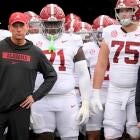
24. Alabama's identity crisis
Alabama is facing an identity crisis under Kalen DeBoer, who won 11 games in his second season but also planted a few red flags heading into 2026.
Alabama couldn't run the ball effectively last season, ranking 125th (104.1 yards per game), which placed too much pressure on QB Ty Simpson and led to a trio of embarrassing losses: at home to Oklahoma, in the SEC Championship Game against Georgia and against Indiana in the CFP.
This spring is all about rekindling some toughness within the Tide's program. Let it serve as a referendum. Four starting offensive linemen are gone, and Simpson is off to the NFL.
The Tide seemingly were on the right path when NC State running back Hollywood Smothers committed to the program, but he changed his mind and signed with Texas. Oof. The QB battle between Austin Mack and Keelon Russell will draw eyes -- and should -- but the more serious situation is in the trenches.
25. No portal, no problem?
The NCAA scrapped the spring transfer portal window at the urging of coaches, framing it as a step toward roster stability. But will players follow the rules?
Plenty of administrators privately doubt it.
There's a growing expectation that some athletes will attempt to leave in April or May anyway, enroll elsewhere over the summer and force the issue. If that happens, schools are prepared to push back legally. In an era shaped by antitrust rulings and athlete mobility, how strong is the argument to restrict a player's movement?
To deter chaos, coaches and ADs crafted a penalty structure aimed not at the player, but at the receiving school. Those new rules include a six-game suspension for a head coach. The emergency legislation could be adopted in April, though the penalty structure could change. Stay tuned.