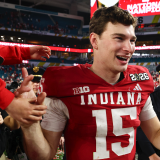

Inside the 12‑play drive -- and Fernando Mendoza's fourth‑down TD -- that won Indiana the national title
The Hoosiers went 12 plays for 75 yards, converted 4th‑and‑5 on a back‑shoulder, then let Mendoza finish it with a spinning, shoulder‑lowering QB draw.

MIAMI GARDENS, Fla. -- Indiana football's historic turnaround as the greatest rags-to-riches story in college football history may be the stuff of American sporting legend, but this is not a Disney movie. There is no magic pixie dust. The Hoosiers are not pulling rabbits out of hats. They are not staring at the game clock, shuffling their feet, before haphazardly driving the lane.
For Indiana, the fundamentals must be executed first before all else: blocking and tackling. It is the foundation on which all of this is built. Miami clearly had more blue-chip players on this night, and in the ferocious Rueben Bain Jr. and electric Malachi Toney, certainly the best individual players on both sides of the ball when both teams lined up, but the Hoosiers out-executed Miami in the game's most critical moments, and that's why they're the national champions.
In this way, Indiana is the embodiment of its head coach. They're boring by design, and the approach powered the Hoosiers to a 16-0 record.
Take the soon-to-be-legendary fourth quarter drive where the Hoosiers went up by 10, keeping Miami at an arms' length as they did for most of the night. It was a 12-play, 75-yard march down the field ending in a touchdown that Indiana had to have. Indiana's offense had sputtered throughout the second half, punting three times on their three possessions at that time. The Hurricanes had just scored and the momentum was changing. The strength of Miami's team, its defensive line, was baring its teeth, having sacked quarterback Fernando Mendoza three times.
So Indiana started experimenting with different personnel packages, turned the football clocks back to inception, and got more big bodies on the field to try and regain the physical advantage.
On the drive's third play, Miami corner Ethan O'Conner got a bead on a pass intended to Omar Cooper Jr. To that point, Miami's defensive backs had played a healthy amount of off-coverage on Indiana's receivers, allowing easy free access for Indiana's wideouts, which Mendoza had taken advantage of for short gains. O'Connor almost had a pick-six but batted the ball away and the Hoosiers lived to fight another down. Five plays later, right after Mendoza failed to hook up with Cooper on a throw that could have ended up in the end zone, Indiana called a timeout on 4th and 5. The decision was clear. For the first time in three CFP games, Indiana was going to go for it on fourth down.
Indiana did not run the most intricate of play designs. In the most crucial moments, it was about players over plays. Mendoza has executed back shoulder throws all season with his receivers (most often Elijah Sarratt) because they have practiced them so much since Mendoza arrived last spring from Cal. Those throws take timing and an uncanny relationship between receiver and quarterback.
CHARLIE BECKER STOPS ON A DIME AND HAULS IN THE PASS FROM FERNANDO MENDOZA! pic.twitter.com/lcA3IKHwv2
— TSN (@TSN_Sports) January 20, 2026
Mendoza had the option to pick either Sarratt to his left, or Charlie Becker to his right. For the type of throw to have the highest chance to succeed, the defensive back can be in tight man coverage but not inside of the receiver. Mendoza looked left to Sarratt and saw just that. Instead he went right and threw a ball Becker corralled, keeping his body in bounds to keep the drive alive.
"Me and Fernando, we've put in a lot of work in that, and, you know, it's done pretty well in the past couple weeks," Becker told CBS Sports. "As the play was called, we saw the look that we wanted. And I just knew that me and Fernando had this good connection. And as the ball was in the air, he has trust in me that I can come down and make a play with it."
CHARLIE BECKER STOPS ON A DIME AND HAULS IN THE PASS FROM FERNANDO MENDOZA! pic.twitter.com/lcA3IKHwv2
— TSN (@TSN_Sports) January 20, 2026
Three plays later, Indiana was again faced with a tough decision. Now well within kicker Nico Radicic's field goal range and five yards to go, would they kick to go up six or try to go up an extra possession with a touchdown? There was 9:27 on the clock.
"At first, the [field goal team] was out there, and then Cignetti comes up, he goes, 'we're going for it, get off the field!' offensive lineman Carter Smith told CBS Sports, doing his best impression of his coach's yinzer accent. From there, Smith said his marching orders were clear: "get out there and put your head down, go smack a cat in the mouth."
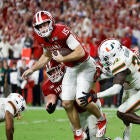
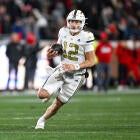
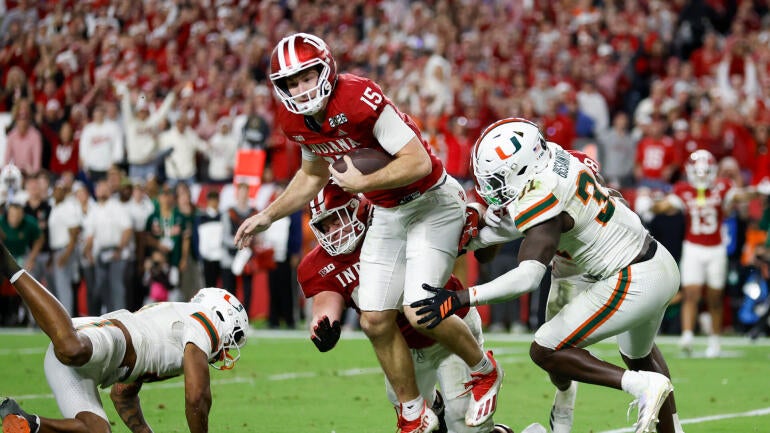
That is exactly what they did. With running back Kaelon Black, one of those James Madison transfers, as a lead blocker, Mendoza carried the ball on a quarterback draw to the left of his offensive line, jump-cut to the right to ensure a first down, lowered his shoulder on Miami linebacker Wesley Bissainthe, spun back as a result of the contact, somehow found time to regain his balance with a right-handed tripod in the dirt, then stretched and dove over the goal line for a touchdown that will go down in college football history.
FERNANDO. MENDOZA.
— ESPN (@espn) January 20, 2026
THE PLAY OF A LIFETIME ‼️ pic.twitter.com/g3o5nNNslr
A good offensive play can often be the result of a bad play by the defense, and that is the flip side of Mendoza's iconic run. If Miami defensive coordinator Corey Hetherman could do it over again, he would have called something different.
"I probably should have called a timeout there," Hetherman said. "We knew that play was coming open. Four (receivers) open, fourth and medium, that's been their go-to play out of that formation all year. We just got to execute that. I could see the signal wasn't getting there. We had [the call in to the defensive player with in-helmet communication], I could see Wes [Bissainthe] trying to make the communication, the 3-technique got it, we didn't get it to the defensive end. We knew what play it was, it wasn't a secret."

Multiple teammates refer to Mendoza as a dog. They appreciate the way he put his body on the line when it was needed the most. He is an unconventional runner. In scramble situations all seasons, he runs almost as if he's a smaller athlete than his long 6-foot-5 frame would indicate. You saw it on the touchdown where he absorbs contact, twists and wriggles his way free, nearly comes to a knee and catapults himself horizontally across the plain outstretched on the other side of bodies hurtling into each other.
"I think everybody on the team including Coach Cignetti makes fun of my running style," Mendoza said. "But as long as it gets the job done, it's 4th down, so no matter how you run, no matter what it is, you've got to put it all on the line, and that's something I was willing to do.
"Any player on our team, if they had that opportunity, they would put their body on the line, too. It's so great because Coach Cig has talked about how close we are, like that's just the epitome of how close we are. I'll have a big run, and [linebacker Aiden Fisher] will be like, man, you looked so stupid, but you got it done. So you make fun of each other, joke, and in the end, we'll all still be really close."
This is the difference in the highest leverage moments in the most important game of the season. Yes, sports often feature the surreal moments that you simply cannot explain where a player makes a play on sheer willpower or grit. But the Indiana machine is more calculated than that. There are cold, hard facts about the way they win: one team executes, and another doesn't. Fine margins decide champions, and it did tonight. It's no wonder how Indiana emerged victorious.