Ranking every Miami national championship team ahead of the Hurricanes' CFP title game showdown with Indiana
Miami won five national championships under four different coaches between 1983 and 2001

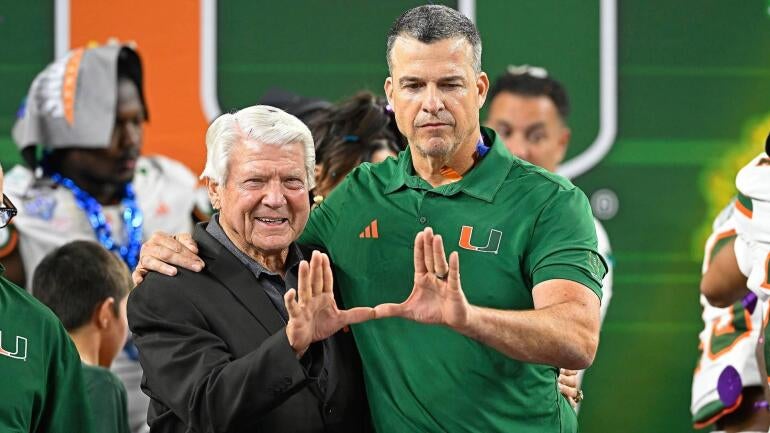
While No. 10 Miami enters Monday night's College Football Playoff National Championship as an underdog to No. 1 Indiana, the Hurricanes own a far heavier trophy case.
The Hoosiers are playing for their first national championship in what is already the most successful season in school history. Miami, by contrast, is chasing its sixth national title -- and its first since the 2001-02 season.
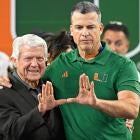
Since hiring Mario Cristobal, a two-time national champion as a player at Miami, the objective has been clear: restore "The U" to championship contention. The Hurricanes narrowly missed the ACC title game in each of the past two seasons, but with 23 wins over that span and a chance to play for the sport's ultimate prize Monday night, Miami has unmistakably re-established itself at college football's top table.
Carson Beck, Rueben Bain Jr., Mark Fletcher and Malachi Toney now have an opportunity to join the exclusive group of Hurricanes who have won a national championship -- a distinction that carries lasting significance within one of the sport's proudest programs.
Regardless of Monday's outcome, the 2025-26 Hurricanes will be remembered as a resilient group that validated itself on the field. Miami owns wins over the No. 2, No. 6 and No. 7 seeds in this CFP field and opened the season with a victory against No. 11 Notre Dame. Those results support what will be a lofty final poll ranking and confirm a genuine return to the national elite.
A championship, however, would elevate this team into rare historical company. A win over No. 1 Indiana would draw immediate parallels to Miami's 1983 national champions -- a team that lost early, received limited respect and ultimately seized the title by upsetting top-ranked Nebraska in the Orange Bowl.
Like that 1983 squad, this Miami team entered the playoff as the last team in the field, securing the final at-large spot as the No. 10 seed ahead of Notre Dame. Like that team, the Hurricanes were given long odds to reach a championship matchup against the nation's top-ranked opponent. And just as the 1983 Hurricanes reshaped the sport's perception of Miami, the 2025 team has a chance to do the same with a win Monday night.
Before placing this group among the program's championship greats, a baseline is required. With that in mind, and weighing both objective and subjective factors, we ranked all five of Miami's national championship teams. It is, inevitably, an imperfect exercise -- splitting hairs among exceptional teams -- but the combination of ratings, results and accolades provided enough separation to establish an order.
5. 1989: 11-1, Sugar Bowl Champions
The disappointment of 1988 helped shape the appetite around Miami entering the 1989 season. Jimmy Johnson departed after finishing No. 2 nationally, trailing a Notre Dame team that handed the Hurricanes their only loss of the season, a 31-30 setback in South Bend.
First-year coach Dennis Erickson inherited an experienced defense anchored by future Hall of Fame selection Cortez Kennedy. That unit ultimately produced five players selected within the first 80 picks of the 1990 NFL Draft. Miami opened the season ranked inside the top three and steamrolled the first half of its schedule, with five of its first six wins coming by margins of 28 points or more.
A 24-10 loss to rival Florida State in Tallahassee temporarily knocked the Hurricanes out of the title picture. But a victory over then-No. 1 Notre Dame revived their championship hopes and set up a clear path -- beat Alabama in the Sugar Bowl and hope for a Colorado loss in the Orange Bowl.
That scenario materialized. The Buffaloes lost to Notre Dame in Miami, opening the door for "The U" to claim the No. 1 spot for the third time in a decade.
Comparing national champions inevitably requires splitting hairs. But the 1989 Hurricanes land fifth in this ranking because of a double-digit loss to Florida State and a slight disadvantage in overall strength of schedule.
4. 1983: 11-1, Orange Bowl Champions
The value of the 1983 team, in terms of historic importance, likely exceeds what any cold, calculating rating can capture. Other title-winning teams can claim more star power in hindsight, but Howard Schnellenberger finishing No. 1 with a hyper-local football juggernaut signaled what was coming in South Florida.
The Hurricanes lost the season opener to Florida, then rattled off 11 straight wins. The run ended with a victory against No. 1 Nebraska on its home field in the Orange Bowl, securing the program's first national championship. Miami's credibility as a national title threat lagged throughout the season; the Hurricanes never climbed higher than No. 5 in the polls before vaulting to No. 1 after the win over the Cornhuskers.
Like many teams on this list, the 1983 Hurricanes were built around an elite defense -- one that rated as the best in the country by a comfortable margin. During the 11-game winning streak to close the season, only Nebraska scored more than 17 points, and seven of those opponents were held under 10.
That defense authored the defining moment of the Orange Bowl, stopping a two-point conversion attempt in the final minute to seal a 31-30 victory.
3. 1991: 12-0, Orange Bowl Champions
The spirit of the 1991 Miami Hurricanes appears to run deep within the 2025 squad, and not merely because current coach Mario Cristobal was an all-conference tackle during that title run. Miami won with an elite defense and a punishing offensive line, allowing Gino Torretta to serve as the steady hand behind a group that included Leon Searcy, Kelvin Harris and Cristobal.
The defense rates as arguably the best, from a performance standpoint, of any of Miami's championship teams. While the 1991 Hurricanes did not post the same volume of blowout victories as the 2001 team, opponents rarely found ways to score.
Only one Miami opponent reached 20 points all season, and it happened in a top-10 showdown against Penn State in the Orange Bowl in mid-October. That victory was one of three regular-season wins over top-10 teams for a Miami squad ranked in the top three throughout the season. The others included a 30-point statement win against Houston in September and the first edition of "Wide Right," a 17-16 victory against Florida State in Tallahassee.
The Hurricanes' 22-0 shutout of Nebraska in the Orange Bowl marked the Cornhuskers' first shutout loss in more than 18 years and concluded a landscape-shifting run of four national championships in eight seasons under three different head coaches.
2. 1987: 12-0 Orange Bowl Champions
It speaks to the internal fire that defined Miami football in this era that the story is often retold through the lens of avenging the previous season's failure. Jimmy Johnson's 1986 team performed at an elite level before unraveling against Penn State in the Orange Bowl, and that disappointment fueled the preparation for 1987. The Hurricanes returned plenty of experienced lettermen while making several notable changes to the starting lineup.
Lowered outside expectations became a perceived slight, and Miami embraced a brutal schedule with the intent of proving its championship pedigree on the field.
The Hurricanes opened the season with back-to-back wins against top-20 Florida and top-10 Arkansas, winning by a combined 71 points. After a victory against top-five Florida State in Tallahassee, it became a matter of holding serve into November. Miami closed the year with top-10 wins against Notre Dame and South Carolina before defeating No. 1 Oklahoma in the Orange Bowl to claim the national championship.
Michael Irvin, Bennie Blades, Bryan Blades and Daniel Stubbs led a group that went 5-0 against top-10 teams and 6-0 overall against ranked opponents, giving the 1987 Hurricanes one of the strongest strength-of-schedule cases among Miami's title teams.
1. 2001: 12-0, Rose Bowl Champions
Miami's talent level at the turn of the century was staggering in hindsight. The 2001 Hurricanes produced 17 future first-round NFL Draft picks, 22 future All-Pro selections and 38 players who eventually made an NFL roster. But what cements that team at No. 1 on this list -- and on many lists of the greatest teams in college football history -- is the way that unprecedented collection of talent dominated on the field.
Miami spent the entire season ranked No. 1 or No. 2, welcoming challenger after challenger and frequently handing out blowouts. The Hurricanes won by an average of more than 32 points per game and finished the season leading the nation in pass defense, scoring defense and turnover margin. Virginia Tech pushed Miami to the brink in Blacksburg in the regular-season finale, and Boston College dragged the Hurricanes into a defensive struggle in Chestnut Hill, but every other game — including the Rose Bowl victory against Nebraska — was decidedly lopsided in Miami's favor.
The roster featured six first-team All-Americans, including Bryant McKinnie and Ed Reed as unanimous selections, and quarterback Ken Dorsey finished third in the Heisman Trophy voting. After navigating NCAA sanctions in the late 1990s, the 2001 season marked a full return to dominance for a program that defined an era of college football.
Miami came within one game of winning a sixth national title the following season before losing in overtime to Ohio State. Not until the 2025 campaign would another championship be this close again.