Why BYU should make the College Football Playoff: Cougars earned a spot regardless of Big 12 title game result
The Cougars are the first 11-1 team from a power conference in the CFP era to not rank in the top 10. Why?

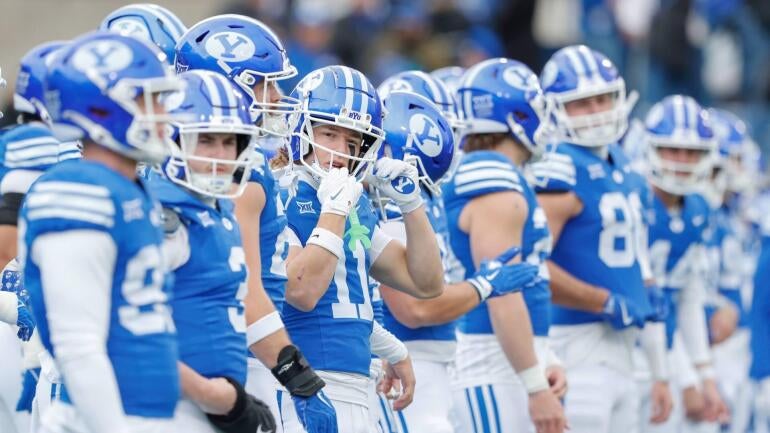
No. 11 BYU can play its way into the College Football Playoff with a win against No. 4 Texas Tech in the Big 12 Championship Game. But it shouldn't have to come to that. The Cougars deserve a postseason spot, and it's absurd that it remains in question.
In the history of the College Football Playoff Rankings, 61 power-conference teams have finished the regular season 11-1 or better. Every one of them entered championship weekend ranked in the top 10. All but two were seventh or higher.
And then, inexplicably, there's BYU.
The Cougars put together a sensational season, reaching 11-1 and earning a spot in the Big 12 title game. They beat No. 15 Utah and went on the road to shock No. 18 Arizona. Yet they sit at No. 11, looking up at several two-loss teams.
In an era of bloated megaconferences, it would at least make sense if BYU's record came with an unusually soft draw. Instead, they rank No. 35 in strength of schedule, ahead of Ole Miss, Notre Dame and Miami. For comparison, Virginia is No. 82. BYU played six of the nine other teams that finished league play with a winning record, and their strength of record sits at No. 6.
Even last season, Boise State reached the Mountain West Championship Game and was ranked No. 10. Somehow, the Cougars are receiving less credit than a Group of Five program.
The early-season nitpicks have also been overstated. A tight road win against Arizona looked shaky at the time, but the Wildcats proved to be a top-25 team. A slow start against Colorado ended with BYU outgaining the Buffaloes by nearly 100 yards. Since then, the Cougars' last four wins have come by an average of 19.3 points, including road routs of previously ranked Iowa State and Cincinnati.
Last year, BYU's profile leaned more on steadiness than star power. This year, there are All-America candidates at every level: running back LJ Martin, safety Faletau Satuala and linebacker Jack Kelly could play anywhere. This roster has real NFL-caliber talent.
Then there's the rise of quarterback Bear Bachmeier, who has transformed the offense. The true freshman has topped 3,000 total yards with 25 touchdowns and has improved steadily throughout the year. If Notre Dame is forgiven for two losses while breaking in first-year quarterback CJ Carr, it's baffling that BYU doesn't get similar credit for developing alongside Bachmeier.
Now the Cougars rank top 20 nationally in both FEI offense and defense, one of only 10 programs to hit that mark. They're also one of only nine to do so in SP+.
At every turn, CFP Committee chair Hunter Yurachek points to BYU's 29-7 loss to Texas Tech as the disqualifier. It's difficult to recall another instance where one performance is so heavily cited. And that's because it's the only real knock.
Meanwhile, a two-touchdown loss by No. 10 Alabama to Florida State is essentially ignored. The Tide trailed 24-7 late in the third quarter against a 5-7 team. Losing big to bad teams apparently doesn't count. Oklahoma was thoroughly outclassed by No. 6 Texas in a 23-6 loss, but beating No. 10 Alabama wiped that away.
Yes, BYU is worse than Texas Tech, and the Red Raiders dominated the Cougars in Lubbock. There's a real chance they'll do it again Saturday. Texas Tech is legitimately elite; SP+ would make them nearly a touchdown favorite on a neutral field against any SEC team. The committee assigns far too much blame to BYU and not nearly enough credit to Texas Tech.
Notre Dame can pound Boston College and Syracuse all it wants. Why should that matter more than handling a tougher schedule? How can the mythical eye test and selective use of analytics outweigh actually playing and winning high-level games?
The committee loves talking about the eye test when making confounding decisions. Somehow, the gaze always drifts toward golden helmets or crimson uniforms, resume be damned.
Last year, for example, BYU finished 10-2 and beat SMU on the road. The Cougars still ended up No. 17 in the final rankings, seven spots behind 11-2 SMU. According to an analysis by Stassen, BYU is on pace to become the most underranked team in the AP Top 25 since 1989 when comparing preseason to postseason position. Too often, it's Cougar Blue left out in the cold.
The case is clear. BYU is 11-1 with quality wins, real star power and a strong schedule. If a team like that can't play for a national championship, what exactly is the point of expanding the playoff?