2026 Fantasy Baseball: Scott White's Tout Wars draft shows the importance of adapting on the fly
While you'd like to hit a home run with every pick, Rotisserie drafts are long enough to make up for early inefficiencies

Sometimes it feels like 2020 is ancient history -- like when I'm drafting in Tout Wars, for instance.
I won the league that year, for those who don't understand the connection. It was the pinnacle of what had been a nice run of success to that point, but boy did the subsequent years knock me off my high horse. I finally made a little headway last year with a fourth-place finish, which entitled me to the fourth choice for where to pick in this year's draft. And with the fourth choice in the where-to-draft draft, I chose ... fourth.
That was my first mistake.
Here's how I reasoned through it. Tout Wars, at least the specific league I play in, uses OBP instead of batting average. It's standard Rotisserie otherwise (albeit on the deeper end, with 15 teams all vying for the top prize), but that OBP distinction takes some of the first- and-second-rounders down a peg. One of them is Bobby Witt, who doesn't walk much. He hits for a high enough batting average that he's likely to have a high on-base percentage anyway, but not high enough to make him the obvious No. 3 pick, in my mind. Who should be? I would say Juan Soto, who's already pretty close in traditional Rotisserie leagues and has the best batting eye in the game.
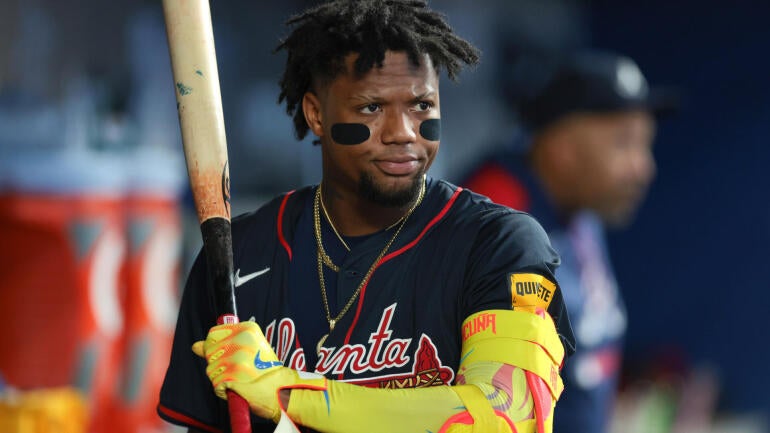
But maybe whoever was picking third would just default to Witt. I had to take that chance for a shot at Soto, and if I couldn't have Soto, I decided that locking in the premier player at the weakest position, Jose Ramirez, would be victory enough. He has reasonably good on-base skills, consistently reaching at a .350-.360 mark, and no real concerns across the other five categories. I convinced myself that I'd prefer him to Witt in an OBP league. I hadn't even considered Ronald Acuna.
That was my second mistake.
I don't work with OBP much. I have a sense of which players rise and fall when it comes into play, but I'm rarely having to cite specifics. So in the minutes leading up to my Tout Wars draft every year, I review the numbers, highlighting players at every position who stand out in OBP, and that's when I was reminded that Acuna has reached base at a .415 clip two of the past three years, better than Soto in both instances and about 60 points better than Ramirez. Sure, it would mean taking on more risk, but the more I thought about it, the more I realized there could be no other choice. On-base percentage is scarcer than batting average, and having that big of an advantage in that scarce of a category was too good of an opportunity to pass up.
And that's how I abandoned a weeks-long plan with only 10 minutes to go. Beautiful! And dare I say not my third mistake. Now, let's go back to the first mistake. Had I known Acuna was also in play for me, might I have chosen to pick fifth, taking whichever of him and Ramirez lasted to me? And had I been just as contented with Witt, might I have opted to pick sixth?
It matters because of what happened in Round 2. Snaking back, I had the 12th pick in that round, and you know who went 10th and 11th? Ketel Marte and Pete Alonso, two high-walk players at thin positions. Oh, how I would have loved to draft either one, especially since they represented to me the last of the second round-caliber players available in Round 2. I had the first choice of the lesser alternatives, and one look at Jackson Chourio's .308 on-base percentage last year steered me directly into the arms of Trea Turner.
I don't love it! The home runs and RBI will be truly lacking. The high batting average is undermined by poor walk numbers. Was it my third mistake? No, just the consequence of that first mistake.
Then came Round 3, where I debated between Matt Olson and Manny Machado. Olson I thought was the better choice statistically, offering the higher power ceiling and the superior on-base skills, and if I had taken Ramirez in Round 1, that's obviously the direction I would have gone in Round 3. But since I hadn't filled third base yet, I figured that was the higher priority, and Machado's production would be close enough. Here's what I actually tweeted at the time:
Went ahead and checked off third base with Manny Machado in Round 3 (Pick 34). Thought about going Matt Olson, but first base is one position that starts to look a little better, actually, in OBP. Famous last words? We'll see!
— Scott White (@CBSScottWhite) March 4, 2026
That was my third mistake.
First base got crushed in this draft. Every single choice was elevated well beyond ADP. Vinnie Pasquantino went 53rd overall. Willson Contreras went 110th. Sal Stewart went 136th. Looking at NFBC ADP since the start of spring training, they're normally 76th, 166th and 190th, respectively. And that's just the tip of the iceberg. Once we got past the Matt Olson range of first basemen, if you wanted a player at that position, you had to pay out the earhole for him.
Conversely, I ended up with three third basemen.
So to recap, I had a first-round pick that changed at the last minute and second- and third-round picks that made me uneasy in the moment and queasy in retrospect. Look away from this massacre, amiright?
My team is shown below. You can find the full draft results here.
Startling lineup (round number in parentheses):
C - Samuel Basallo, BAL (16)
C - Sean Murphy, ATL (28)
1B - Spencer Steer, CIN (18)
2B - Brice Turang, MIL (4)
3B - Manny Machado, SD (3)
SS - Trea Turner, PHI (2)
MI - Konnor Griffin, PIT (12)
CI - Isaac Paredes, HOU (14)
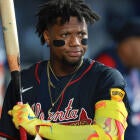
OF - Ronald Acuna, ATL (1)
OF - Pete Crow-Armstrong, CHC (5)
OF - Jose Altuve, HOU (8)
OF - Daulton Varsho, TOR (15)
OF - Chase DeLauter, CLE (22)
U - Royce Lewis, MIN (17)
SP - Jesus Luzardo, PHI (6)
SP - Framber Valdez, DET (7)
RP - Josh Hader, HOU (9)
RP - Carlos Estevez, KC (10)
SP - Trevor Rogers, BAL (11)
SP - Brandon Woodruff, MIL (13)
SP - Merrill Kelly, ARI (20)
SP - Ryne Nelson, ARI (21)
SP - Jacob Lopez, ATH (24)
Bench:
U - Bryce Eldridge, SF (19)
SP - Shane Bieber, TOR (23)
SP - Mick Abel, MIN (25)
SP - Parker Messick, CLE (26)
1B - Charlie Condon, COL (27)
RP - Alex Diaz, TEX (29)
Hang on, let me rub my eyes for a second. Yeah, that's what I thought. It looks ... fine. For as disappointing as it started out, I really think I pulled it together. Sure, there are weak spots. Yeah, there are areas where I'm asking for a lot to go right. If you make it through a 15-team Rotisserie draft without any of those, you have a guardian angel.
Pete Crow-Armstrong in Round 5 represents the other side of the OBP coin, as in the players who tumble down draft boards because they're bad at it. And rest assured, he's bad at it. He just delivered what may have been his best-case scenario in 2025 and had only a .287 on-base percentage in doing so. But other early-rounders who are bad at getting on base didn't fall nearly as far, and if 2025 is any indication, Crow-Armstrong is going to dominate the other categories. If opting for Acuna and his elevated OBP over Ramirez in Round 1 is what put me in a position to take advantage of Crow-Armstrong's slide, it was well worth it.
All right, I relented and took PCA in Round 5, 64th overall. The other players in my queue were Chris Sale, Max Fried and Ben Rice, and they all went back-to-back-to-back just before me, making it easy. I'll need to hit pitching hard soon.
— Scott White (@CBSScottWhite) March 4, 2026
You see how I pivoted hard to filling the pitching categories thereafter? It's not that I was opposed to taking a pitcher in Rounds 1-5. It's just that it would have been a reach to do so. I'm pretty happy with the stable of starters I put together, though. Jesus Luzardo performed like an ace last year apart from two miserable starts when he was tipping his pitches. Framber Valdez was regarded as an ace going into last year, and I don't see anything in the data to suggest he's a changed pitcher, despite the second-half slump. Trevor Rogers and Brandon Woodruff were themselves aces last year, at least for the period when they were active. There's some downside risk for those four, no doubt, but I circled back late with a couple of low-risk ratio stabilizers in Merrill Kelly and Ryne Nelson, two of the last of their kind, and gave myself even more bites at the apple with some upside arms late. I may not have made the biggest investment in starting pitching, but I got the kind of arms that could emulate such an investment and built in more pitching buffer than most teams did.
There's less margin for error as far as saves go. I don't think most anyone goes into a draft saying they want either of Josh Hader or Carlos Estevez as their closer, but you have to understand the context. Closer got hit harder than even first base in this draft. By the time I took Hader, Dennis Santana was already off the board. By the time I took Estevez, Seranthony Dominguez and Griffin Jax were already gone, not to mention Santana. Hader and Estevez were obviously the ones to take at the point when I took them, in other words, and there's certainly a scenario in which the two of them carry me to a top-three finish in saves. Hader's biceps injury doesn't seem like it'll keep him out for long, and he's been a stud closer since forever. Estevez's velocity apparently plummeted last spring as well before correcting during the season, and he went on to lead the majors with 42 saves. The risks are clear enough for both that they should be sliding down draft boards, but they shouldn't slide forever.
The pick that's probably going to get the most attention is Konnor Griffin in Round 12. That's the point when I knew I'd be slumming it at first base (Sal Stewart, Jonathan Aranda and Spencer Strider had gone off the board well ahead of ADP), and I wanted to make a splash at some other hitting position to make up for it.The timing was reasonable -- Griffin has been, on average, the 158th player drafted since spring training began, according to NFBC, and I got him at 177th -- and I can shift Jose Altuve from the outfield to middle infield if I end up having to wait a few weeks for the 19-year-old to arrive.
I'd say my linchpin pick, though, was Isaac Paredes two rounds later. The guy met four of my needs there at Pick 207, offering home runs, on-base percentage, corner infield help, and a path to first base eligibility as a semi-regular fill-in for Christian Walker. He'll have to play enough to make good on it, but I think the Astros recognize he's one of their better hitters and will rely on his versatility to get him in the lineup most every day. Not every player blocking him is a model of health anyway.
And about first base ... I don't hate the way that turned out either. I don't think anyone's excited to draft Spencer Steer in 2026, but he's a full-time player, which counts for a lot at the point when I drafted him, and was much better from May 1 on last year, having overcome an early health issue. He should keep me afloat in the counting stats, and in the meantime, Bryce Eldridge will be picking up first base eligibility. The consensus top-25 overall prospect has monster power and a clear path to playing time, but he's getting buried in drafts because he struggled in his first taste of the majors and opens the year with only DH eligibility. That'll change, though, with the Giants plan to have him and Rafael Devers flip-flop between first base and DH. Meanwhile, Charlie Condon is making a bid to claim the Rockies' starting first base job this spring with some impressive home runs already. He's a no-risk gamble that could pay off handsomely. And yes, Paredes is also a future possibility for me at first base.
Real quick, here's a summation of what I like and don't like about my team.
What I like about my team
I have plenty of stolen bases. This has been a trouble spot for me in this league over the years. Between Acuna, Turner, Turang, Crow-Armstrong and Griffin, it absolutely won't be this year.
I have four quality outfielders. Also typically a trouble spot for me. With every team having five outfield spots to fill, the position is stretched thin, particularly in a league of this size. It's hard to keep all five in top working order, but the task becomes especially arduous when you're having to patch up 2-3 spots at once.
I still got a potential stud catcher even though I basically ignored the position. Catcher is uncommonly deep this year, but once that depth is exhausted (which will happen in a league where 30 catchers are started), the gap between the haves and have-nots becomes even starker. That Samuel Basallo lasted to me at Pick 237 when he normally goes around 170th was something of a miracle. I very nearly paired him up with fellow rookie Carter Jensen at the 16-17 turn, which would have been unbelievably fortuitous.
I have contingencies at most every position. That's especially true along the infield and at starting pitcher. If Konnor Griffin doesn't make the team, though, and I have to shift Jose Altuve to middle infield, I'll be scrambling to pick up an extra outfielder.
I gave myself the most bites at the positions where I'm weakest, namely first base and starting pitcher. You're for sure going to be weak somewhere in a league of this size, but if you give yourself enough chances, you may not stay weak there.
What I don't like about my team
Apart from how the second and third rounds went, I mean.
I passed on Chase Burns for Josh Hader in Round 9. Just a flub on my part, and it's my biggest regret of the draft. While I would have put myself in an even more desperate spot for saves without Hader, that's just one category. If I had Burns' strikeout upside behind Luzardo and Valdez, my starting pitching would be a clear strength rather than a fingers-crossed situation, despite beginning my draft with five hitters.
All of my saves sources are in a precarious spot. It would have been nice if I could have paired Bryan Abreu with Hader, but he went at the start of Round 15, which was the same place where I was deciding between personal favorites Daulton Varsho, Kris Bubic and Joe Musgrove. No way could I have justified taking Abreu then. Meanwhile, Carlos Estevez's plummeting velocity this spring is a real source of alarm. There's been talk of Alexis Diaz getting a look as Rangers closer, which is why I threw my final pick at him, but it's been a long time since we've actually seen him pitch well.
Four of my pitchers are already injured. While it's true all of Hader, Brandon Woodruff, Merrill Kelly and Shane Bieber could begin the year on the IL, Bieber is the only one who I'm genuinely concerned could miss substantial time, and I drafted him 334th. Still, it's not like injuries go on pause now that the draft is over, and a couple more could put me in a really tight spot.
I have six rookies. I swore I'd never again entrust my fate to so many unproven players, particularly in a league with a sparse waiver wire to fall back on, but it's not like I was cutting in line to take any of Konnor Griffin, Samuel Basallo, Bryce Eldridge, Chase DeLauter, Parker Messick and Charlie Condon. Sure, it's risky to ask so much from Griffin and Basallo, but they both met a need that no one else in the player pool could have at that point. And whatever veterans I could have taken in the spots where I took Eldridge and DeLauter, to the extent I'm count on them, had their own risks, be they health-related, role-related or performance-related. So while I don't like drafting so many rookies in principle, it's what had to be done in practice.