Mike Axisa's 2026 Baseball Hall of Fame ballot
CBS Sports' Mike Axisa breaks down his selections for Cooperstown

By
Mike Axisa
•
13 min read
The National Baseball Hall of Fame's 2026 induction class will be announced next Tuesday, Jan. 20, and for the second time I had the privilege to vote as a member of the Baseball Writers Association of America. I started an old Blogspot blog about baseball as a hobby way back in 2006 because I was bored one day. That's really all there was to it. That eventually led me to CBS Sports in 2013 and the BBWAA in 2015. After the requisite 10-year waiting period, I became a Hall of Fame voter last year.
Over time, I've become a "big Hall" guy, and I'm big on comparing players to their contemporaries and within the context of the era in which they played, not the entirety of baseball history. That doesn't mean the best players of the generation automatically get my vote, just that I prefer to look through that lens, especially with pitchers. Their roles and their usage has changed so much over the years. I think Hall of Fame standards should adjust as well.
I treat postseason performance as something that can elevate a player's Hall of Fame case, though I won't ding someone for a poor showing in October. The postseason is often a tiny number of games and a small fraction of the player's entire career. As for performance-enhancing drugs, I will explain my feeling below. Here now is my 2026 Hall of Fame ballot:
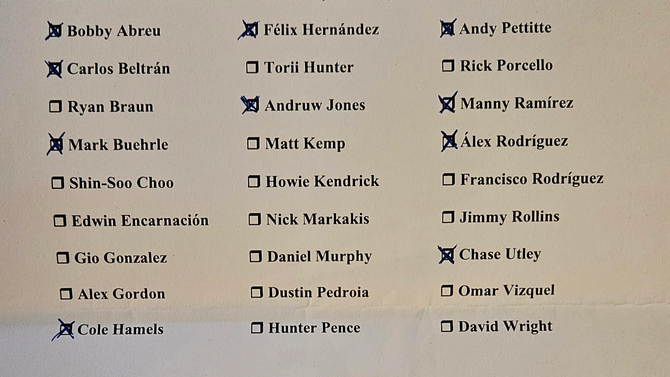
Unlike last year, when the great Ichiro Suzuki was Hall of Fame eligible for the first time, I didn't consider anyone on this year's ballot a slam dunk, no-doubt-about-it Hall of Famer. Everyone on this year's ballot required some level of deliberation. Cole Hamels, Félix Hernández, and Andruw Jones are the new additions to my ballot. They stepped into the spots that went to Ichiro, CC Sabathia, and Billy Wagner last year. The other seven players I voted for this year also got my vote last year.
Accountability and transparency are of paramount importance in this business. If you won't explain yourself, how can you expect the players and people you write about to do the same? How could you expect readers to take you seriously? To that end, here is why I filled out my Hall of Fame ballot the way I did. The players are listed in no particular order.
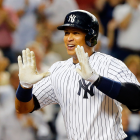
Manny Ramírez and Álex Rodríguez
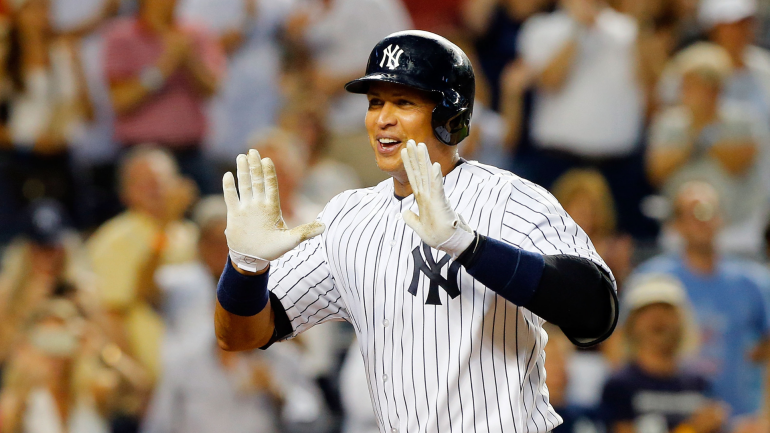
Manny and A-Rod were, honestly, the two easiest boxes for me to check this time around. Their on-field accomplishments are as good as it gets. They're two of the best right-handed hitters ever and Rodríguez is one of the best all-around players to ever play the game. He's one of only 32 players in the 100-WAR club and he has the highest baseball IQ of any player I've seen. Off-the-charts fundamentals and historic production. A-Rod was put on this planet to play baseball. He and Manny have first ballot numbers.
That said, neither Manny nor A-Rod are anywhere close to the 75% threshold for induction (they're both under 50% on the public ballot tracker as I write this) because of their PEDs ties. In their cases, it's not speculative. Ramírez tested positive twice and was suspended twice. A-Rod admitted his PED use (eventually) and served the longest PED suspension in baseball history in 2014. They did it. We know it for a fact and PEDs are the only reason these two will almost certainly never get into the Hall of Fame.
I have no issue with anyone, including my colleague Matt Snyder, who doesn't give Manny, A-Rod, and all the other PED guys their Hall of Fame vote. I try not to moralize and keep these things simple. Manny and A-Rod were punished in accordance with the rules of the time and served their suspensions. It's case closed. They were punished and I don't believe in punishing them further. Put "suspended for PEDs" right on their Hall of Fame plaques for all I care. It's part of their legacy. We can acknowledge it.
Also, I think it's very hypocritical that Bud Selig, who oversaw MLB making money hand over fist during the Steroid Era and didn't crack down on PEDs until the players pushed for testing, is in the Hall of Fame while these players are not. I take the responsibility of being a Hall of Fame voter seriously and I don't believe it means punishing players who have already been punished. Testing and discipline rules were in place and and Manny and A-Rod were punished accordingly. That's enough for me.
Carlos Beltrán
A true five-tool talent, Beltrán was pretty close to the perfect player at his peak. He hit for average and power. He got on base. He's one of the most efficient basestealers in history and he stole with high volume. He was also a terrific defensive center fielder. Beltrán has the counting stats (2,725 hits, 435 homers, 312 steals) and he had a Hall of Fame-worthy peak from 2003-11: .283/.371/.511 (131 OPS+) with 220 homers and 184 steals, and 5.0 WAR per season. His legendary 2004 postseason (20 for 46 with eight homers) is another feather in his cap. For me, Beltrán was an easy yes. He clears my Hall of Fame bar and then some.
The only real knock on Beltrán's Hall of Fame worthiness is his involvement in the Astros' sign-stealing scandal at the end of his career. He was the only player named in MLB's investigation (he publicly acknowledged his involvement afterward), which was conducted after Beltrán retired, and was identified as something of a ringleader. Beltrán was not disciplined because no player was disciplined as a result of the investigation. The Astros were hit hard by penalties. The players skated. Beltrán did, however, "mutually part ways" with the Mets soon after being named their manager because the scandal had become a distraction.
Similar to Manny and A-Rod, my thoughts on Beltrán's sign-stealing scandal involvement is that the league investigated and handed out the discipline it deemed fit, which in this case was none. He suffered some reputational damage and that's really it. I just don't believe in punishing players (by withholding my Hall of Fame vote) who have already been punished.
The longevity starting pitchers
I voted for four starting pitchers and I mentally have them playing in two different eras even though their careers overlapped quite a bit. The older of those four starters are lefty workhorses Mark Buehrle and Andy Pettitte, who got my Hall of Fame vote moreso because of their longevity than a towering peak. Neither was one of the four best pitchers of their era because they played at the same time as Roger Clemens, Randy Johnson, Greg Maddux, and Pedro Martinez. Buehrle and Pettitte were both very good every year for the better part of two decades though. Their careers numbers are quite similar:
| Buehrle | Pettitte | |
|---|---|---|
Years | 2000-15 | 1995-2013 |
Innings | 3,283 ⅓ | 3,316 |
W-L | 214-160 | 256-153 |
ERA | 3.81 | 3.85 |
ERA+ | 117 | 117 |
K/BB | 2.55 | 2.37 |
WAR | 60.0 | 60.7 |
7-year peak WAR | 35.8 | 34.1 |
To put that another way, Buehrle averaged 205 innings and 3.8 WAR per year for 16 years. Pettitte averaged 175 innings and 3.2 WAR per year for 19 years, plus he's the all-time leader in postseason starts (44) and postseason innings (276 ⅔ innings). Pettitte played an extra month all those years with the Yankees and had one fewer month to recover each offseason, yet he posted up every single season. His durability -- and Buehrle's -- was simply remarkable.
These two also have signature moments. Buehrle threw a no-hitter and a perfect game, and was the ace of a World Series winner. Pettitte had several terrific postseason performances, most notably the pivotal Game 5 of the 1996 World Series. Did you know Buehrle was second only to Hall of Famer Roy Halladay in pitching WAR from 2000-15? My Hall of Fame ballot is not strictly a "he met this WAR threshold, so he's in" ballot, but WAR does inform my decision to some extent. Buehrle had an incredible run.
Only 57 pitchers in history have thrown at least 3,000 career innings with a 115 ERA+ or better; only 23 of those 57 started their careers after baseball first expanded in 1961. Buehrle and Pettitte are two of the 23. Their sheer volume of high quality innings is enough to get my Hall of Fame vote. They may not have ever been the best pitcher in their league, but Buehrle and Pettitte were so good for so long.
The peak value starting pitchers
The other two starters I voted for, Cole Hamels and Félix Hernández, received my Hall of Fame vote because of their peaks more than their longevity, though both played a good long time. Hernández in particular has a strong argument for being the American League's best pitcher from about 2009 through 2014. During those six years, he ranked (minimum 1,000 innings):
- 1st in innings (1,394 ⅓)
- 2nd in ERA (2.73)
- 3rd in ERA+ (141)
- 1st in strikeouts (1,358)
- 2nd in WAR (33.4)
That's a six-year run averaging 232.4 innings and 5.6 WAR per season. Clayton Kershaw was at the height of his powers those years. He was the best pitcher in baseball. Hernández wasn't too far behind him at No. 2. He won a Cy Young (2009), could have won two more (runner-up in 2009 and 2014), and has a signature moment in his perfect game. Félix never got the opportunity to star in the postseason because the Mariners and their front office let him down. It stinks for him and all of us.
Sandwich several other strong seasons around that tremendous six-year peak, and Hernández did enough to get my vote. I will admit that he's on the lower end of what I would consider a Hall of Fame starting pitcher, mostly because he was done as an effective starter by age 31, but at his best, Hernández was about as good as anyone the game has seen the last 40 years or so. Compared to the historical standard for starting pitchers, no way is Hernández a Hall of Famer. My vote stems from me comparing a player to his era and only his era, and King Félix was one of the best to do it in the 2000s and 2010s.
As for Hamels, he had a longer stretch as one of the game's top starters than Hernández (3.81 ERA in 141 ⅔ innings at age 35, for example), though it is again the peak that does it here. Hamels averaged 202.7 innings and 4.5 WAR a year from 2007-17, and 4 WAR is right about where guys get to the All-Star Game and receive Cy Young consideration. Hamels never did win a Cy Young, but he was top eight in the voting four times, and he was the ace of a World Series winner at age 23 (he was the NLCS and World Series MVP in 2008). Plus we can add a no-hitter on top of that.
Hamels followed the usual aging curve beautifully. He was very good early in his career, at his best in his mid-to-late 20s, then he had a graceful decline in his 30s. Only 24 pitchers started their careers after baseball expanded in 1961 and finished with a 120 ERA+ or better in 2,500 innings. Hamels is one of them, and he ranked eighth in the 2000s and 2010s in pitching WAR despite not making his MLB debut until 2006. It's a "top five pitcher in baseball" peak with nice longevity as well. Like Hernández, Hamels was one of the best players of his era and that's how I evaluate starting pitchers for the Hall of Fame.
Bobby Abreu
Criminally underrated during his heyday, Abreu authored a .308/.416/.525 (143 OPS+) line and averaged 41 doubles, 23 homers, and 29 steals per season from 1998-2004. He was also a very good defensive outfielder in his prime (not so much later in his career). Abreu finished his career with 2,470 hits and 1,476 walks (20th all-time!), and is top 50 in career times on base. He reached base more times than Tony Gwynn (3,979 vs. 3,955) in fewer plate appearances (10,232 vs. 10,081). I say that not to diminish Gwynn, who I think is the best pure hitter of the last 50 years, but to elevate Abreu. I get that he's a stathead Hall of Famer more than a traditional choice, but I'm a stathead, and a Hall of Famer is a Hall of Famer to me. Abreu was getting on base at elite clips before it was cool and he was an all-around impact guy at his peak. He hit well, he ran the bases well, he defended well, and he did it for almost two decades.
Chase Utley
There is a pretty good argument to be made that Utley was baseball's second-best player behind Albert Pujols from about 2005 to 2009, a five-year stretch in which he hit .298/.388/.523 (133 OPS+) while averaging 27 homers and 15 steals per season. Add in excellent second base defense and only Pujols (44.6 WAR) bested Utley's 39.7 WAR those five years. That's a Hall of Fame peak to me, and not by a small margin either. Utley also had a gentle decline phase, putting up 3 WAR seasons well into his 30s before settling as a role player near the end. What a ballplayer this guy was. Well-rounded, hard-nosed, and clutch. He was the best player on those powerhouse late-2000s Phillies teams even though he wasn't the one winning MVPs. I have Utley as the best second baseman of his generation and one of the best of all time, really.
Andruw Jones
Like Félix Hernández, I would have voted for Jones last year if I had room on my ballot, but I did not. So it goes with the 10-vote limit. Jones was the greatest defensive center fielder of his generation and one of the greatest ever, and he did that while slashing .270/.347/.513 (119 OPS+) during his prime years from 1998-2006. The average Andruw season was 35 home runs and 6.1 WAR during that nine-season stretch. Jones was done as an everyday player by age 31, though he came up so very young -- he is the youngest player in history with a two-homer game in the World Series (age 19 in 1996) -- that he still put together a lengthy Hall of Fame career. I wonder if the perception of Jones' career would be different if he had his peak from, say, ages 23-32 instead of 20-29? He gets dinged for being done at a relatively young age, but he was still so good for so long.
Others considered
I voted for the maximum 10 players and, if I had room, I would have strongly considered voting for Dustin Pedroia and David Wright as well. I'm not 100% convinced they're Hall of Famers, though I would have given both a vote to do what I can to keep them over the 5% threshold to stay on the ballot another year so I could consider them further in the future. Like Andruw Jones, Pedroia and Wright were both done as everyday players in their early 30s, though Jones had a greater peak, so he got my vote.
Jimmy Rollins played for a long time and had some terrific seasons, plus retiring with 2,455 hits and 470 steals (and an MVP) is nothing to scoff at. Ultimately, there were too many seasons where Rollins was a below-average hitter (100 OPS+ only five times from 2001-15), and good shortstop defense and elite baserunning only counts for so much to me. Rollins is in the Hall of Very Good for me and not quite in the Hall of Fame. The peak was quite short and the longevity was more good years than great years.
There are no bad players on the Hall of Fame ballot. This year's ballot covers nearly three decades of baseball and only 27 of the thousands of players to play those years are on the ballot. Just getting here is an accomplishment. So although I didn't vote for Matt Kemp and Francisco Rodríguez and 15 others, I just want to say they were all very good players who carved out there own little place in baseball history. You don't have to be a Hall of Famer to make a mark on the game, and these 27 players all did.