
Could the Jordan Walker breakout finally be real? Why the erstwhile top prospect may have put it all together
On a rebuilding Cardinals team full of young hope, Walker looks like he could be part of the future -- if it lasts

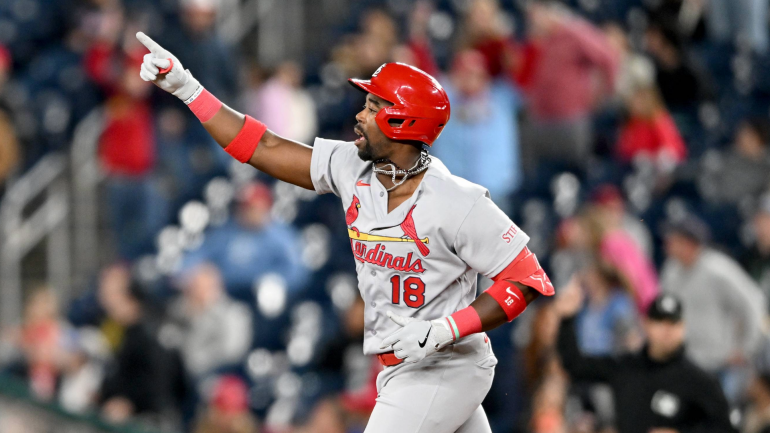
The numbers -- arresting in any context -- are made more stunning by the hitter who's authoring them. Through the first 16 games of the 2026 season, he's batting .333/.394/.767 with an MLB-leading eight home runs, including seven in his last eight games, and the best quality-of-contact indicators in the entire league. All of that is in pointed contrast to the hitter's prior two seasons in the majors, when he slashed .211/.270/.324 across a tidy 162 games from 2024-25. Over that span, he managed just 11 home runs in 527 at-bats. The hitter raised hopes initially with a solid rookie campaign in 2023 at just 21, but extreme struggles with making contact and keeping the balls he did hit off the ground seemed to waylay his promise.
The organization surely didn't help matters when they promoted him to the majors based on a couple of weeks of high batting average in Grapefruit League play in the spring of 2023. He was 20 at the time and hadn't played above Double-A, and at the same time, he was tasked with transitioning from third base to the outfield. In between largely fruitless stints in the majors, the hitter likewise struggled to produce in the minors. The shine had come off, and it continued to come off this past spring, when he showed the same fatal flaws through the vast majority of camp. Then, though, the first three weeks of the 2026 regular season happened, and what we thought we knew about this hitter has been smashed to bits -- not unlike the baseballs pitched in his direction lately.
By now, you've probably guessed that this nameless hitter is Jordan Walker of the St. Louis Cardinals, a 23-year-old former first-rounder and bygone top prospect who entered the current campaign perhaps in peril of being adorned with the "bust" label. Suffice it to say, said peril is far lesser right now, at least as much as it can be at this relatively early juncture of the season. His thunderous start to 2026 and the swift reversal of fortunes merit further exploration, especially given how vital Walker is to the Cardinals' long-term future.
Walker had two main weaknesses coming into 2026
Walker, as a large and strong hitter with best-in-class bat speed, has always hit the ball extremely hard. The problem in prior seasons, as hinted at above, is that he wasn't able to take full advantage of that skill thanks to excessive strikeouts and strong ground-ball tendencies. This season, he's made the sharpest progress on keeping the ball off the ground, which of course helps him hit the ball at, to, and over fences. Consider:
| Stat | 2025 | 2026 |
|---|---|---|
Ground-ball percentage | 47.5% | 34.2% |
Fly-ball percentage | 22.3% | 36.8% |
Average launch angle | 10.3 degrees | 13.5 degrees |
Barrel rate | 10.9% | 26.3% |
Ideal attack angle percentage | 47.7% | 62.9% |
For those unfamiliar, launch angle is the angle at which the ball leaves the bat; barrel rate is the percentage of batted balls that leave the bat with the ideal combination of launch angle and exit velocity for power production; and ideal attack angle percentage is that rate at which a hitter puts the sweet spot of the bat on the ball within the ideal range of angles at contact.
Walker in 2026 is hitting the ball harder than ever -- his average exit velocity of 97.1 mph (!) leads the majors -- and now he's putting it in the air via fly ball or line drive a majority of the time. Combine air balls with that kind of loud contact and you get power. That's why Walker leads the majors in homers and is slugging an MLB-best .767. Just about the only thing bigger than Walker's SLG is his expected SLG of .799. Yes, you can make the case he's actually been a bit unlucky at the plate thus far in 2026. No, he doesn't pull the ball in the air very often, but when you hit the ball as hard and as far as Walker does, it matters much less where in the air you're hitting it. All of this is why Walker in 2026 is racking up total bases instead of smoking 105 mph grounders to the shortstop and third baseman.
He's made more modest improvement in that other area, but that may be less important
When it comes to limiting strikeouts and more generally improving his plate discipline, Walker's progress doesn't leap off the page like his newfound fly-ball proclivities do, but it's progress just the same. Regard:
| Stat | 2025 | 2026 |
|---|---|---|
K% | 31.8% | 27.3% |
Chase rate | 34.1% | 29.7% |
Whiff rate | 35.6% | 30.9% |
BB% | 7.3% | 9.1% |
That's broad-based improvement, and it's no doubt playing a role in Walker's success to date. You'll note, as mentioned, that the breadth of Walker's improvement in the plate discipline arena isn't as substantial as it is at the level of batted ball. While he's whittled down his K%, for instance, he's still in just the 24th percentile in that category. He's still striking out more than the average batsman.
A team in general will live with strikeouts and swing and miss if it's in tandem with power. That's plainly the case with Walker this season, and his present capacity to do damage on contact means you can be even less mindful of his strikeouts. He's slugging more than 1.000 when he puts the bat on the ball, and he's got an xwOBA (what's this?) on contact of .689. Those are extreme figures, and if Walker is going to continue mixing his elite exit velos with his newfound ability to lift the ball, then you're not going to be so worried about his swing and miss. Shohei Ohtani and Aaron Judge, for instance, tend to strike out and whiff quite a bit.
Swing and approach changes are underpinning the improvements
While sample size caveats still apply and no firm conclusions should be made until that sample is larger, Walker's mechanical adjustments make all his progress more likely to be sustainable on some level. Those changes -- really, the latest suite of changes for Walker -- were hard-won. The St. Louis Post-Dispatch explains:
This past winter, Walker saw how adjustments to stay back in his hips and hit from his back side could help him tap into the ability to drive the ball from gap to gap. He went through adjustments focused on his movement in the batter's box to address how forward he felt when hitting. He worked through the adjustments, which would also allow him to see pitches better and help him navigate at-bats, in spring training.
The changes were a bit slow to take. At the nadir of Walker's spring training struggles, he was pulled from the lineup and assigned cage work with a pitching machine that replicates the stuff of specific major-league pitchers. Just before returning to game action, Walker was counseled by staff to, in essence, stop thinking about his new swing and let his body do what it now knew to do. Thereupon, Walker finished spring with a flourish and hasn't let up since.
In the service of keeping his back hip from collapsing too soon and seeing pitches better, Walker is now standing with his feet significantly closer together, which makes him more upright than he has been in past seasons. As well, his stance is significantly less open than it has been prior, and he's standing a little farther back in the box than he did in 2025. To state the obvious, it's all working.
He's vital to the ongoing Cardinals' rebuild
Under first-year president of baseball operations Chaim Bloom, the Cardinals are undertaking a belated rebuild that's already seen vets like Brendan Donovan, Sonny Gray, Willson Contreras, and Nolan Arenado traded away for, mostly, young pitching. A parallel effort is determining which young players will be part of the Cardinals' next winning core. If things go better than anticipated this season, the core may include "older" young players like Lars Nootbaar, Nolan Gorman, Alec Burleson, and Matthew Liberatore. More likely, it will be centered around the younger set like rookie second baseman JJ Wetherholt and Walker, who's a mere 111 days older than Wetherholt.
The Cardinals have for years struggled to develop a homegrown power hitter and, at the same time, a homegrown outfielder capable of producing at a high level. Walker, this new version of Walker, is poised to check both boxes and become a load-bearing presence for the Cardinals once they're ready to contend again.
That Walker is doing so well -- far beyond anyone's expectations coming into the season -- means that the Cardinals' rebuild is off to an optimal start. He's that important to the future of the organization.