
Luis Robert Jr. trade grades: Mets land low-risk, high-reward OF, White Sox invite more questions
Chicago netted back Luisangel Acuña and pitching prospect Truman Pauley

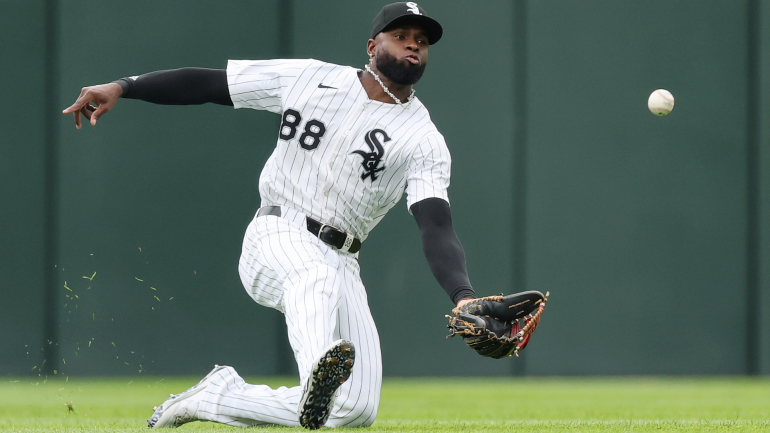
The New York Mets and Chicago White Sox agreed to a three-player swap late on Tuesday night headlined by former All-Star outfielder Luis Robert Jr. In exchange, the White Sox received two talents: big-league utility player Luisangel Acuña and minor-league right-hander Truman Pauley.
As is the case whenever a notable trade happens during Major League Baseball's offseason, I'm here to provide analysis on all of the involved players. I've also rendered a letter grade that sums up how each team fared in the deal. Do note that the letter grade is the least important part of the exercise.
Before getting too far down the road, here's the deal reprinted again in its entirety:
- Mets receive: OF Luis Robert Jr.
- White Sox receive: UTL Luisangel Acuña, RHP Truman Pauley
Let us proceed.

Mets grade: A
One of the inherent promises of Steve Cohen's extreme wealth is that it allows the Mets to conduct business like this, where they effectively gain upside by taking on another team's unwanted contract. Does the $20 million owed to Robert in 2026, plus the $2 million buyout on his subsequent club option mean much to Cohen or the Mets? Not at all. They were already well beyond the highest luxury tax threshold, to the extent that the only downside is a higher tax bill for Cohen. Who cares about that?
Robert, 28, is now a few seasons removed from a five-win campaign that netted him MVP award consideration. He hasn't performed well at the plate in either of the past two campaigns, hitting .223/.288/.372 (85 OPS+) with per-season averages of 14 home runs and 28 stolen bases. It doesn't help that he's remained prone to injury, with last year's 110 appearances serving as the second most of his big-league career. (Note that he's been around, on a full-time basis, since 2020.)
It's fair to describe Robert as a volatile player, in terms of performance and availability. But his volatility cuts both ways. It's possible that he misses chunks of time and only manages a one-win season (on the strength of his plus center-field defense and basestealing). It's also possible that the change of scenery helps him unlock more from his still-impressive tools. He ranked in the 90th percentile or batter in bat and sprint speed last season and, while the results haven't been there, it's clear that the potential for another 30-30 effort remains present if the Mets can help him get right.


Those disappointing topline results have obscured the gains Robert has made in other parts of his game. He's grown more disciplined at the plate, reducing his chase rate more than 10 percentage points since 2022 without a similar drop in his zone-swing rate. Additionally, Robert's whiff rate last season was his lowest in years. As for the environmental fits, it should be noted that Citi Field is more giving to right-handed power than Rate Field. Robert stands to perform better just by switching homes.
Granted, you may find it tiresome to talk so much about potential when the player in question is 28. At the same time, that's part of the warp and woof of modern baseball. The parlance goes that if you're reading about a hot stock in the newspaper, you're already too late. The seamhead version of that is that if you're relying on a Baseball Reference page to let you know who's on the rise, you're probably not going to pull off many value wins. (Besides, if you're going to play the lottery or invest in a penny stock, at least do it at the appropriate cost. This is that, in my estimation.)
If you'll allow for a cross-city comparison, this feels a bit like the deal from last winter that saw the Yankees acquire Cody Bellinger from the Chicago Cubs for reliever Cody Poteet. In both cases, the New York teams gave up little to land a somewhat expensive, highly volatile outfielder from their Chicago counterparts. The Yankees won their gamble in a big way, with Bellinger posting his first five-win season since he received the National League's Most Valuable Player award in 2019. Robert doesn't have to soar to such heights in order to provide the Mets with a boost and David Stearns with a savvy win.

White Sox grade: D
This is a messier trade to grade for the White Sox than it appears at first blush. Yes, their decision to exercise Robert's option has been vindicated. No, they didn't have to even pay down his salary to make it happen. Yes, they received two players of varying intrigue in return. No, they didn't maximize Robert's trade value -- either by moving him years ago, at the peak of his value, or by including money here to sweeten the pot, the way the St. Louis Cardinals have in all of their big winter trades. Yes, they created some financial wiggle room. No, it doesn't matter if they aren't going to use it. (If they do, on whoever and whatever, then fair play and feel free to mentally adjust this grade upward.)
Let's leave the rhetorical and theoretical aside and address who the White Sox actually netted here.
Acuña, 24 in March, isn't far removed from being regarded as a decent prospect. He's now without minor-league options or major-league success, a combination that made him a potential waiver candidate with the Mets. He should get a more extended opportunity with the rebuilding White Sox.


Acuña's offensive game is built around contact. He connected on almost 90% of his in-zone swings last season, albeit without doing much damage. His swing is flat and his barrel is often angled toward the opposite field at contact, limiting his ability to lift the ball (he had a 56% ground-ball rate in the majors). Acuña's approach also trends toward "aggressive," meaning that he has to hit for average to produce at a reasonable rate. When he does reach base, he has well-above-average speed and a track record (more than 200 steals in 533 minor-league games) of being a competent thief.
Defensively, it's to be seen how the White Sox deploy Acuña. Barring another move, they'll enter the spring with obvious candidates to start at first (Munetaka Murakami), second (Chase Meidroth), third (Miguel Vargas), and shortstop (Colson Montgomery). He doesn't seem likely to leapfrog any of those players, at least not out of the gates. In all likelihood, Acuña will serve in a reserve capacity, bouncing around to and fro as manager Will Venable desires.
An alternative option here is for the White Sox to audition Acuña in the outfield. He doesn't have much experience on the grass, but he's played there throughout winter ball and his speed should enable him to cover a lot of ground. Your mileage may vary on whether or not the White Sox should want their own version of Cleveland's Angel Martínez. That outcome doesn't seem out of the question though.
Pauley, 22, was the Mets' 12th-round draft pick last summer out of Harvard. He made three professional appearances after signing, walking more batters than he struck out in a small sample. Pauley showed off an arsenal that includes a low-to-mid-90s rising fastball, two breaking balls, and a cutter. That fastball featured more than 19 inches of induced vertical break from a 5-foot-6 release height, or several inches superior to the average four-seamer thrown from similar heights. That's the attribute to hold dear if you want to dream on him developing into a big-league contributor in due time.