
Why new Yankees pitcher with a 6.18 career ERA could surprise in 2026
The Yankees traded for righty Angel Chivilli earlier this week in a deal with the Rockies

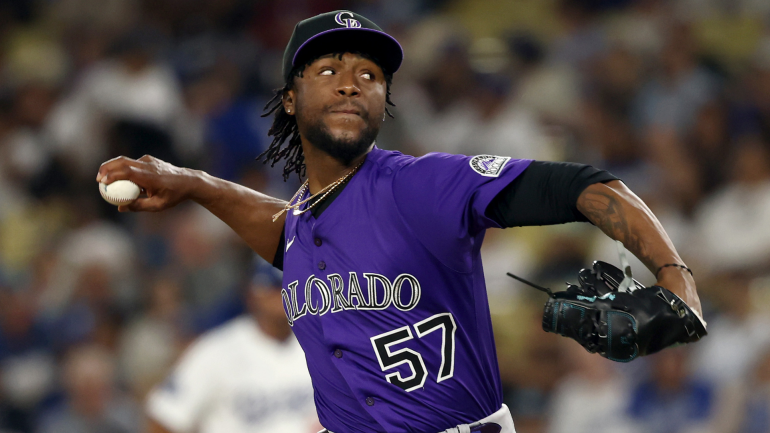
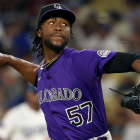
The New York Yankees made a small trade with the Colorado Rockies on Wednesday, sending out minor-league first baseman T.J. Rumfield in exchange for right-hander Angel Chivilli. The Yankees haven't made many external additions this winter, so making an exception for a reliever coming off a season in which he surrendered an ERA over 7.00 (7.06, to be exact) would seem like an odd use of time and resources.
Indeed, the 23-year-old Chivilli appeared in 73 games for the Rockies over the past two seasons, compiling marks that include a 6.18 ERA (78 ERA+) and a 2.15 strikeout-to-walk ratio. Last year alone, Baseball-Reference's estimates had him close to a win below replacement level. That's a fancy way of saying that he was perceived as pitching way worse than if the Rockies had picked a minor-league reliever at random and afforded him the same opportunity. Why bother?
Because a deeper look at Chivilli's game reveals why he's a solid bet to far outperform his career statistics heading forward. Here are three particular reasons why Chivilli is an intriguing add.
1. Innate traits
Earlier this winter, the Seattle Mariners traded catcher Harry Ford to the Washington Nationals for reliever Jose A. Ferrer. Ford is a top-100 prospect, albeit one whose value to the Mariners was diminished by Cal Raleigh's presence behind the plate; Ferrer, meanwhile, is a left-hander coming off a much better season than his inflated 4.48 ERA indicates.
Why is that relevant to this deal? Because it demonstrates, among other points, that teams no longer look at ERA when they're evaluating pitchers. Additionally, they're not focused just on past performance when they're projecting the future. The Mariners can all but bank on Ferrer pitching better for them because of his quality arsenal and some of his underlying metrics.
Chivilli is not as good as Ferrer, but there are more than a few similarities between them. They both throw hard (each average over 97 mph on their fastballs) with comparable capacities for spin, and they have close to identical arm angles and release points. The key differences are that Ferrer is left-handed; that he's fully leaned into throwing a sinker instead of a four-seamer (something that the Yankees may task Chivilli with doing); and that he has a nasty changeup with good sinking action (something else the Yankees may try to tweak with Chivilli).
Those are legitimate differences and they help explain why Ferrer netted a top-100 prospect and Chivilli did not. Still, the comparison is less important than the larger takeaway, with that being that pitchers cannot be assumed to be finished products anymore, not when they have loud innate traits.
2. Low-hanging fruit
There's clear room for improvement with Chivilli's game even if he doesn't add to or otherwise modify his arsenal. Part of that is because he's escaping Coors Field, the most favorable offensive environment in the majors. Part of it, too, is because his pitch mix leaves room for optimizing.
Last year, Chivilli threw his fastball 46% of the time -- that despite it being his worst pitch from a swing-and-miss perspective. His secondary pitches, a changeup and slider, both had whiff rates above 40%. Yet Chivilli threw fewer than 20% sliders despite it grading as his best weapon through the eyes of various public-facing pitch-quality models.
There's more to more to this than just throwing the pitch with the most whiffs, especially if the pitcher in question lacks the usability to throw said offerings for strikes often enough. Even so, it's easy to look at Chivilli and envision the Yankees having him follow the pathway cut out by Fernando Cruz, who upped his splitter usage by 20 percentage points (all the way over 60%) upon joining the Yankees.
That's the kind of low-hanging fruit that inspires confidence Chivilli will be much better heading forward than you might otherwise expect given his body of work.
3. Options
You can be excused if "can this player be sent to the minors?" isn't one of the first questions you ask of a new addition. Front offices have to be mindful of the answer to that question, however, as an essential part of the team-building process -- particularly when it comes to assembling a bullpen.
For those unaware, most players receive several minor-league "options" that kick into effect after the player is placed on the 40-player roster. MLB now caps how many times a player can be sent down throughout a season, but for three seasons (and sometimes four, in case of injury) the player can be moved between the majors and minors without requiring a trip through waivers. In other words, that player's team can rely on them being part of their depth chart for the rest of the year.
Chivilli, for his part, has another option year remaining. That's especially important to the Yankees, who are projected to have just three optionable pitchers in their bullpen: Camilo Doval, Fernando Cruz, and Jake Bird. Doval and Cruz aren't heading to the minors unless something goes wrong, and the Yankees can only hope that Bird fares better than last year's introduction to New York. Regardless, the Yankees are largely landlocked with their bullpen and needed some optionable depth in a bad way.
It's easy to see a scenario where Chivilli opens the season in the minors, where he can serve as insurance against injury/underperformance and work on some suggested tweaks away from the public eye that comes with pitching in the majors. At some point throughout the year, he's going to be summoned for a real opportunity to pitch for the big-league club -- and he just might surprise.