
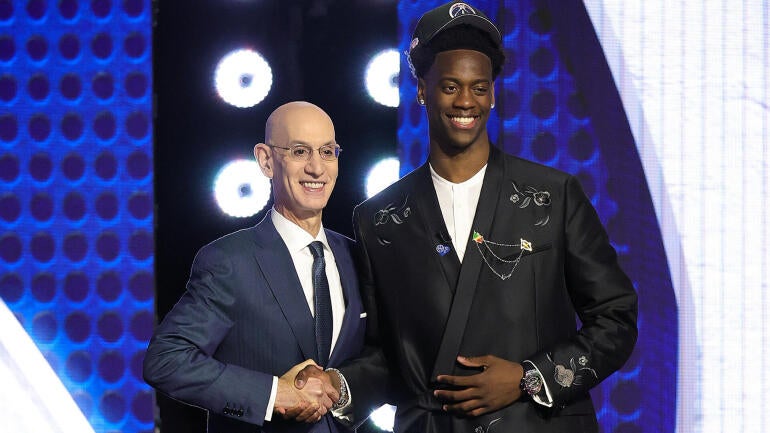
The 2026 NBA Draft is one that scouts and executives have targeted for several years now. Loaded at the very top with a Big 3 whose potential stardom has been well-documented since high school - AJ Dybantsa, Darryn Peterson, and Cameron Boozer could all change the course of an NBA franchise. In the hours leading up to the draft though, there was still uncertainty about exactly where they would all end up.
Thanks to the emergence of other freshmen like Caleb Wilson and Keaton Wagler, who could round out the top five, there's even more potential star power than we might have anticipated. Wagler is also just the tip of the iceberg when it comes to one-and-done point guards who could be prioritized in the lottery as Darius Acuff, Mikel Brown, and Kingston Flemings are all highly coveted coming into this draft.
While Brayden Burries and Nate Ament add even more from a loaded freshmen class, there are some college veterans to be had as well, particularly off the defending national champions. Just a day after Dusty May left Michigan to take the Dallas Mavericks job, Aday Mara, Yaxel Lendeborg, and Morez Johnson all have a chance to be a lottery pick. If it comes to fruition for all three then this would be the first time since 2007 that three-non-freshmen from the same team were picked in the lottery.
CBS Sports will be with you throughout the 2025 NBA Draft with pick-by-pick grades and analysis from our NBA Draft experts. Live, continuous coverage of the draft will also be available live on CBS Sports HQ at the top of this page or on any device of your choosing.
More: NBA Draft hub | LIVE updates | Team grades
CBS Sports mock drafts: Finkelstein | Parrish | Salerno | Norlander | Trotter
2026 NBA Draft Grades
Round 1

1. Washington Wizards: AJ Dybantsa | BYU | SF
Dybantsa is a prototypical big wing with positional size, length, athleticism, and an elastic build who can score from all three levels and create his own offense almost on demand. He pressures the rim, understands how to get fouled, and is as polished of a scorer as we've seen in several draft cycles. He will be a Day 1 scorer in the NBA and yet still has plenty of room to keep taking his game to new levels with the progression of his 3-point shooting, handle, and defense. Dybantsa legitimately has the potential to lead the NBA in scoring one day, but also has to prove that he can consistently impact, and ultimately, drive winning. Grade: A

2. Utah Jazz: Darryn Peterson | Kansas | PG
Peterson is the best fit here and has the higher long-term upside. At Kansas this season we saw a level of shot-making that we did not know existed. Peterson can get to the rim, score at all levels, and is a dynamic shotmaker. He has a chance to be the very best player to come out of this draft. With the frontcourt rebuilt this year, you can slot Peterson very cleanly next to Keyonte George to create Utah's backcourt of the future. With this move, the Jazz have essentially rebuilt its roster. The hope is that the durability issues from last season are now behind him and he can merge the shot-making we saw at Kansas with the creation we saw in high school. Grade: A

3. Memphis Grizzlies: Cameron Boozer | Duke | PF
Boozer has the highest floor in the draft and an underrated ceiling. Not only can no other player in the field match Boozer's history of winning or production, but Boozer also has an unmatched overlap of size, skill, physicality, and feel for the game. He's also very much in line with the type of player that Memphis has prioritized in the draft process in recent years. Memphis can plug Boozer in next to Zach Edey and Cedric Coward and Memphis' rebuilding project already has their frontcourt of the future figured out. Grade: A+

4. Chicago Bulls: Caleb Wilson | N. Carolina | PF
Wilson was the fairly obvious choice here. He has legit star-type outcome and potential. He's the most explosive athlete in the draft with a big-time motor and unusual elasticity (or bend) for a player his size. At North Carolina, Wilson was farther along offensively than expected and yet has immense room for progress, not just with his perimeter skill-set, but even his defensive polish. Those tools should check a lot of boxes for new Executive Vice President of Basketball Operations Bryson Graham. Grade: A

5. Los Angeles Clippers: Keaton Wagler | Illinois | PG
Of the four one-and-done freshman point guards, Wagler is the easiest to pair with Clippers' guard Darius Garland. The positional size and shooting give him on/off ball versatility that would be critical in this context, but it's his feel for the game and natural instincts that may be his true superpower. Wagler is a natural shooter with versatility to make shots off the catch, dribble, or on the move. He has terrific basketball instincts, high basketball IQ, and a very deliberate pace that prevents opposing defenders from speeding him up. Grade: B+

6. Brooklyn Nets: Mikel Brown Jr. | Louisville | PG
Brown gives Brooklyn a naturally skilled, high-upside, late-blooming lead guard, whose athleticism is catching up. He's incredibly skilled, naturally ambidextrous, has complete control of the ball, is a pinpoint passer, and a much better shooter than his numbers showed at Louisville. Brown Makes deep shots in bunches when he gets hot. Excellent left hand too. Very good floor-vision, passing, and ability to make reads coming off of ball-screens. Ranked in the 89th percentile as a pick-and-roll ball-handler. Grown into having positional size at 6-3.5 without shoes, long arms, and newfound athleticism. The concerns are Brown's lack of strength and physicality. He can hunt high-level plays instead of making the easy one, and he has a history of injuries, which could impact his durability.B rown impressed teams when he met with them face-to-face. Grade: B+

7. Sacramento Kings: Darius Acuff Jr. | Arkansas | PG
This is exactly what Sacramento wanted and it didn't have to trade up to get him. Acuff gives the Kings the type of offensive alpha creator they don't yet have and he provides a more immediate impact than other players on the board, especially on the offensive end of the floor. Acuff is a shot-creator and multi-level scoring threat. He has the strength, balance, and poise to dictate his own pace and supplements that with extreme confidence to deliver in big games and moments. There are some concerns with his defensive commitment and approach. Size, length, and athleticism are adequate for NBA standards, but not ideal. Grade: A-

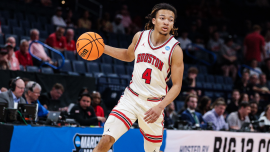
8. Atlanta Hawks: Kingston Flemings | Houston | PG
Flemings gives Atlanta a high-level athlete and two-way lead guard with a high floor. Flemings would fit with a defensively oriented young perimeter core in Atlanta, and give them plenty of upside if his shooting proves to be sustainable. What is undeniable is that Flemings is an elite athlete who can get a piece of the paint on demand and rise up explosively at the rim.
Flemings is a dynamic athlete with end-to-end speed, burst in his first step, physical strength, and leaping ability. He puts constant pressure on the paint, attacks both sides off the dribble, and rises up for big finishes. He's also capable of getting to his pull-up at virtually any time and arguably the most dedicated defender of this freshman quartet. Flemings has solid positional size, but lacks great length. His 3-point shot is still very streaky with questionable mechanics. Grade: B+

9. Dallas Mavericks: Morez Johnson Jr. | Michigan | PF
New Mavs coach Dusty May brings in a Michigan player to Dallas. Morez Johnson was one of the biggest winners of the combine, measuring bigger than expected with massive length, well-rounded athleticism, and simultaneously reaffirming the shooting gains we saw this year. Johnson is long and powerful with an NBA-ready body and rugged physicality to match. He is a two-way rebounder and a versatile defender who can not only guard ball-screens in multiple ways but also be switchable inside-and-out.
Johnson is not a creator and doesn't project as being more than a complementary piece offensively. Shooting is also still largely unproven with a total of 12 3-pointers in two college basketball seasons. He can provide some secondary rim protection, but doesn't project as a primary shot-blocker at the NBA level. Grade: C+

10. Milwaukee Bucks: Brayden Burries | Arizona | SG
The Bucks benefit from Dallas taking a swing on Morez Johnson and are able to get Burries at No. 10. Burries is a strong and aggressive two-way guard who can get downhill with force, provide a formidable 3-point shooter, and defend his position, all with an NBA-ready frame. He has versatility in his shot-making profile and utilizes his strength as an engaged defender and high-volume perimeter rebounder. Burries played point guard when he was younger, but hasn't shown the ball-handling or passing growth as much since. Best as a secondary handler. Grade: B+

11. Golden State Warriors: Yaxel Lendeborg | Michigan | PF
Lendeborg is one of the more versatile two-way players, and specifically defenders, in the draft. At 6-9 with a 7-3+ wingspan, he often guarded opposing point guards this year, is an excellent passer, and improved shooter who made 37% of his 3-pointers. Very good passer who can be a connector offensively, start the break himself, and has improved each year as a shooter.
The questions about Lendeborg are tied to his upside since he will turn 24-years-old before playing in his first NBA game. Very solid ball-handler for his size but more of a straight-line driver than dynamic creator or change of direction play. Aday Mara would have been a better roster fit here for the Warriors. Grade B-
12. Oklahoma City Thunder: Aday Mara | Michigan | C
The Thunder picking Mara here is easily seen as a direct answer to attempting to defend San Antonio Spurs superstar Victor Wembanyama for the foreseeable future. At 7-3 (without shoes), Mara is a giant, even by NBA standards, and a tremendous rim protector. He's also got sneaky mobility, good hands, real passing ability, and provides vertical spacing. Mara is a defensive anchor who alters or discourages as many shots as he blocks thanks to his timing and massive size.
Playmaking big who has good touch, can pass the ball from various spots on the floor, and even show some creativity with the way he can manipulate passing angles. Vertical spacer and lob threat who ranked in the 97th percentile at the rim with his extreme reach, underrated hands, and coordination for his size. Mara's body mechanics aren't ideal with less visible muscle mass and high/wide hips that can impact his flexibility. Not always a graceful mover on the perimeter, but more adept at keeping people in front than he sometimes gets credit for. He is an inconsistent free-throw shooter who has shown a reluctance to develop his face-up touch. Grade: A-
13. Milwaukee Bucks (via trade with Miami): Nate Ament | Tennessee | PF
The Bucks begin their rebuild after trading away Giannis Antetokounmpo by selecting Ament, a late-blooming 6-10 combo-forward who is fluid and has touch and skill. Ament remains inconsistent and needs to get stronger, but has a great overlap of positional size, along with dexterity (great left hand) and fluidity as a mover. He has soft natural hands and touch and a high release point on his shot.
Ament has a lack of strength and sheer force in his game, which can impact his physicality. He can play upright, without ideal bend or upper body elasticity, on both ends of the floor, and is somewhat in between positions defensively. Ament's shooting and finishing numbers haven't been nearly as encouraging in college as they were in high school. While his freshman year was up and down, Ament's overall arc has been linear, and there's still glaring potential. That upside makes him a logical choice here. Grade B+

14. Charlotte Hornets: Hannes Steinbach | Washington | PF
Steinbach is a skilled and smart big man who has elite hands and is a high-volume rebounder. He's a bit between a 4 and a 5, but with the NBA trending back towards more size in the frontcourt, he should be capable of playing both positions on most nights. Efficient offensive player (58% field-goal shooting) with footwork, passing instincts, and versatility as a roller (can slip, short-roll, or even play-make some). Soft touch around the rim and floor-spacing potential (35% on catch-and-shoot 3-pointers). There are some athletic limitations both in terms of vertical explosiveness in traffic and lateral mobility when pulled to the perimeter defensively. Grade: B
15. Chicago Bulls: Dailyn Swain | Texas | SF
Swain is a high-upside big wing who puts pressure on the rim, has all the tools to blossom into an elite defender, and significant upside if he proves to be more of a primary creator. The questions are the shooting and the high turnover rate. Swain checks a lot of boxes as a defensive-oriented big wing who can play off the bounce, pressure the rim, and provide some secondary creation.
He has the two-way versatility and the potential to play multiple positions with his perimeter size, 6-10 wingspan, and on-ball creation. If he proves to be a jumbo initiator, rather than a slashing wing, it changes his upside. Grade: C+
16. Oklahoma City Thunder (via reported trade with Memphis): Bennett Stirtz | Iowa | PG
Stirtz is a highly skilled true point guard with an elite feel for the game. He's not an overwhelming athlete or defender, but he's a big-time shooter, ultra-reliable, and always in the right spots. Stirtz one of the smartest players in the draft, a floor-spacer and another ball-handler who can run the offense. Stirtz combines true shot-making (49% on catch-and-shoot 3-pointers) with the ability to run.
Stirtz has solid positional size, but otherwise lacks overwhelming or ideal physical tools for NBA standards. Perceived lack of rim pressure and separation at the next level given his lack of elite burst. There are questions about how Stirtz will match up with elite playmaking guards at the point of attack defensively in the NBA. Good move by OKC to takes advantage of loads of future draft assets to make sure Memphis doesn't take the guy it wants. Grade: B+

17. Detroit Pistons (via reported trade with Memphis): Ebuka Okorie | Stanford | PG
Detroit did a ton of due diligence here on Okorie. He lacks overwhelming size, but he has terrific speed, can get a piece of the paint on demand, and his shooting continued to tick up as the season went on last year. Okorie puts constant pressure on the rim, beginning in the open floor by utilizing his speed, but continuing in the halfcourt where he's effective with his angles and footwork.
Okorie gives Detroit speed and rim pressure but is not an elite shooter, and so he doesn't really help their floor spacing quite as much as hoped around Cade Cunningham, but he does give them another creator when Cunninghm is off the floor
Undersized for the NBA with a still relatively undeveloped, 186-pound frame that needs to keep bulking up without compromising his burst. Grade: B
18. Charlotte Hornets: Christian Anderson | Texas Tech | PG
19. Toronto Raptors
20. San Antonio Spurs
21. Detroit Pistons
22. Philadelphia 76ers
23. Atlanta Hawks
24. New York Knicks
25. Los Angeles Lakers
26. Denver Nuggets
27. Boston Celtics
28. Brooklyn Nets (via reported trade with Minnesota)
29. Cleveland Cavaliers
30. Dallas Mavericks
Round 2
31. New York Knicks
32. Memphis Grizzlies
33. Brooklyn Nets
34. Sacramento Kings
35. San Antonio Spurs
36. Los Angeles Clippers
37. Oklahoma City Thunder
38. Chicago Bulls
39. Houston Rockets
40. Boston Celtics
41. Miami Heat
42. San Antonio Spurs
43. Brooklyn Nets
44. San Antonio Spurs
45. Sacramento Kings
46. Orlando Magic
47. Phoenix Suns
48. Dallas Mavericks
49. Denver Nuggets
50. Toronto Raptors
51. Washington Wizards
52. Los Angeles Clippers
53. Houston Rockets
54. Golden State Warriors
55. New York Knicks
56. Chicago Bulls
57. Atlanta Hawks
58. New Orleans Pelicans
59. Minnesota Timberwolves
60. Washington Wizards