

In a perfect world, NBA teams would make every decision purely based on basketball merit. It rarely works out that way. Locker room dynamics are tricky. Players fight hard to earn their stature within the sport. It affects their reputations, their earning power and their entire careers. It usually isn't something they're eager to sacrifice because someone else thinks it might make the team slightly better. For the sake of maintaining harmony, teams are frequently forced to make decisions they might not otherwise make.
The Portland Trail Blazers are currently experiencing such a dilemma. Earlier this offseason, the Blazers traded for Ja Morant. Last summer, they reacquired Damian Lillard as he recovered from a torn Achilles. And last season, Deni Avdija grew into an All-Star as Portland's only reliable ball-handler. Having one consistent shot creator isn't enough. Having three, at least in the wrong context, is too many. Yet at his media availability at training camp on Tuesday, Lillard said he expects to start alongside Avdija and Morant this season.
This was apparently news to first-year coach Micah Nori, who has made it clear he does not yet know who will start and, according to The Athletic, said that Lillard and Morant starting together would make little sense. That, fundamentally, is the issue here. Avdija, as the youngest and best of the players at the moment, will be starting.


The question is who should be starting next to him, and the basketball answer almost certainly isn't both Lillard and Morant. The pair would represent the NBA's worst defensive backcourt by far. Putting two extra ball handlers in Avdija's starting lineup mutes his own impact. Morant's poor shooting would just further cramp the floor for him. These are concerns that likely should have arisen as the Blazers were discussing the Morant trade to begin with, but that ship has sailed.
He's on the team now, and it needs to figure out how to make the most of him.
Why Ja Morant should come off the bench
On paper, the answer is obvious. Morant should come off the bench for the Blazers.
Lillard, at least the theoretically healthy version of him, represents the ideal balance between what the Blazers lacked last season and what they loaded up with for this season. Avdija badly needed someone to share the shot-creation burden with. Lillard's shooting equips him to more easily function off the ball while Avdija has it, yet his own pick-and-roll excellence should open doors for Avdija that were closed last season. If nothing else, sharing that load should help him bounce back defensively after a year spent devoting all of his energy to offense.
The defensive potential of lineups featuring a more balanced version of Avdija, Donovan Clingan, Toumani Camara and a high-level guard like Jrue Holiday is considerable enough to make up for Lillard's well-known deficiencies on that end of the floor. It sets Morant up to own the bench units rather than time-share with the starters.

The danger in acquiring a player like Morant is that his function on a roster mostly depends on him being a star-level shot creator. His poor shooting and defense simply don't scale down well. Even if you assume he can recapture his old form, the entire point of employing him is to give him the ball as much as possible and let him generate offense. He just isn't generating much value when he's doing anything else. Yet on a team with Avdija and Lillard (not to mention extension-eligible Scoot Henderson and Shaedon Sharpe when he eventually returns), that just isn't as valuable as it was on a Memphis Grizzlies team that was built around him.
Bringing Morant off the bench allows him to maximize the number of minutes in which he does what he does best, even if it means playing fewer minutes total. That is the version of this team that makes the most sense. It may not be the one Morant and his teammates are most excited to accept.
A challenge to navigate for first-year coach Micah Nori
Few 27-year-old former All-Stars are ever especially enthused by the idea of coming off the bench, after all. It's been less than a year since Morant's public spat with Grizzlies coach Tuomas Iisalo, and their issues were grounded more in Iisalo's unconventional rotation patterns than anything else. Morant still started every game he played for Iisalo last season. He's come off the bench only twice in his career, both following an injury at the peak of his powers. Though he's making max money now, Morant has only two years left on his deal. A move to the bench might make more sense for the team, but even if it succeeds, backups simply live in a different salary range than starters.
Nori is aware of all of this. "What we don't want is, just because Jrue may not care about starting, saying, 'Well, Jrue will handle it the best, so don't start him,'" he said. His expectation, for now, is to start Lillard and Morant together in the preseason and see how it plays out. If it comes to bringing Morant off the bench, Nori acknowledged the potential issues. "On the outside, I think he would handle it great," Nori said. "On the inside … I don't know."
This may be the sort of thing that needs to be settled on the court.
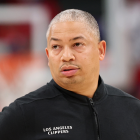
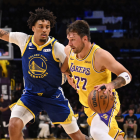
That very often happens in these situations, with Russell Westbrook being the clear example. Darvin Ham let Westbrook start three games for the Los Angeles Lakers in the 2022-23 season -- all losses -- before pulling the plug and moving him to the bench. Ty Lue approached Westbrook's partnership with the newly acquired James Harden similarly for the Los Angeles Clippers. They started five games together, lost all of them, then won 27 of their next 34 games with Westbrook off the bench.
Of course, the Lakers already had a year of evidence that starting Westbrook didn't work. Lue, as a championship-winning coach, had the cachet to make decisions other coaches might not. And by that point, Westbrook had already gone through a benching with the Lakers and was nearing the end of his Hall of Fame career. Morant is far younger. He's newer to the team than Westbrook was with the Clippers.
And Nori is not Lue. He's a rookie head coach balancing a number of competing priorities: how best to deploy his players strategically, how to keep them bought in, how to manage a front office that probably didn't imagine the $40 million player it acquired coming off the bench, and, inevitably, how to handle the reality that he's effectively on a one-year contract. He told The Athletic that it wouldn't affect his decision, but that's easy to say in October. Things get harder if the season starts poorly.
These are the sort of hard decisions coaches are hired to make. Whether it's now or later, there is a strong chance that the Blazers will eventually have to sell Morant on coming off the bench. How effectively they do so may be the determining factor in how successful their season turns out.