The Hawks are reportedly serious about an Anthony Davis trade, but that raises questions about Trae Young
The Hawks might need to move Trae Young to afford Anthony Davis

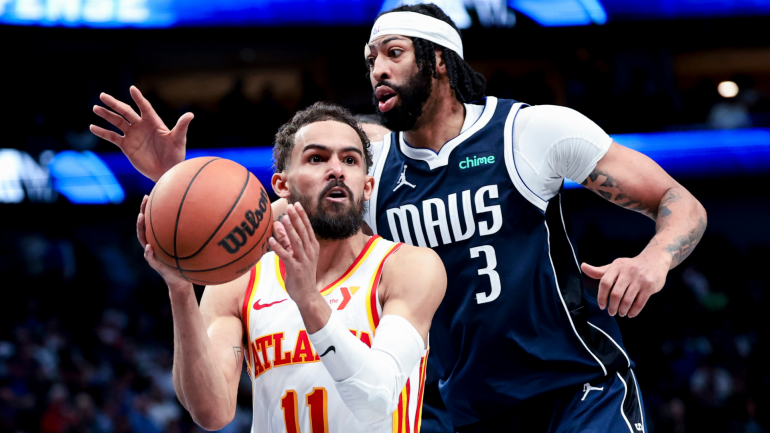
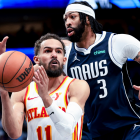
The Anthony Davis trade market seemed fairly quiet in the immediate aftermath of Nico Harrison's firing. A strong December seems to have awakened some suitors. In the nine games he completed this month, Davis has averaged over 23 points and nearly 13 rebounds while providing his standard defensive excellence and helping the Mavericks creep their way back into the Western Conference Play-In Tournament picture.
A number of teams, including the Golden State Warriors, have reportedly considered runs at Davis, but the Atlanta Hawks, according to Marc Stein, "do appear to be the most determined suitor for Davis at this juncture." There's a pretty straightforward path to a trade available if Atlanta wants to pursue it. The Hawks can do a good chunk of the necessary salary-matching with the expiring contract of Kristaps Porziņģis. They have a recent No. 1 overall pick in Zaccharie Risacher who, according to Stein, they are open to dealing in the right package.
Their draft debt to the San Antonio Spurs -- accumulated in the Dejounte Murray trade -- is far less daunting now than it looked in the moment. Aside from their seemingly untouchable first-round pick from the Pelicans this June, the Hawks should also have a mid-first round pick thanks to the swap rights they acquired from the Cleveland Cavaliers in last year's De'Andre Hunter deal. They owe San Antonio their first-round pick next year, but have a better pick incoming thanks from their follow up Murray trade with New Orleans. The Hawks will receive the lesser of the Pelicans' and Bucks' first-round picks in 2027, provided they don't both land in the top four. After 2027, the Hawks control all of their own first-round picks. They are free and clear to trade draft capital if they want to, and based on Stein's reporting, they are seemingly smitten enough with Davis to consider it.
But there's another obstacle in play here: money. Davis is owed quite a bit of it, over $58 million for next season, before you even factor in a possible extension. Reporting has indicated that Trae Young would not be in a possible Davis deal, meaning his $49 million player option has to be considered in any possible 2026-27 salary planning. Together, that's around $107 million. The Hawks owe another $85 million or so to core players Jalen Johnson, Dyson Daniels, Onyeka Okongwu and Nickeil Alexander-Walker. Throw in that first-round pick from New Orleans, and the Hawks are already flirting with $200 million in payroll committed to seven players.
This is notable since the projected luxury tax level for next season is just a hair below $202 million. The Hawks haven't paid the luxury tax since 2011 -- before both this ownership group and the original, punitive tax changes that came in the 2011 collective bargaining agreement much less the harsher ones that followed in the 2023 edition. Unite those six players and a high first-round pick and the Hawks would be a tax lock and would likely have to veer into apron territory to build the depth necessary to contend for a championship. Maybe this ownership group would be willing to pay the tax for this group. We just don't have immediate evidence that they would.
Stein's reporting acknowledges that reality while hinting at a possible solution: trading Young before he can exercise that option this summer. "There is a growing belief leaguewide that the Hawks are more open to trading him away than they've ever been," Stein wrote. Of course, this raises the issue we've been covering all season with players like Ja Morant and LaMelo Ball: there is seemingly less of an appetite around the league than there has ever been to trade considerable assets for defensively deficient guards who don't consistently make their 3s.
Young has missed most of this season due to injury. He's been disappointing when he's played, posting some of the worst shooting numbers of his career while generating less value as a playmaker as the Hawks have handed more of his on-ball responsibility to his younger teammates. Atlanta wants Davis because of how well it played without Young. With him, the Hawks are 2-8 so far this season. The question here is, if the Hawks don't want to pay Young, why would anyone else?


You're looking for a very specific sort of team. The concept the Hawks would seemingly be moving toward by bringing in Davis and sending Young out would be to lean fully into size and defense. That's become an increasingly popular model, while the heliocentric, pick-and-roll offenses of the past decade are starting to fall out of fashion. Such players can still have their place, but as floor-raisers more than ceiling-raisers. Young's deficiencies as a defender and off-ball offensive player are so glaring that teams trying to win a championship probably don't want him. But teams trying to win 40 or 45 games? Well, that's his speciality. The Hawks are on a five-year run in which they've won no fewer than 36 games and no more than 43 (or, if you adjust the 2020-21 season to an 82-game pace, 47). So the goal here would be to find a team that, for one reason or another, wants to be in that range and has expiring salaries to send Atlanta in order to accommodate its new, Davis-centric payroll.
The Clippers make a lot of sense in this respect. They have the expiring contracts in John Collins, Bogdan Bogdanović and Brook Lopez. They also have a desperate need to maintain some veneer of respectability. They're on track to hand the Thunder a high lottery pick this year, and they owe out their next three first-round picks to Oklahoma City and Philadelphia. This is a team that wants to be a recruiting power. Handing rivals future stars isn't the way to do that. Young could be a bridge. Pair him with Ivica Zubac and a bunch of defense-first wings and the Clippers could be competitive for a few years while they wait out the draft picks they owe and plan for their real future.
The Kings can usually be relied upon to do something reckless, and consistent play-in berths would represent meaningful improvement for them. They've already been linked to Morant. Perhaps they'd view Young as a suitable De'Aaron Fox replacement a year after their ill-fated Zach LaVine trade. They don't have expiring contracts, but there are ways of rectifying that. The easiest would involve them trading Domantas Sabonis elsewhere and ensuring that only expiring money comes back to them, which they could then flip for Young.
It's not an exciting pool of suitors, but that's where the point guard market is today. In truth, the proper basketball decision -- at least in the short-term -- would probably be to keep Young alongside Davis early on. They're easy fits as a high-end pick-and-roll guard and one of the best lob threats in NBA history. Perhaps playing together raises Young's stock enough to compel him to opt out this summer. Worst-case scenario, it's only one more year on his contract. Nobody is asking the Hawks to pay the repeater penalty. Keep the team together for a year-and-a-half. Pay one big tax bill. Re-assess things from there.
Some teams are more comfortable wading into those financial waters than others. This Hawks ownership group has never paid the tax, but it's never had a roster worthy of doing so either. Maybe a version of these Hawks with Young and Davis is good enough to justify it. Or maybe the entire concept of acquiring Davis is about reorienting the roster away from Young, leaning fully into all of that size and defense and athleticism they've accumulated even if it means sacrificing on offense. Stein's reporting here seems to hint that that's the idea. Why else would you be linked to one All-Star while simultaneously be open to moving another. This seems less like an all-in push than a deck shuffling. Davis is certainly gettable for the Hawks. The question here is whether they'll be able to make the money work around him, either by ponying up for Young or by trading him to keep the rest of the roster intact.