
Peyton Watson's breakout is a boon for the 2026 Nuggets and a potential financial crisis for the 2027 Nuggets
Watson, a restricted free agent this summer, is one of the NBA's top breakout players this season

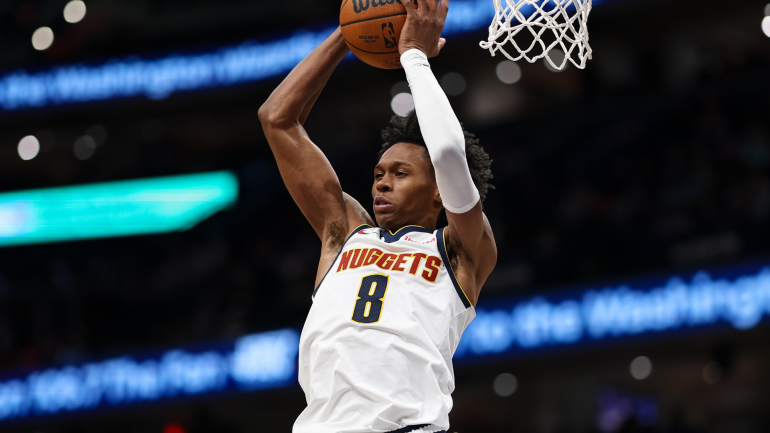
Take a bow, Calvin Booth. As messy as things may have gotten at the end of your tenure running the Denver Nuggets, one of those draft picks you banked the future on is really starting to bear fruit. Peyton Watson is one of the breakout players of the 2025-26 NBA season, and beyond Jamal Murray, likely the biggest reason the Nuggets have been able to stay afloat with Nikola Jokić injured. Thursday was just the latest step in his star turn.
In a 107-97 win over the Washington Wizards, Watson finished with 35 points, eight rebounds, four blocks, three assists and two steals. You can take that with a grain of salt, sure. It was the Wizards, after all. But since Jokić went down, Watson is averaging over 23 points per game. After years of struggling to develop a 3-point shot, he's up to 42.1% from deep this season on by far the highest volume of his career. Years of playing off of Jokić have honed his off-ball instincts, but in an NBA increasingly reliant on having multiple ball-handlers, the fact that more than one-third of his field goals have been unassisted since Jokić went down looms large. He's exactly the sort of big, athletic, multi-positional defender teams crave. He is, in short, becoming a perfect modern basketball player.
This bodes incredibly well for the 2025-26 Denver Nuggets as they attempt to win their second championship in franchise history. Depth limitations cost them their last two shots at the title. They've effectively lacked exactly this sort of player. If Denver wins it all this season, Watson's ascendance is probably going to be a big reason why.
But it creates some potentially significant financial problems for the 2026-27 Nuggets. Watson hasn't just grown into exactly the sort of player Denver needs. He's grown into exactly the sort of player everyone needs. The timing works out nicely for Watson. He's an impending restricted free agent, and demand is going to be high. There are quite a few teams at the bottom of the standings with cap space that are seemingly planning to be competitive next season. The Jazz, Nets, Wizards and Bulls could all use someone like Watson. The Lakers loom here as well, though it's unclear how they'll manage their potential cap space.
Denver not only has full Bird Rights on Watson, but the right to match any offer he gets in restricted free agency. Here's where things get tricky: as of right now, with just 11 players under contract for next season along with their first-round pick, the Nuggets are already projected to exceed the second apron. That's without Watson. With him? You can bet interested parties will try to frontload offer sheets to make Denver sweat. That could mean a payroll $25-30 million above the second apron. For reference, the most expensive team this season is Cleveland. The Cavaliers are around $22 million above the second apron, and will therefore pay roughly $392 million for their roster with luxury tax included. Denver would have to pay far more than that, because the Cavaliers aren't paying the repeater tax penalty. The Nuggets would. Depending on how expensive Watson gets, they'd potentially have the highest payroll in NBA history.
Let's make this clear from the jump: the Nuggets should just pay it. There's a time for frugality. That time is not when you have the greatest player in franchise history at the absolute peak of his powers. It might be 50 years before Denver has a player as good as Jokić or a team as good as this one. The Kroenke family, owners of this team, the Colorado Avalanche and the Los Angeles Rams, can afford a brief payroll bump. But they're not exactly Steve Ballmer or Joe Lacob. While they've paid the tax to keep the Nuggets in contention, they're not unlimited spenders. They let Kentavious Caldwell-Pope walk for free in 2024 to duck the second apron. Part of the motivation for last summer's Michael Porter Jr. trade was saving money. Sure enough, Denver has a pretty clear path to ducking the luxury tax this year if it wants to, though that would not reset their repeater tax clock. Their history would suggest some degree of caution when it comes to payroll. They're not the Warriors. The budget might be high, but it exists.
That's probably going to mean finding savings somehow, and it's probably going to be a more significant move than. So let's go through the options the Nuggets are likely weighing here as they figure out Watson's future.
Option No. 1: Trade Watson now
Let's make this clear from the jump: Denver shouldn't do this. Even if the Nuggets know for certain that they're losing Watson over the summer, his presence is meaningful enough to their 2026 championship odds that keeping him now is still the correct choice. The Nuggets really shouldn't be thinking long-term here. That isn't just because Jokić is in his prime, but because the Thunder and Spurs aren't. In all likelihood, no matter what course the Nuggets take with Watson, their 2026 team will be better than their 2027 team and their 2027 team will be better than their 2028 team. Their core is getting older. Oklahoma City and San Antonio are still so young that the natural course of time will help them as much as it hurts Denver. The Nuggets have several years of contention ahead of them, but their best chance at another title is here and now. Their odds probably decrease with each passing season.
This is only worth bringing up because of the haul Watson could generate. Every team needs wings. Every team needs youth. Every team can afford to trade for Watson's $4.4 million cap hit. There would probably be multi-first-round pick offers out there for Watson right now. Even with his raise coming next season, his restricted free agent rights would be that valuable. They could also combine him with other matching salary to pursue win-now help that makes more financial sense moving forward.
Of course, if you asked what the Nuggets would need in a world without Watson on their roster, the answer would be "someone like Peyton Watson." So that more or less eliminates this concept. There's no price that would make it worthwhile for this year's team.
Option No. 2: Sign-and-trade him over the summer
This option is slightly more desirable than trading Watson now for the simple reason that it allows him to be a part of this year's championship push. However, an offseason sign-and-trade would come with significantly more complications than an in-season deal involving his meager rookie contract. Why? Because under the 2023 CBA, when a player is signed-and-traded, the trading team can only bring salary back in the deal if it agrees to remain below the second apron for the rest of the league year. That wouldn't be plausible for the reasons we've already covered. Denver is slated to be a second-apron team next season. Therefore, the Nuggets would have to sign-and-trade Watson to a team with the cap space to absorb him so as to avoid that second-apron hard cap. In other words, the field is smaller. It would just be the teams with the money to pursue him as a free agent anyway.
However, those teams would still be incentivized to cooperate with Denver because of those match rights. Signing Watson to an offer sheet means tying up your cap space for 48 hours as you wait for the other team to potentially match the deal. Considering how quickly free agency moves now, by the time Denver potentially matched, there would be no other good way for the team in question to spend its money if not on Watson. Agreeing to a sign-and-trade guarantees that you'll actually secure Watson, provided he is on board with the contract. It would require cooperation from all three parties, but it's potentially doable. If the Nuggets decide Watson is the odd man out of their payroll, this is probably the course they take. If they decide Watson is essential for the long haul, well, we move on to other options.
Option No. 3: Nickel and dime the depth over the summer
We can broadly say that Denver's core consists of Jokić, Murray, Aaron Gordon, Christian Braun, Cam Johnson and now, Watson. Say the Nuggets could find someone to take the $7.5 million or so owed to Zeke Nnaji. That would likely mean attaching their first-round pick, which means shedding another $3 million or so in salary. And then there's Jonas Valančiūnas. His $10 million salary for next season is non-guaranteed, and given his offseason desire to return to Europe, he might not mind getting waived anyway. Between just those maneuvers, Denver could clear out a decent chunk of change.
Then you'd look to the structure of the Watson contract. The longer it goes, the lower you could theoretically set his starting salary. Consider the contract the Nuggets just gave Braun last offseason. He's getting paid $125 million over five years, or an average of $25 million. His salary in the first year of the deal, however, is at $21.5 million. He just gets 8% annual raises. Denver could structure a Watson deal this way if it needed to save every last penny for the 2026-27 deal.
Say Watson's deal starts where Braun's did. That six-man core would cost Denver roughly $207.3 million. The projected second apron is around $223.1 million. Denver couldn't duck it entirely, but with rookie deals and minimum salaries everywhere else, it could at least stay reasonably close to the line rather than bolting miles beyond it as Cleveland has this season.
Of course, that would mean betting big on minimum-salary players and cheap youngsters as depth. Valančiūnas has been the best backup center of the Jokić era. Would DaRon Holmes really be ready to replace him? Could Jalen Pickett and Hunter Tyson play consistent rotation roles as Booth once intended? Would they dump Julian Strawther and his $4.8 million considering how poorly he's played this year?
Denver would immediately become the most desirable minimum-salary destination in the NBA. Second-apron teams usually are because high-level minimum players know they can get minutes on those teams. It's how Milwaukee has done so well on the minimum market lately. Denver was already succeeding on that front having gotten Tim Hardaway Jr. and Bruce Brown for the minimum this season. But go ask the 2024 Suns or the 2022 Lakers what happens when you bet too big on minimums. There's a reason those players are available for that price. You might hit on one or two. It's very, very difficult to build an entire bench that way.
Option No. 4: Trade someone expensive over the summer
We've covered the "cheap out on the bench" path. Now, we consider that five-man core. Jokić is obviously untouchable. Murray almost certainly is too, not only now that he's headed for his first All-Star selection, but because, given the market we've seen for players like Ja Morant and Trae Young, there just isn't a worthwhile trade market out there for small guards on max contracts anyway. So really, the question becomes, would Denver potentially value Watson more than Gordon, Braun or Johnson? There are interesting conversations to be had about any of them.
Gordon is the player of those three that Watson theoretically overlaps with the most. Part of the reason Watson struggled to get consistent minutes early in his career was that he was, to an extent, a worse version of Gordon. They were both athletic freaks valuable primarily for defense and cutting, but since they both struggled to make 3s, playing them together would cramp the offense's spacing too much. Well, now both of them can shoot, so that limitation is gone. They've played 289 minutes together this season with a +13.5 net rating. The only real motivation for trading Gordon would be trying to get ahead of any age- or injury-related decline. He's 30, so that may be coming, but he's still so good and has so much equity with that organization that a trade feels almost impossible. Denver likely wants to lean further into the Gordon-Watson pairing for its defensive upside, not split it apart.
That leaves Braun and Johnson. Braun is homegrown. He was drafted by the old front office, but extended by the current one. Johnson is the external addition. The Nuggets gave up a valuable first-round pick to get him, so there is plenty of investment there, but he's had an up-and-down first season in Denver. He's making his 3s now, but he hasn't brought quite as much as a creator or defender as the Nuggets likely hoped. Braun is the more well-rounded player, but Johnson has the skill set they need more given his shot. Braun's hesitance to take any 3-pointer that isn't wide-open is a meaningful offensive detriment even if he makes the ones he takes. The Nuggets will always be a low-volume shooting team, so they've needed someone like Johnson or Michael Porter Jr. to help balance their shot diet.
It's always easier to predict a trade for the recent addition than the team lifer. Johnson is older and the team is probably less attached to him. But depending on how the rest of the season goes for Watson, either would be plausible candidates for a trade in order to facilitate keeping him. Watson has been better than Johnson this season. He's been better this year than ever version of Braun has ever been. Watson may not be at the Jokić-Murray-Gordon level of importance in Denver, but there's a real chance he passes the other two before the dust settles in June. At that point, it might just come down to who Denver can get a better offer for.
Option No. 5: Wait until 2027, let existing contracts expire
Everything we've covered thus far would involve changes for the 2026-27 season. But, as we argued from the beginning, the Nuggets should just pay the giant tax bill. After all, the way they're set up, it could theoretically just be a one-year blip. Even if Valančiūnas comes back, his contract expires in the summer of 2027. So does Johnson's. Maybe the move here is to get really expensive for one year, try to make the most of the next 18 months in pursuit of another ring or two, and then let some money come off of the books and re-evaluate where you stand.
There's one other notable Nugget whose salary will be different for the 2027-28 season, and that's Jokić. He was eligible for an extension last offseason and declined it. The expectation is that he will re-sign this summer, and that deal will include declining his 2027-28 player option and adding multiple years in its place. He's worth every cent he's eligible to sign for, but maybe the Nuggets could convince him to shave just a little bit off of his max to help keep more of the team together. Likely? Probably not. The best player in the world shouldn't offer discounts. But he's already cycled through multiple max deals, and the cap is rising so quickly that contract figures have gotten big enough for some players to willingly accept a bit less. Jalen Brunson and Kevin Durant have done so recently, albeit under somewhat different circumstances.
In a perfect world for Nuggets fans, ownership would keep this team together for as long as it is capable of contending for championships. That just isn't realistic. The Kroenkes should pay whatever it takes to do that. Their history running the Nuggets suggests they'll likely be a bit thriftier. If this team can't sustain a historic payroll indefinitely, fine. Denver is a small market. It doesn't generate the revenue teams like the Warriors and Clippers did when they were racking up monster tax bills on an annual basis. Having some line is reasonable. But punting on a team this good because of one expensive season would be an enormous disappointment. This is the appropriate middle ground. Play out the next two years. See how it goes. Adjust accordingly. And don't let this breakout player walk for nothing.