

There's a well-worn social media meme about messy people doing messy things because that's just who they are in their core. But then someone comes along and thinks they can fix that person despite all the available evidence to the contrary. This is the precursor to the classic Arrested Development bit. Something tells me Minnesota bossman Tim Connelly is unfamiliar with those pop culture staples.
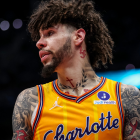
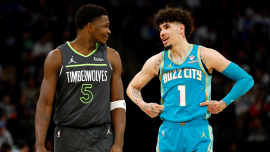
On Thursday, the Timberwolves acquired LaMelo Ball and Josh Green from the Charlotte Hornets in exchange for Naz Reid, a 2033 unprotected first-round pick, three first-round pick swaps (2028, 2029, 2030) and three second-round picks. That's a lot of draft capital for the Wolves to give up, to say nothing of losing a former Sixth Man of the Year in Reid, a guy who could have been the starting power forward in Minnesota after they cut ties with Julius Randle earlier in the week.
In the course of all this, the already-thin Wolves -- who gave Ayo Dosumnu a new five-year deal worth $112 million but are likely to be without the services of Donte DiVincenzo for next season due to an Achilles injury -- have even less depth. Pairing Ball with Anthony Edwards was apparently too enticing for the Wolves to pass up, but there are countless questions about why Connelly would find that so alluring and how he plans to build out the rest of the roster.
Why the Hornets wanted to move on
We'll start with Ball, who the Hornets rightly decided wasn't their guy anymore, choosing to take Reid, the haul of draft picks and swaps, and build around two players who are just flat out better in Kon Knueppel and Brandon Miller. Ball is a counting stats monster, but he's also rarely available. Yes, he played 72 games last season, but in the three seasons prior to that, he managed to be on the floor for just 105 games combined. And when he did play in Charlotte, the Hornets weren't a very good basketball team. In six seasons, the Hornets went 139-164 with him on the floor. That's less than ideal.
Credit to Hornets coach Charles Lee for trying to coach up Ball and get him to play within the confines of a team system, but LaMelo never consistently got the message. Now and then, it looked like he was willing to be less of a freelancer, only to then revert back to his poor decision-making and abiding love for me-first highlight reel hoops. Ball's brand of basketball is something approaching YOLO on roller skates. Someone -- and apologies to who first came up with this because I can't remember, but it was a great line -- once said he looks like he's playing basketball in slides. It can be entertaining at times. Unless your main goal is to try to win games above all else, at which point his approach is something much closer to maddening.
Even when the Hornets won games with Ball, it was just as frequently in spite of him as because of him. And sometimes all of that happened on the same night, where Charlotte was forced to overcome messy LaMelo for long stretches, only for him to do something spectacular when the odds seemed heavily stacked against it.
The LaMelo Experience (summed up in one game)
There was perhaps no better example of the full LaMelo Ball Experience than the Hornets play-in game against the Miami Heat this past postseason. Ball hit the game winner and the Hornets won the 9-10 matchup by one point in overtime.
That was good LaMelo, the flash of bright light that can draw so many people toward him. Bad LaMelo was everything that came before that moment, and there was a lot of it. Ball had 30 points, 10 assists and 5 rebounds in that game, but he also needed 31 shots to do it. That included an almost impossible but decidedly comical 14 misses on 16 3-point attempts. At some point, you'd think that, with his shot not falling from distance, he'd adjust his game. You'd think he'd give consideration to the situation on the floor, the time on the clock, how the game was unfolding and how he might best serve his team. You'd think that, and you'd be wrong. Just look at this inadvisable logo 3 he walks into against the Heat with the Hornets up three, halftime approaching, and a ton of time on the shot clock.
My favorite part of that clip is play-by-play announcer Kevin Harlan exclaiming "oh no" as Ball launched. There's perhaps never been a more succinct encapsulation of how Ball plays.
But that decision was merely a garden variety Ball mishap. There were far more egregious examples of him going Full LaMelo against Miami. At one point, he pulled Bam Adebayo's leg out from under him, causing Adebayo to miss the rest of the game with an injury.
bam adebayo; lamelo ball pic.twitter.com/BCgJzhF3oC
— ◇ (@F0RGIAT0) April 15, 2026
Heat head coach Erik Spoelstra wasn't amused. After the loss, he was asked about Ball's actions and said "I don't think it's cute. I don't think it's funny. It's a dangerous play." Spoelstra added that Ball should have been thrown out of the game. He wasn't, but the league did fine him $35,000. He also got hit with another $25,000 fine for cursing in the postgame interview while boasting about the game-winning shot -- which also conveniently helped everyone forget about the two boneheaded mistakes he made right before that easily could have cost the Hornets their dramatic victory.
With under 20 seconds remaining in overtime and the Hornets up two, Ball brought the ball up the floor but failed to react quickly enough to the Heat sending a double team at him before he reached halfcourt. He then panicked and threw the ball away, a costly turnover that let the Heat sprint the other direction where Tyler Herro ran to the corner and hoisted a 3-pointer. Even worse than the untimely turnover, Ball compounded his earlier mistake by fouling Herro on the shot. It was a disastrous sequence that was emblematic of how Ball's style, bad decision-making and lack of awareness can haunt his team.
Herro hit all three free throws to put the Heat up one. But because Ball made the last shot and won the game, those inexcusable miscues faded into the background. That game was a stark example of how volatile LaMelo can be on the court, but there are countless other instances that preceded it. And now it will be up to the Wolves and head coach Chris Finch to manage all the Ball boo-boos that follow.
Wolves have work to do
On paper, Ball's talent is tantalizing and there's an argument to be made that the Wolves had to roll the dice in the hyper-competitive Western Conference. They were unable to get past the conference finals in two consecutive years and got bounced in the second round this past season. Connelly obviously decided it was time for a change and evidently hopes that pairing Edwards and Ball will level up the Wolves. I'm skeptical.
The guess is that Dosumnu goes to the bench as a super sub and makes a bid for Sixth Man of the Year, because playing him as a starter along with Ball and Anthony Edwards would leave them vulnerable at the defensive end. Dosumnu is crafty but small, and the next time Ball plays good defense will be the first.
Beyond Ball, with Reid and Randle gone, who's the power forward here? Is Joan Berringer really the backup for Rudy Gobert at center? And how do they plan to address the rest of the bench? They have a team option on Terrance Shannon, while Bones Hyland, Kyle Anderson and Mike Conley are all free agents.
There's a lot of work to do in Minnesota. Connelly is one of the best executives in the NBA. He built the Nuggets roster that won the championship a few seasons ago and then overhauled the Wolves that went deep into the postseason in back-to-back years. But he doesn't have a ton of levers left to pull, considering he just gave the Hornets control of the Wolves draft for a big chunk of the next seven years. Connelly must have a vision here, but what it is beyond let Ant and LaMelo cook and hope for the best is hard to see at the moment.