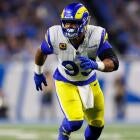


Three-time Defensive Player of the Year Aaron Donald is adding his name to the list of iconic football players to unretire, as he will rejoin the Rams after two years away from the NFL.
Specifically, Donald joins an elite group of pass rushers who came out of retirement. Among those players are Hall of Famers Reggie White, Charles Haley and former Defensive Player of the Year James Harrison. Donald is the second notable defensive player to unretire in as many years; Brandon Graham ended a seven-month retirement by returning to the Eagles for the second half of the 2025 season.
Donald's return inspired us to put together the following ranking of the best second acts in NFL history, which includes one of the most improbable postseason runs.
15. WR Randy Moss (2012)
After a year away from football, the dynamic Moss returned as a member of the 49ers. Moss caught 28 of 50 targets for 434 yards and three touchdowns that season while averaging 15.5 yards per catch.
In the playoffs, Moss caught seven passes for 112 yards that included two grabs for 41 yards in San Francisco's Super Bowl loss to Baltimore, which proved to be the final game of his Hall of Fame career.
14. DE Reggie White (2000)
A Pro Bowler each year from 1986-98, White signed with the Panthers for what ended up being the final year of his Hall of Fame career. In 16 games, White recorded 5.5 sacks before retiring as the NFL's career leader with 198 sacks.
13. DB Deion Sanders (2004)
Sanders chose his age -- 37 -- as his new uniform number upon signing with the Ravens and thus ending his three-year retirement. Despite making just six starts, Sanders was still a productive player during his two years in Baltimore. He recorded five interceptions that included his ninth career pick-six.
12. DB Eric Weddle (2021)
After having a borderline Hall of Fame career with the Chargers and Ravens, Weddle retired after the 2019 season.
Weddle signed with the Rams -- who suffered injuries as a safety -- just before the start of the 2022 playoffs. Weddle, 36 at the time, played well despite spending the previous two years on the sidelines. He started and won his only Super Bowl after helping the Rams defeat the Bengals in Super Bowl LVI.
11. TE Russ Francis (1982)
A three-time Pro Bowler with the Patriots, Francis played seven more seasons after signing with the defending champion 49ers ahead of the 1982 season. He won a Super Bowl with the 1984 49ers and later finished his 13-year career in New England.
10. QB Tom Brady (2022)
Brady returned for what would be his final NFL season 40 days after announcing his retirement on social media.
While the 2022 season wasn't his best, the 45-year-old Brady still played extremely well. For a second straight year, he led the NFL in both attempts and completions while throwing for 4,694 yards (the fifth-highest total of his career) and leading the 8-9 Buccaneers to a second straight division title.
Brady's decorated career came to an end in the wild-card round. He went 35 of 66 passing for 351 yards with two touchdowns and an interception in a 31-14 loss to the Cowboys.
9. RB Marshawn Lynch (2017)
Lynch famously announced his first retirement via a vague social media post during the Super Bowl. An Oakland native, Lynch returned a year later in order to fulfill his dream of playing for his childhood team, the Raiders. In 15 games, Lynch ran for a respectable 891 yards and seven touchdowns while averaging 4.3 yards per carry.
Lynch played in just six games in 2018 and didn't play at all in 2019 until he signed with the Seahawks -- the team he spent the majority of his 12-year career with -- late in the regular season. Lynch capped off his career by scoring three touchdowns in the postseason and helping Seattle win its final playoff game of the Pete Carroll era.
8. LB James Harrison (2014)
From a longevity standpoint, Harrison's comeback is one of the best in NFL history. While he was no longer a Pro Bowl-level player, the 2008 Defensive Player of the Year was still an able pass rusher who helped the Steelers win three division titles over a four-year span.
In 2015, Harrison notched two sacks during the postseason and led all postseason defenders in tackles for loss. A year later, Harrison became the Steelers' career sack leader. In the playoffs, he had 2.5 sacks and once again led all defenders in tackles for loss as Pittsburgh got to within one game of the Super Bowl.
Unhappy with his lack of playing time, a then 39-year-old Harrison left the Steelers late in the 2017 season. He finished his career in New England after helping the Patriots reach the Super Bowl.
7. QB Randall Cunningham (1997)
Cunningham retired after the 1995 season, having won just one of his four starts. He returned in 1997 with the Vikings as a backup, but ended the year with five consecutive starts, including a thrilling come-from-behind win over the Giants in the wildcard round.
In 1998, Cunningham delivered the best season of his career. Armed with the aforementioned Moss and Cris Carter, Cunningham finished second in the MVP voting while leading an offense that scored a then-NFL-record 556 points.
After a 15-1 season, the Vikings' season came to a crashing halt after they were upset by the Falcons one game shy of the Super Bowl. Cunningham lost his starting job the following season and finished his career as a backup in Baltimore.
6. TE Rob Gronkowski (2020)
Gronkowski added to his legacy as arguably the greatest tight end in NFL history when he reunited with Tom Brady in Tampa. After a one-year retirement, Gronkowski caught seven touchdowns in the regular season before catching one of Brady's three touchdown passes in the Buccaneers' Super Bowl win over the defending champion Chiefs. He was productive again in 2021 before hanging up his cleats for good. His Tampa run featued 100 regular-season receptions for 1,425 yards and 13 touchdowns.
5. RB Ricky Williams (2005)
Williams' career would be remembered much differently had he not returned in 2005 following one of the most shocking retirements in NFL history.
After missing the entire 2004 season, the 1998 Heisman Trophy winner enjoyed a productive 2005 season while sharing the workload in the Dolphins' backfield with then-rookie Ronnie Brown. Williams would miss most of the next two seasons before having three more largely productive seasons with the Dolphins before finishing his career with the Ravens.
While his retirement and 2006 suspension likely cost him a chance at the Hall of Fame, Williams still carved out an impressive career that included a rushing title and 10,009 career rushing yards. He does regret not finishing his career in Miami, which would have given him a chance to surpass Hall of Famer Larry Csonka as the franchise's career rushing leader.
4. QB Brett Favre (2009)
Favre's second comeback in as many seasons proved to be a memorable one. After spending one so-so season with the Jets, the 40-year-old Favre decided to return the following season, signing with the Vikings.
A motivation behind Favre signing with the Vikings was that it would give him the chance to face his longtime team -- the Packers -- twice during the 2009 season. Favre was lights out in both games against his former team, throwing a combined seven touchdowns and no picks while completing nearly 70% of his passes. The Vikings won both games en route to the NFC North title.
.@BrettFavre's first game against the Packers?
— NFL Legacy (@NFLLegacy) December 23, 2019
271 yards, 3 touchdowns, and a @Vikings win! #Skol (Oct. 5, 2009)#GBvsMIN: Tonight at 8:15pm ET on ESPN pic.twitter.com/vpVGs05O6f
Favre's MVP-caliber season ended in heartbreak, however, as his late-game interception contributed to Minnesota's overtime loss to the Saints in the NFC title game. Favre and the Vikings then endured a forgettable 2010 season that included two losses to the Packers, who went on to win that Super Bowl.
Favre retired after that season and went on to a 2016 Hall of Fame induction.
3. DE Ed 'Too Tall' Jones (1980)
The Cowboys' menacing pass rusher briefly retired after the 1978 season to pursue a boxing career. Jones returned a year later, however, and played another 10 years, including three consecutive Pro Bowl nods and an All-Pro selection in 1982.
A member of Dallas' 1977 Super Bowl-winning team, Jones' 106 sacks are the fourth-highest career total in Cowboys history.
2. FB/LB/T Bronco Nagurski (1943)
Nagurski had been retired for over five years before he returned for the 1943 season, as the Bears had lost so many players to World War II. Nagurski played tackle that season and also scored a touchdown as a fullback to help propel the Bears to the NFL Championship Game. He scored again in the title game as the Bears recorded a 41-21 win over Washington.
A member of the Pro Football Hall of Fame's inaugural induction class, Nagurski retired for good after the '43 season.
1. RB John Riggins (1981)
Riggins retired after the 1979 season over a contract dispute. He returned, however, prior to the 1981 season, while proclaiming, "I'm broke, I'm bored and I'm back."
Riggins' return started with a memorable meeting with then-Washington first-year coach Joe Gibbs, who drove to Kansas to convince Riggins to come out of retirement. Gibbs, however, was taken aback when Riggins, who had a beer in hand when Gibbs arrived at his home, offered him a drink as well. Mortified, Gibbs left the meeting thinking about possibly trading Riggins for a high draft pick if he rejoined the team. Riggins quickly squashed that idea, though.
"Two days later, I get a phone call from John," Gibbs recalled. "He goes, 'Joe, there's only one thing I want in my contract. ... A no-trade clause.'
"Now, I tell everybody, somebody up there was looking out over me."
Gibbs and Riggins led Washington to the franchise's first Super Bowl win a year later. He won Super Bowl MVP honors while carrying the ball a Super Bowl-record 38 times in Washington's 27-17 win over the Dolphins.
Goal Line, I-Left, Tight Wing, 70 Chip on white
— Kevin Gallagher (@KevG163) January 30, 2025
The Diesel, John Riggins
Redskins #HTTR #RaiseHail
The signature play of Super Bowl XVII
January 30, 1983 pic.twitter.com/iAExA4l7lt
Riggins then led the NFL in rushing touchdowns the next two years while leading Washington back to the Super Bowl in 1983. He retired for good after the 1985 season and was inducted into the Hall of Fame in 1992.