
FRISCO, Texas -- Communication is one of the many reasons the Dallas Cowboys' defense face-planted under now-fired defensive coordinator Matt Eberflus in 2025. Since-released Pro Bowl cornerback Trevon Diggs repeatedly went at Eberflus on the record about communication issues and not enough man coverage usage, but he wasn't alone in those who were dissatisfied.
Cornerbacks DaRon Bland and Reddy Steward told CBS Sports that Eberflus' defensive play calls were sometimes one or two entire sentences. That left the Dallas defense a step behind opponents in getting lined up, both individually and collectively. The end result was Dallas being the NFL's worst scoring defense (30.1 points per game allowed), passing defense (251.5 passing yards per game allowed) and third down defense (47.3% third down conversion rate allowed) in 2025.
"It's more so how fast the offense is moving, that's what speeds you up," Bland said. "You have to get the call and then get everybody on the same page at the same time, and make sure everyone gets good communication. When we're going fast, I have to know my job, and I hope my teammate got it. Sometimes it was moving too fast, so we couldn't get all the communication."
Bland agreed with the assertion that the defense was collectively moving half a step slower due to longer calls last year.
"Yeah, because we still have to diagnose the offense to see how they're lined up," Bland said.
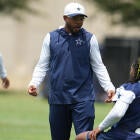
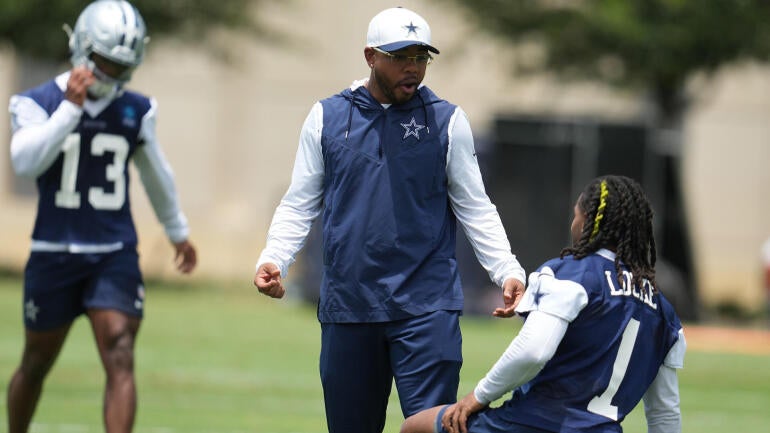
Fixing that defensive play-call communication is one of the things new defensive coordinator Christian Parker, a longtime disciple of Vic Fangio, has focused on early in his tenure in Dallas. His solution: shortening play calls to as few as two to four words for an entire call. That's it.
Making his defensive play calls as simple as they are hasn't been easy. Parker possesses an ever-expanding Microsoft Excel document on his desktop to organize what words mean, and which specific player assignment actions on the field. Weapons, NBA teams, and insects are among the word categories Parker uses to build his defensive play-calling system. The first letter of some of these words -- letters like S, W, F, B -- also has an underlying meaning that conveys what players are supposed to do on the field for a given play.
"It takes a lot to go into that. We try to be intentional with that in terms of those words having meaning and certain letters having meaning," Parker said. "You don't want to have five-and-six-word play calls when teams are going fast, and guys have to communicate that in the huddle and outside of it. Being able to condense that and have those things be very direct is a good process to go through, and I think our guys have embraced it."
Coach Brian Schottenheimer, who also serves as the Cowboys' offensive play-caller, described a complete shift in his defense's on-field communication during organized team activities and mandatory minicamp.
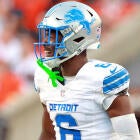
"Yeah, (Parker) is very convicted and short when he speaks," Schottenheimer said. "Very direct. The play calls, I would say are that way as well. Not that it's easier to call, I am the all-time volume guy and verbiage guy as an offensive guy. It's cool to see these green dots rattle off these two or three words out of their mouths, which is a little different than what we did last year."
| Cowboys defense under Matt Eberflus in 2025, NFL ranks | NFL rank | |
|---|---|---|
PPG allowed | 30.1* | Last |
Total YPG allowed | 377.0 | 30th |
Yards per play allowed | 6.1 | 31st |
Passing yards per game allowed | 251.5 | Last |
Third down conversion rate allowed | 47.3% | Last |
Red zone TD rate allowed | 66.7% | 29th |
Completion percentage allowed | 68.5% | 30th |
Pass yards per attempt allowed | 8.1 | 31st |
Passer Rating | 109.6 | 31st |
* Second-most PPG allowed in a season in the Cowboys' 66-season history
The players noticed the difference immediately.
"Yeah, he makes it simple," Bland said. "He makes sure we over communicate. That's one of his biggest things: making sure everybody is on the same page so we can do our jobs. ... It makes everything fast. It makes it calm when you get your reads and you know what you're doing. It makes it easier to do your job. ... He's smart. I love him. I can definitely see what everybody is talking about with him. Definitely a good coach that we have. I love how he's getting everybody on the same page to make sure we're getting communication, we know our jobs and we know our fits."
Defensive meetings are more connected because Parker breaks down each position's responsibilities rather than just having specific parts fed to players in position meetings. That sounds like a minuscule process change, but according to the players, knowing the why behind each position's actions on a given play makes a significant difference.
"I think every single detail from the way the defensive tackle is lined up to the way the eyes need to be in the defensive backfield get addressed amongst the whole entire unit instead of amongst each position unit," Quinnen Williams said. "I think the detail from that standpoint is really good."
The increased on-field and meeting-room communication has been most apparent to Schottenheimer on the defensive line.
"When there's motion or change of strength, it flips a lot of things. You hear them all talking really at all three levels," Schottenheimer said. "Another thing I'll say: our defensive line is communicating differently than most defenses I've been around with their anticipation of what runs are coming, what protections are coming, based on the formation sets and things like that. I think that's got to do with, No. 1, how it's emphasized in every room, not just with the linebackers and safeties. But also the experience we have on our defensive line."
At the end of the day, Parker's efforts to be more direct and all encompassing in his defensive meetings are all in service of one thing: giving more time back to his players before the snap.
"There are so many things when the linebacker or safety, whoever has the green dot, is communicating that, you break the huddle, it's 'what's the situation?'" Parker said. "Offense breaks the huddle. What personnel grouping are they in? What's the formation? Where is a certain player we might be doing a double team to? Whatever the case might be, there's so many things to process from the play call to the snap. The best I can shorten that process for them by being very direct and getting constant reps at that, I try to put that on my plate, not theirs."