

Shortly after another former NFL player opted to go back to college, the NFL is providing clarity regarding league rules governing player eligibility.
Per ESPN, a player who goes back to college this season will be prohibited from signing with an NFL team during the 2026 season. A player who signs an NFL contract and is subsequently cut becomes a free agent. While he may sign with another NFL club, join the CFL or return to college, he is considered a free agent and will not be subject to a future draft.
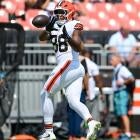
The league's decision to address the matter comes just days after former Browns tight end Dae'Quan Wright joined LSU's football team after clearing waivers following his release by Cleveland. Wright is the first player with NFL experience to enter the transfer portal.
In addition to Wright, defensive tackle Zxavian Harris also elected to play for LSU after spending time with an NFL team. Harris -- who, like Wright, played for current LSU coach Lane Kiffin at Ole Miss -- went undrafted and was waived after spending time this summer with the New Orleans Saints. After clearing waivers, Harris entered the transfer portal following a successful lawsuit in Louisiana.
LSU also recently acquired former Notre Dame pass rusher Junior Tuihalamaka after the NCAA granted him another year of eligibility.
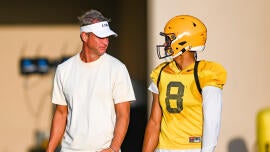
Browns head coach Todd Monken shared last week that Kiffin reached out to him. Kiffin stressed this week that his program isn't the only one pursuing NFL players.
Texas, for example, recently acquired fifth-year offensive lineman Cole Hutson, who had taken part in NFL minicamps but didn't sign a contract. Hutson joined Texas following a lawsuit in which he sought a temporary injunction that would allow him to compete during the 2026 college football season.
On Tuesday, the SEC announced a policy stating that a player who has either signed a contract or been listed on a professional sports roster is not permitted to play in the conference. Players who participated in professional league drafts are also prohibited from competing.
The SEC finalized penalties for violating the rule Wednesday, sources told CBS Sports' Matt Norlander. The penalties include a half-season suspension for the head coach, loss of certain conference voting privileges and a fine of up to 50% of the sport's annual operating budget. SEC commissioner Greg Sankey also has discretion to impose additional penalties.
LSU president Wade Rousse abstained from Wednesday's vote on the penalty structure, which passed 15-0. A day earlier, however, Rousse and LSU athletic director Verge Ausberry voted in favor of the SEC rule banning former NFL, NBA and WNBA players from competing in the conference.
"At the end of the day, because of these rulings, they're either going to play for you or they're going to play for someone else around the country," Kiffin said. "So we've made the decision to recruit them like probably most people are."
Given all of the changes in college football, it makes sense that the NFL would provide clarity regarding its player eligibility rules, especially with the league's mandatory cutdown date fast approaching.
The idea of NFL players going back to college is downright puzzling for Rams head coach Sean McVay, who offered a colorful response when he heard about Wright's move from the Browns to LSU.
"I feel like I took a freakin' gummy," he said. "I don't even understand it. … I mean, I'm looking at this stuff. I'm like, 'Surely that's not real.' I just try to stay in my lane. But I would say it's very unique, and it's very different. ... It's wild. That's what I would say."