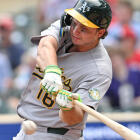
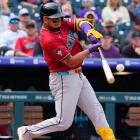
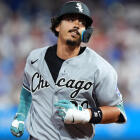
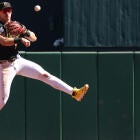
Chances are we haven't seen the last major prospect call-up of 2026. Just because rosters have already expanded by two doesn't mean a Trey Yesavage or Bryce Eldridge won't arrive later, as happened last September.
But anticipating which ones and stashing them ahead of time feels like a poor use of roster space at this point. The remaining call-ups will be few and not so plainly telegraphed. Plus, a bumpy transition is to be expected. Even if you single out the correct prospect and time your pickup perfectly, at what point will you feel comfortable using him? Only three lineup locks remain.
Fittingly, I'll be forgoing the usual Five on the Verge, Five on the Periphery format for the short time that remains this season. I have some other angles in mind, though, including this one:
September call-ups. A few teams actually did use one (or both) of their extra roster spots on legitimate prospects. I'd like to highlight the top 10 of those here, ranking them by how useful they're likely to be to Fantasy Baseballers down the stretch.
At the risk of putting too fine of a point on it, the answer for all 10 is "not very." The top two give me the most hope, seeing as they're consensus top-100 prospects, but I wouldn't consider either to be must-add outside of deeper Rotisserie leagues. Nos. 3-7 at least have a chance, but playing time is a major concern for each. Nos. 8-10 are mostly just here for me to comment on.
Now that I've put them in their proper context, let's look at the 10 best of the September call-ups.
1. Lazaro Montes, OF, Mariners
2026 minors: .249 BA (453 AB), 38 HR, .927 OPS, 79 BB, 166 K
Lazaro Montes put his power on display in his very first game Tuesday at Boston with a 407-foot home run to center field, and this part of his profile leaves no room for doubt. From the time he first entered the Mariners system at age 17, Montes has been a masher of the highest order. His time at Triple-A this year only served to quantify it with a 94.9 mph average exit velocity and 116.3 mph max. Unfortunately, those were accompanied by a 31 percent strikeout rate and 72 percent zone-contact rate, which have also always been a part of his profile. A close corollary would be Munetaka Murakami, and that's a hopeful enough scenario, though it's worth noting that not all has been roses for Murakami, who's currently sporting a .215 batting average. Montes feels about as boom-or-bust as prospects get, and it's not clear that he'll get to play much against left-handers down the stretch given that he hit just .201 with a .692 OPS against them in the minors this year.
2. Ethan Salas, C, Padres
2026 minors: .296 BA (348 AB), 10 HR, 17 SB, .822 OPS, 47 BB, 58 K
Ethan Salas became a consensus top 10 prospect after reaching Double-A as a 17-year-old in 2023 and then basically disappeared for the next couple years. He's bounced back with gusto this year, though, finally justifying the initial hype, and will soon be the youngest catcher to play in the majors since Ivan Rodriguez in 1991. Of course, that very detail introduces some skepticism. Even though he theoretically gives the Padres a more complete catcher than the bat-first Luis Campusano and the glove-first Freddy Fermin, being a standout defender himself, it sounds like his arrival is more about getting his feet wet for next year than improving the team's standing this year. "For now, they envision him as a third-catcher type and a useful left-handed bench bat," beat writer AJ Cassavell wrote for MLB.com. That could change if Salas makes good on his chances, but those chances figure to be limited in the immediate term.
3. Yohandy Morales, 1B, Nationals
2026 minors: .286 BA (405 AB), 25 HR, .882 OPS, 43 BB, 111 K
As a right-handed corner man with defensive challenges and subpar plate discipline, Yohandy Morales faces long odds for becoming a major league regular, which is why he doesn't place high on any prospect rank list. But he does the most important thing a hitter can do: throttle the ball when he makes contact. His average exit velocity at Triple-A was 91.5 mph, and his max was 113.1 mph, which are readings comparable to Luis Garcia or Drake Baldwin. Those strengths were on full display in his debut Tuesday, with all three of his hits, including a 407-foot home run, coming off the bat at more than 100 mph. Morales was in the lineup at DH even against a right-hander, which strongly suggests that he could be in for a healthy amount of playing time. The Nationals haven't had a dedicated DH all year and are less than settled at the two positions Morales has played the most, first and third base.
4. Sean Keys, 3B, Blue Jays
2026 minors: .294 BA (357 AB), 28 HR, 1.019 OPS, 60 BB, 97 K
2026 majors: 6 for 36, 1 HR, 1 2B, 1 BB, 13 K
Sean Keys was up a couple times previously this season, albeit to no great effect. Still, there's no discounting the breakout he had in the minors this year, maxing out his power projection with an 85th percentile average exit velocity and 91st percentile pull-air rate. He walked plenty, too, reaching base at a .417 clip while striking out a modest 22 percent of the time. So what does he need to do to translate that production to the majors? "Hit breaking balls," manager John Schneider said. "He did a good job of that the last month down in Triple-A." Schneider added that he'll "try to get [Keys] in as much as we can," whether it's at third base, first base, left field or DH. The Blue Jays are somehow on the fringes of the wild card race, but if they drop out, they'll likely want to give Keys a thorough audition for next year.
5. Leonardo Bernal, C, Cardinals
2026 minors: .278 BA (374 AB), 16 HR, 9 SB, .831 OPS, 51 BB, 86 K
Jimmy Crooks' removal (he was sent back to Triple-A) accompanied Leonardo Bernal's arrival, putting the latter in position to play plenty down the stretch. Manager Oli Marmol already confirmed as much. Neither Ivan Herrera (for defensive reasons) nor Pedro Pages (for offensive reasons) profiles as a No. 1 catcher, but Bernal contributes adequately on both sides of the ball. The 22-year-old doesn't have a standout skill as a hitter but doesn't have an obvious flaw either, placing above the median in contact quality, plate discipline and pull-air rate. He went 1 for 5 with two strikeouts in his debut Monday and is a borderline pickup in two-catcher leagues.
6. Ben Ross, SS, Twins
2026 minors: .274 BA (413 AB), 20 HR, 20 SB, .884 OPS, 68 BB, 124 K
After previously earning high marks for defense, Ben Ross has made himself into a prospect of note with a 20/20 campaign between Double- and Triple-A. The exit velocities leave much to be desired, but he makes up for them with a 91st percentile pull-air rate. The profile isn't so dissimilar to the one that vaulted Luke Keaschall up prospect rank lists a couple years ago, though Ross' plate discipline is more adequate than exceptional. Still, he brings defensive value that Keschall never did and could factor as a utility player down the stretch.
7. John Peck, SS, Tigers
2026 minors: .288 BA (271 AB), 11 HR, 22 SB, .841 OPS, 19 BB, 75 K
John Peck is another defensive-minded prospect who squeezed out just enough offense this year to suggest he might have a future as a major league regular, and indeed, he started at shortstop in his debut Tuesday, going 0 for 4 while batting ninth. AL Rookie of the Year favorite Kevin McGonigle was at DH, however, and you know that's not a permanent arrangement. Peck is already 24, doesn't reach base at a particularly high rate, and barely got any time at Triple-A before making the leap to the majors, so even though his home run and stolen base pace was nice, I'm not expecting huge things offensively. His defense should keep earning him chances, though, and with the Tigers being one of the few AL teams truly out of the playoff race, they're free to experiment.
8. Ricky Tiedemann, LHP, Blue Jays
2026 minors: 0-1, 3.75 ERA, 1.25 WHIP, 12 IP, 4 BB, 17 K
2026 majors: 1.2 IP, 2 H, 1 ER, 0 BB, 2 K
Ricky Tiedemann is a long shot to matter in Fantasy Baseball this month because he only recently returned from Tommy John surgery in 2024 and is still building up to a starter's workload, having yet to throw even two innings. Both of his appearances in the majors so far have been in relief, and that's presumably the role he'll fill down the stretch, which generally doesn't yield much for Fantasy. He was once an elite pitching prospect, though, following a similar trajectory to Andrew Painter by reaching Double-A as a 19-year-old and then losing two years of development to Tommy John surgery. However, unlike Painter, the effectiveness of his fastball has remained intact upon his return, still pushing 98 mph with extra movement because of a low delivery. A strong impression late this year could put Tiedemann in the mix for a rotation spot next year.
9. Luis De Leon, LHP, Orioles
2026 minors: 6-6, 4.73 ERA, 1.47 WHIP, 99 IP, 53 BB, 121 K
As with Ricky Tiedemann, Luis De Leon is expected to serve as a reliever down the stretch before resuming his development as a starter next year. His numbers this year won't blow you away, but he's that rare caliber of pitcher who misses bats at a high rate while still inducing feeble contact, compiling a ground ball rate of around 60 percent over his minor league career. Control remains a major hurdle, as was also once true for Cristopher Sanchez. I invoke that name purposely, though it's obviously a high bar for De Leon to meet.
10. Cameron Cauley, OF, Rangers
2026 minors: .275 BA (346 AB), 14 HR, 35 SB, .828 OPS, 51 BB, 85 K
2026 majors: .207 BA (58 AB), 1 HR, 1 3B, 3 2B, .626 OPS, 5 BB, 15 K
We've already gotten a look at Cameron Cauley -- long enough that he technically no longer qualifies as a prospect -- and it was nothing to write home about. His performance at Triple-A is good enough to warrant a second look, though it's not clear that this September return will present him with such an opportunity. He's more likely to serve as a defensive replacement and pinch runner, with those being his two standout skills, for a team fighting for a division title. Cauley has shown he's capable of hitting the ball over the fence and working the count, but his exit velocities are suspect and his pitch recognition needs improvement.